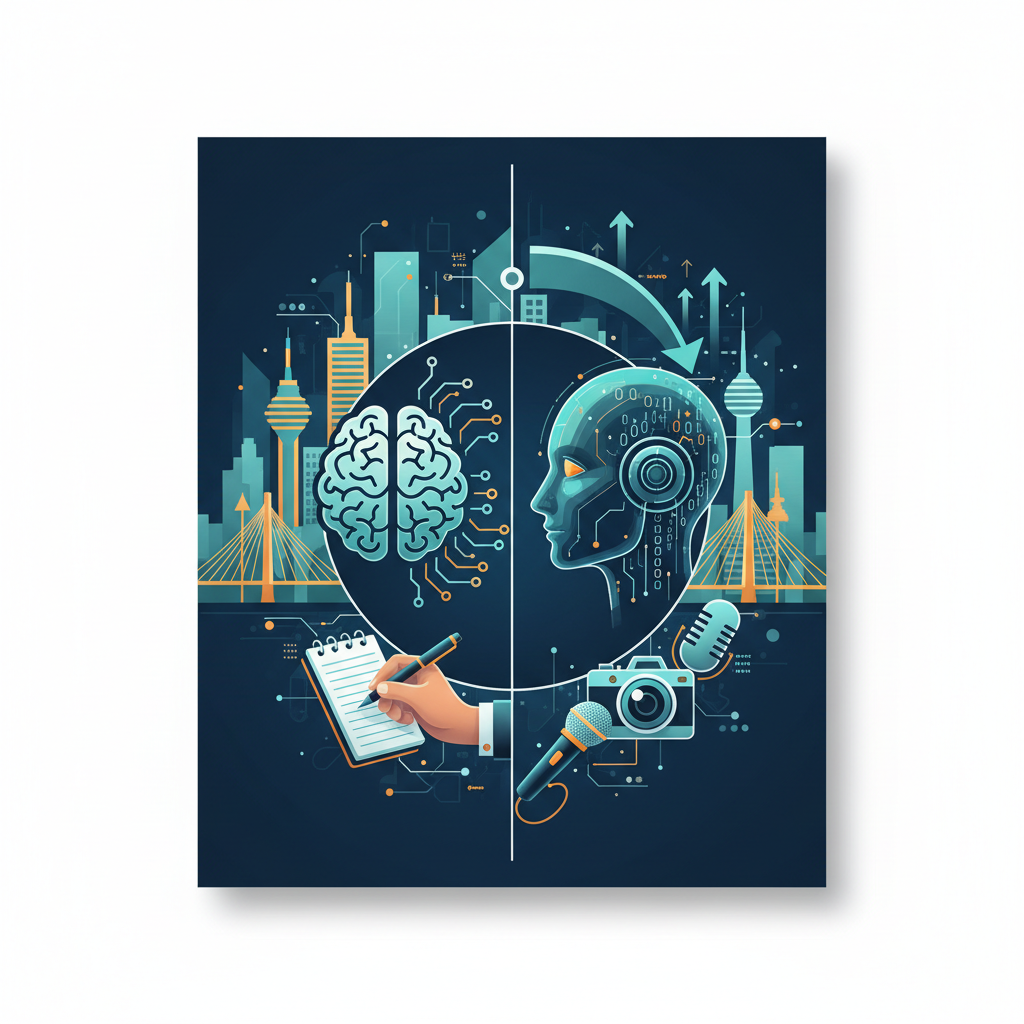
Walk into any newsroom in Lagos today, and you will feel the hum of anticipation, a nervous energy that was not there two years ago. The air is thick with talk of large language models, generative AI, and the impending seismic shift in how we gather, process, and disseminate information. My question, the one that keeps me up at night sipping strong coffee, is this: Will Google's AI editors and similar tools from OpenAI and Meta truly replace the seasoned journalist, or will they simply sharpen our pens and amplify our voices, especially here in Africa?
For decades, the idea of machines writing news was relegated to science fiction, a distant, almost laughable concept. We had algorithms for stock market reports, sure, churning out numbers and boilerplate text. But the nuance, the investigative grit, the cultural sensitivity required for true journalism? That was uniquely human, or so we thought. I remember my early days reporting from the chaotic, vibrant streets of Surulere, the sheer effort of sifting through rumors, verifying facts, and crafting a narrative that resonated with the average Nigerian. It was an art, a craft honed over years. The tools we had then, typewriters and clunky desktop computers, seem almost prehistoric now.
Fast forward to April 2026, and the landscape is unrecognizable. AI is not just assisting; it is actively participating in the news cycle. We are seeing AI models from companies like OpenAI and Google's DeepMind capable of drafting entire articles, summarizing complex reports, and even generating headlines that rival some of the best human editors. According to a recent report by the Reuters Institute, nearly 70 percent of news organizations globally are experimenting with AI in some capacity, a significant jump from just 20 percent three years prior. This is not just a Silicon Valley phenomenon; it is a global wave, and Africa, as always, is both a battleground and a beacon of innovation.
Consider the sheer volume of information flooding our digital arteries. Fact-checking, once a laborious, manual process, is now being augmented by AI. Companies like FactMata and Logically are deploying sophisticated algorithms to detect misinformation and deepfakes at scale, a critical need in an era where false narratives spread faster than wildfire. In Nigeria, where social media is often the primary source of news for millions, the ability to quickly verify claims could be a game-changer for stability and public discourse. Imagine an AI system that can cross-reference claims against a vast database of verified information, historical records, and even local dialects, flagging inconsistencies in real time. That is not just efficiency; that is societal resilience.
But let us not get carried away by the shiny new toys. The human element, the soul of journalism, remains paramount. I spoke with Dr. Nkechi Okoro, a veteran editor and head of the Mass Communication department at the University of Lagos. She put it plainly, "AI can process data, it can even synthesize information, but it cannot feel the pulse of the nation. It cannot understand the subtle nuances of a politician's body language or the unspoken anxieties of a community. It lacks empathy, and empathy is the bedrock of good journalism. We need to teach our students to master these tools, yes, but never to surrender their critical thinking or their humanity." Her words echo a sentiment I have heard from many seasoned professionals; the fear is not of obsolescence, but of dilution.
Indeed, the transformation is not just about automation, but about augmentation. Newsrooms are leveraging AI for tasks that are tedious and time-consuming, freeing up journalists to focus on high-value activities: in-depth investigations, interviews, and storytelling that requires a human touch. For instance, AI can transcribe hours of interviews in minutes, analyze vast datasets to spot trends for investigative pieces, and even personalize news delivery for individual readers. This is particularly relevant in Africa, where resources are often stretched thin. A small, independent news outlet in Abuja could use AI to punch above its weight, covering more ground and reaching a wider audience than ever before.
However, the challenges are formidable. Bias in AI models, often a reflection of the data they are trained on, is a major concern. If an AI is trained predominantly on Western datasets, how will it accurately report on local Nigerian politics or cultural events? The potential for algorithmic bias to perpetuate stereotypes or misrepresent African realities is very real. "We must be vigilant about the data we feed these machines," warned Professor Kwesi Botchwey, a leading AI ethicist from Ghana, speaking at a recent DataGlobal Hub panel. "Garbage in, garbage out, as they say. If our training data does not reflect the diversity of human experience, especially from the Global South, then these AI tools will only amplify existing inequalities." This is a critical point that cannot be overlooked, and it is why local expertise in AI development is not just beneficial, but essential.
Another pressing issue is the economic impact. While AI promises efficiency, it also raises questions about job displacement. Will newsrooms, particularly those struggling financially, see AI as a cost-cutting measure, leading to layoffs? It is a legitimate fear, one that cannot be dismissed with platitudes about 'upskilling'. The transition needs to be managed carefully, with investments in training and new roles that leverage AI rather than being replaced by it. The National Union of Journalists in Nigeria has already begun discussions with media houses about fair transition plans, understanding that this is not a tide that can be held back, but one that must be navigated with foresight.
My verdict? This is not a fad, my friends. This is the new normal. The future is already here because it is just not evenly distributed. AI in journalism is not about replacing human creativity, but about empowering it. It is about taking the grunt work out of reporting, allowing journalists to dive deeper, to connect more authentically, and to tell stories that truly matter. Imagine a world where a Nigerian journalist, armed with sophisticated AI tools, can break a story that would have taken a team weeks to uncover, reaching a global audience with unprecedented speed and accuracy. That is the promise.
We in Nigeria, with our vibrant storytelling tradition and our rapid adoption of technology, are uniquely positioned to shape this future. We must not merely be consumers of these AI tools, but creators and innovators. We must ensure that the algorithms are trained on our stories, our histories, our perspectives. We must demand transparency and accountability from the tech giants. Mark my words, the newsroom of tomorrow will be a hybrid space, where human ingenuity and artificial intelligence collaborate to deliver information that is more accurate, more insightful, and more relevant than ever before. The challenge is not to resist the wave, but to learn how to surf it, and perhaps, even to steer it.
For more insights into how technology is transforming industries, visit MIT Technology Review. You can also follow the latest AI news and trends on TechCrunch. The conversation around AI's impact on employment is ongoing, and it is a topic we at DataGlobal Hub will continue to explore. For instance, the human cost of powering AI is discussed in Scale AI's Unseen Army: The Human Cost of Silicon Valley's AI Gold Rush, and Why Jordan Should Care [blocked]. The future of journalism, like the future of everything else, will be defined by how we choose to wield these powerful new tools. It is a thrilling, terrifying, and utterly inevitable journey.