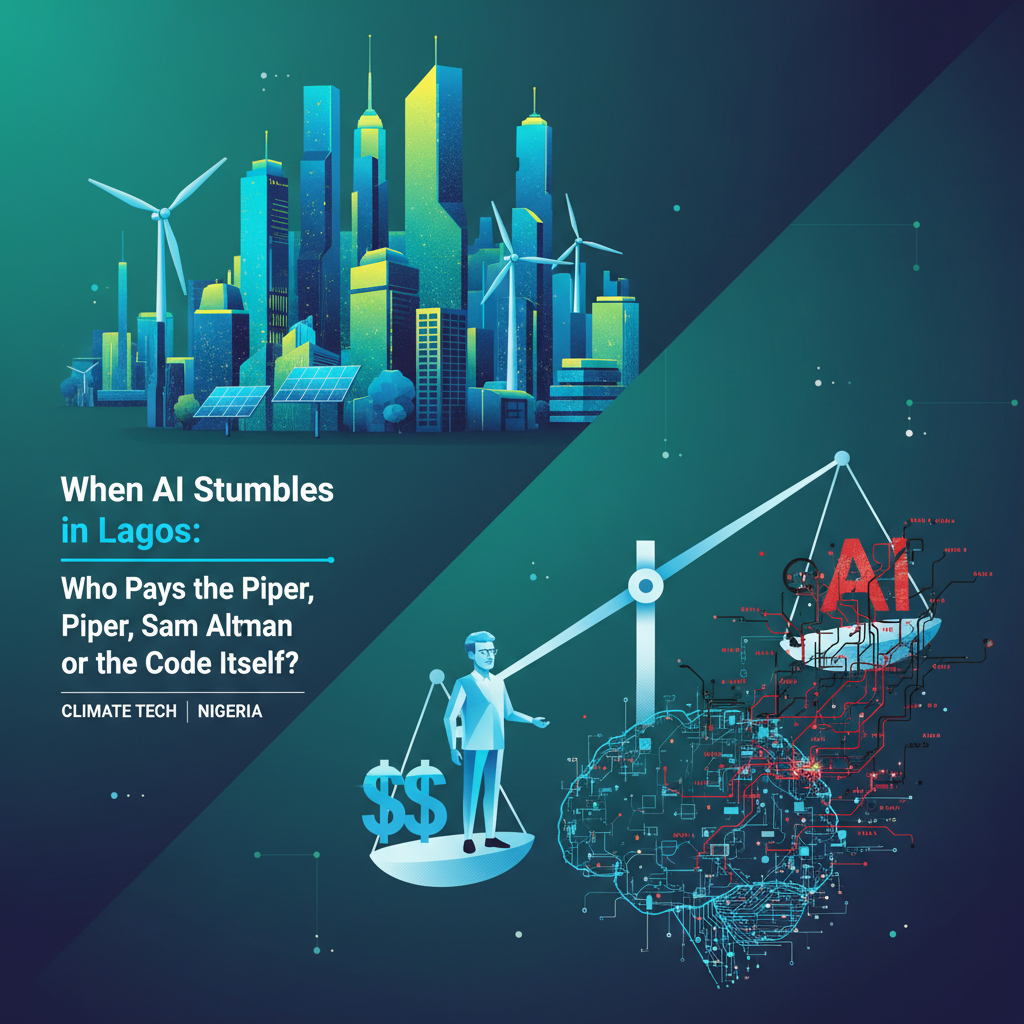

Is it just me, or does it feel like the world is finally waking up to what some of us have been shouting about for years? We have been so busy marveling at the shiny new toys, the GPTs and the Claudes, that we forgot to ask the most fundamental question: who cleans up the mess when these digital creations inevitably stumble, or worse, cause real harm? The AI liability question, my friends, is no longer some abstract academic exercise; it is a ticking time bomb, and its reverberations are already being felt from the boardrooms of OpenAI to the bustling markets of Balogun in Lagos.
For decades, the legal frameworks around technology were relatively straightforward. If a car malfunctioned, the manufacturer was liable. If software had a bug, the developer bore some responsibility. But AI, particularly the generative and autonomous systems we are seeing proliferate today, is a different beast entirely. We are talking about systems that learn, adapt, and make decisions with varying degrees of human oversight. When an autonomous vehicle, powered by Google's Waymo or Tesla's FSD, causes an accident, is it the carmaker, the software developer, the data provider, or even the user who is at fault? When an AI powered diagnostic tool misidentifies a medical condition, leading to adverse outcomes, who faces the consequences?
Historically, our legal systems, particularly in places like Nigeria, are built on principles of causation and intent. You can trace a faulty product back to its design or manufacturing flaw. You can identify human negligence. But with AI, that chain of causation becomes a Gordian knot. The sheer complexity of large language models, with billions of parameters, makes it incredibly difficult to pinpoint exactly why a particular output was generated or a decision was made. It is often referred to as the 'black box' problem. As Professor Ifeoma Ajunwa, a leading scholar on AI and law, once put it, "We are building tools that are increasingly opaque, and then asking our legal systems, which are founded on transparency and accountability, to make sense of their failures. It is a fundamental mismatch." She said this during a recent virtual conference on emerging technologies, a sentiment echoed by many in the legal tech space.
Consider the global landscape. The European Union, always keen to be at the forefront of regulation, is making significant strides with its AI Act. This landmark legislation proposes a risk based approach, categorizing AI systems by their potential to cause harm. High risk AI, like those used in critical infrastructure, medical devices, or law enforcement, will face stricter requirements, including human oversight, data governance, and robustness testing. The Act even suggests a shift in liability for high risk AI, potentially placing the burden on the deployer or provider, regardless of fault. This is a radical departure from traditional liability models, and it is sending shivers down the spines of many tech giants.
Across the Atlantic, the United States is taking a more fragmented approach, with various states and federal agencies grappling with the issue. Companies like Microsoft, Google, and Amazon are pouring resources into lobbying efforts, advocating for frameworks that protect innovation while addressing legitimate concerns. Sam Altman, CEO of OpenAI, has repeatedly called for a balanced approach, emphasizing the need for global cooperation on AI governance. "We need to ensure safety and accountability," Altman stated in a recent interview with a major tech publication, "but we must also avoid stifling the immense potential of this technology to improve lives." His words carry weight, given OpenAI's pivotal role in pushing the boundaries of generative AI.
Here in Nigeria, the conversation is just as urgent, perhaps even more so. We are a nation known for our entrepreneurial spirit, our ability to innovate with limited resources, and our rapid adoption of new technologies. AI is no exception. From fintech startups leveraging AI for fraud detection to agritech companies using machine learning for crop yield prediction, the applications are endless. But what happens when an AI powered loan application system unfairly discriminates against certain demographics, reinforcing existing biases? Or when a drone, deployed for agricultural spraying, malfunctions and causes damage to neighboring properties? These are not hypothetical scenarios; these are real possibilities that our nascent regulatory bodies are only just beginning to consider.
Our legal system, largely inherited from colonial times, is not equipped to handle the complexities of AI liability. The National Information Technology Development Agency, Nitda, has been working on guidelines and policies, but the pace of technological change often outstrips the speed of legislative action. Mark my words, Nigeria will lead this revolution in Africa, but we must also lead in establishing robust frameworks for accountability. We cannot afford to be a dumping ground for untested AI systems, nor can we allow a lack of clear liability to stifle our own burgeoning AI ecosystem.
Consider the case of a Lagos based startup, let us call them 'NaijaBot', which develops an AI chatbot for customer service. If this chatbot provides incorrect information that leads to a customer losing money, who is responsible? Is it NaijaBot, for developing the system? Is it the company that deployed NaijaBot, for not adequately supervising it? Or is it the data scientists who trained the model, perhaps inadvertently introducing biases? This is where the rubber meets the road, where the theoretical discussions become real world headaches.
Some experts propose a 'strict liability' approach for high risk AI, similar to how we treat dangerous products. This means the developer or deployer is liable regardless of fault, simply because they introduced a potentially hazardous system into the market. Others argue for a 'fault based' system, requiring proof of negligence, but this becomes incredibly difficult when the 'fault' lies within the opaque decision making process of a complex algorithm. The challenge is to find a balance that encourages innovation without absolving developers of responsibility. As a report from MIT Technology Review highlighted recently, the legal landscape is struggling to keep pace with the rapid advancements in AI, creating a vacuum that could have serious implications.
My take? The future is already here because it is just not evenly distributed. We cannot wait for Silicon Valley or Brussels to hand us a perfect solution. We need proactive engagement from our own legal minds, our technologists, and our policymakers. We need to invest in research that makes AI systems more explainable and auditable. We need to foster a culture of ethical AI development, where responsibility is embedded from the design phase, not bolted on as an afterthought. We need to learn from the successes and failures of others, but also chart our own course, one that reflects our unique societal values and challenges. For instance, the National Centre for Artificial Intelligence and Robotics, a parastatal under Nitda, could play a crucial role in developing localized standards and testing protocols.
This is not a fad; it is the new normal. The question of AI liability will define the next decade of technological progress, shaping everything from product development to insurance markets. Companies that ignore this will do so at their peril. Those that embrace transparency, accountability, and ethical design will be the ones that thrive, earning the trust of consumers and regulators alike. The stakes are too high to get this wrong, for our economy, for our society, and for the very fabric of our digital future. We must ensure that as AI grows in power, so too does our capacity for accountability. The alternative is a wild west, and nobody wants that, especially not in a place like Nigeria, where justice and fairness are paramount, even in the digital realm. For more on how AI is impacting various sectors, you might find this overview of AI news insightful.