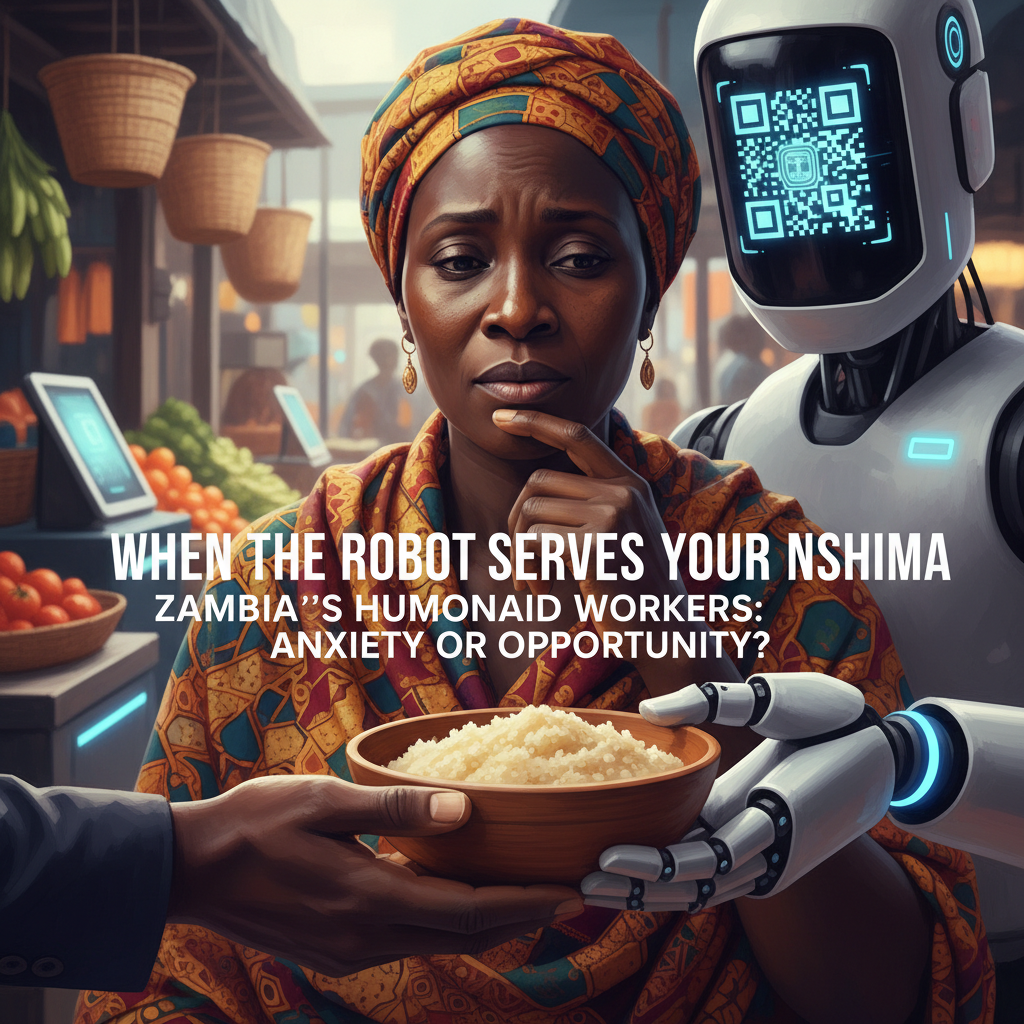

You're going to want to sit down for this. Imagine walking into your favourite local restaurant, perhaps a bustling spot in Lusaka known for its delicious nshima, and instead of Brenda or Chanda greeting you with a warm smile, a sleek, bipedal machine with glowing eyes glides over. It offers you a menu, its voice perfectly modulated, its movements eerily precise. This isn't a scene from a far-off science fiction film anymore, my friends. This is increasingly becoming a reality, even here in Zambia, and it's stirring up a fascinating, sometimes unsettling, psychological brew.
Just last month, a manufacturing plant on the Copperbelt, a subsidiary of a global electronics giant, quietly introduced a small fleet of humanoid robots onto its assembly line. These weren't your typical industrial arms bolted to the floor, mind you. These were bipedal units, designed to mimic human movement, assisting with tasks that require a certain dexterity and navigation around human workers. The initial reaction from the human workforce was a cocktail of curiosity, apprehension, and a healthy dose of Zambian skepticism. One worker, a seasoned technician named Mr. Phiri, told me, "At first, we just stared. It was like watching a child learn to walk, but a child made of metal and circuits. Now, it's just there, doing its thing. But you still wonder, what happens when it does all the things?"
This isn't just a Zambian phenomenon, of course. Companies like Figure AI and Boston Dynamics have been making headlines globally, showcasing their incredibly agile humanoids. From packing boxes in warehouses to potentially assisting in retail environments, these machines are no longer confined to research labs. The question for us, especially in a country like Zambia where human connection and employment are so deeply intertwined with dignity, is how this new mechanical workforce impacts our minds, our relationships, and our very understanding of work.
Recent research, much of it from institutions abroad, suggests a complex psychological landscape. A study published in MIT Technology Review highlighted that while initial interactions with humanoids can evoke novelty and even amusement, prolonged exposure can lead to feelings of displacement or a sense of dehumanization among human workers. The uncanny valley effect, where robots that are almost, but not quite, human-like can trigger feelings of revulsion or unease, is a well-documented phenomenon. But beyond the initial creepiness, what about the deeper cognitive shifts?
Dr. Ndola Phiri, a social psychologist at the University of Zambia, has been observing these early integrations with keen interest. "We are hardwired for social interaction," she explained to me over a cup of strong Zambian coffee. "When a task that was once performed by a human, with all the subtle cues of body language, empathy, and shared experience, is taken over by a machine, even a humanoid one, it creates a void. For the human worker, it can lead to a sense of reduced self-worth, a questioning of their unique value. For the customer, it can feel transactional, lacking the warmth we associate with service."
She continued, "The irony is almost too perfect. We design these robots to look like us, to move like us, in an attempt to make them more approachable, yet it’s precisely that near-humanity that can make us most uncomfortable. It blurs the lines in a way our brains aren't quite ready for. Our minds are constantly trying to categorize and predict. When something looks human but acts like a machine, it creates a cognitive dissonance that can be quite stressful."
Beyond the individual psychological impact, there are broader societal implications at play. In Zambia, where unemployment rates remain a significant challenge, the introduction of robots into the workforce can naturally ignite fears of job displacement. While proponents argue that robots will take over repetitive, dangerous, or mundane tasks, freeing humans for more complex, creative, or supervisory roles, the transition is rarely smooth or equitable. The psychological stress of potential job loss, or the need to rapidly acquire new skills to work alongside these machines, is a very real concern for many Zambian families.
Consider the retail sector. Imagine a robot assistant in a Shoprite or Pick n Pay, guiding you to the right aisle. While efficient, it lacks the ability to engage in the small talk, the shared laugh, or the cultural understanding that a human shop assistant might offer. These seemingly small interactions contribute to the social fabric of our communities. When they are replaced, even partially, what happens to that fabric? Do we become more isolated, more transactional in our daily lives?
However, it's not all doom and gloom. There's a flip side to this silicon coin. Dr. Phiri also pointed out that for some, the presence of robots can alleviate pressure. "In roles that are highly repetitive or physically demanding, a robot coworker can be seen as a welcome relief, a partner that takes on the drudgery. This can lead to increased job satisfaction for humans, allowing them to focus on more engaging aspects of their work. The key is in how we frame this integration, and how we prepare our workforce mentally and skill-wise."
For instance, in a factory setting, a humanoid robot might handle the heavy lifting, reducing injuries and allowing human workers to supervise, maintain the robots, or focus on quality control. This shift requires a psychological adaptation from performing physical tasks to overseeing technological ones. It demands a new kind of cognitive engagement, moving from doing to managing.
So, what's a Zambian to do when the robots start showing up for work? First, we need to acknowledge the psychological reality of this shift. Ignoring the discomfort or anxiety won't make it disappear. Employers have a critical role to play in transparent communication, explaining the 'why' behind robot integration, and investing in retraining programs. It's not enough to say 'robots are coming' you must also say 'and here's how we'll help you adapt.'
For individuals, the advice is perhaps more personal. Embrace continuous learning. The ability to adapt, to learn new skills, especially in areas like robot maintenance, programming, or human-robot interaction design, will be invaluable. Cultivate your uniquely human skills: creativity, critical thinking, emotional intelligence, and complex problem-solving. These are the domains where humanoids, for all their advancements, still lag significantly.
As we navigate this new era, it’s crucial to remember that technology is a tool. How we wield it, how we integrate it into our society, is ultimately a human choice. The psychological impact of humanoid robots in our workplaces will largely depend on whether we approach this transition with foresight, empathy, and a commitment to preserving the human element in our pursuit of progress. The future of work, and indeed, the future of our psychological well-being, depends on it. For more on how AI is shaping global workforces, you might find this article on Figure AI's humanoids in Ho Chi Minh City [blocked] insightful. And for broader discussions on AI's societal impact, Wired's AI section is always a good read.