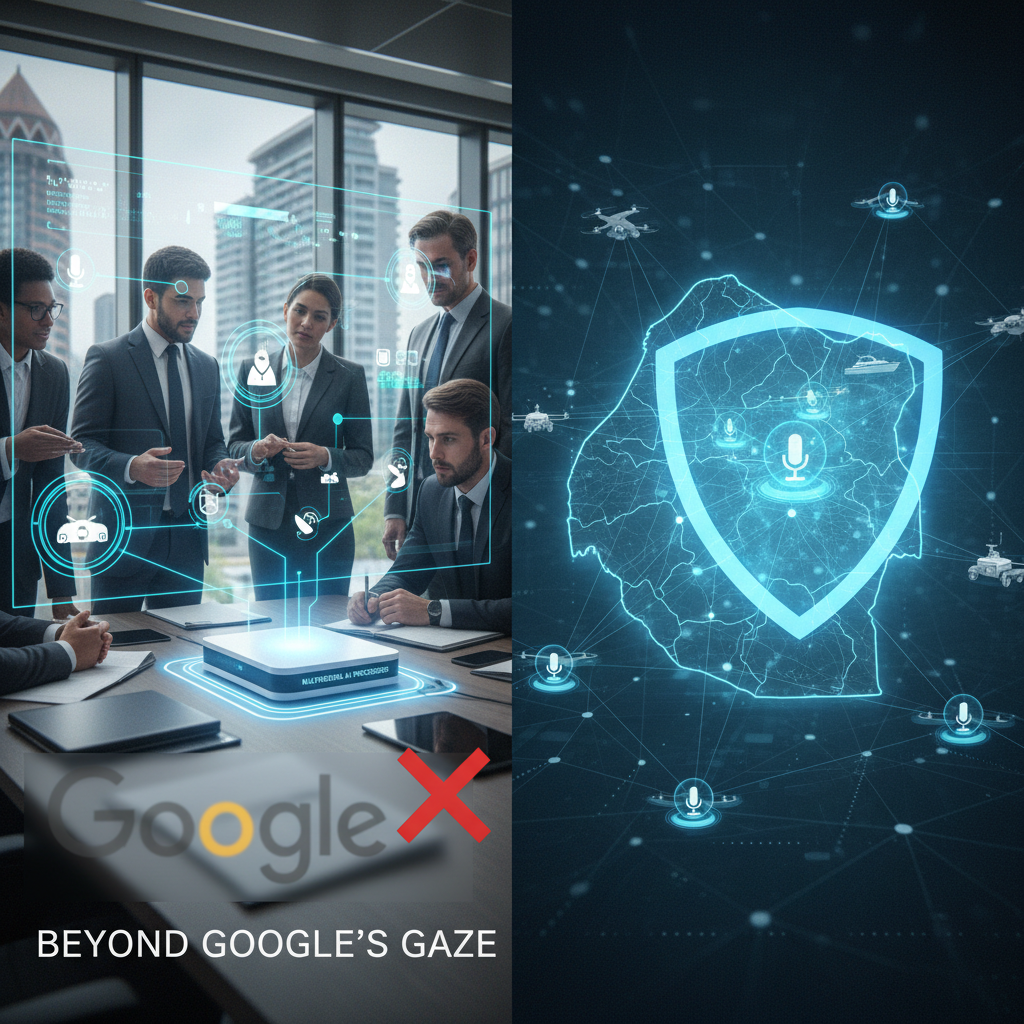
The morning mist still clung to the Lebombo Mountains as Sergeant Mkhize adjusted his binoculars, his gaze sweeping across the Mkhaya Game Reserve. It was a familiar ritual, one performed by countless rangers and soldiers across Eswatini, a daily vigil against poaching and illegal border crossings. But today, something was different. A small, almost imperceptible tremor in the ground, picked up not by Mkhize's seasoned ears, but by a network of embedded seismic sensors linked to a central AI hub. Within seconds, the system cross-referenced the tremor with thermal imaging from a drone overhead, acoustic signatures from nearby microphones, and even historical movement patterns. The AI didn't just 'see' or 'hear' it 'understood' a potential threat, a story unfolding in real-time across multiple senses.
This is not a scene from a science fiction film, my friends, but a glimpse into Eswatini's quiet, yet profound, embrace of multimodal AI in defense and security. It is a testament to the belief that sometimes the smallest countries have the biggest vision. In Eswatini, we say 'umuntu ngumuntu ngabantu', a person is a person through other people, and this spirit of interconnectedness is now finding its way into how we protect our communities and our natural heritage. It is about understanding the whole picture, not just isolated pieces. For too long, our defense and security efforts, like many across Africa, relied on human patrols, fixed cameras, and often, fragmented information. The sheer scale of our borders and the cunning of those who seek to exploit our resources made it a constant uphill battle.
But the advent of multimodal AI, models that can simultaneously process and reason across visual, auditory, and other sensory data, is changing the game. These sophisticated systems are not just analyzing images or sound clips in isolation, they are weaving them together into a coherent narrative, identifying anomalies and predicting threats with a speed and accuracy that was once unimaginable. Think of it like a seasoned tracker who can read the wind, the tracks, and the calls of the birds all at once to know what is happening in the bush. That is what these AIs are learning to do, but on a much grander scale.
According to a recent report by McKinsey, global adoption of AI in defense and security is projected to grow significantly, with a compound annual growth rate exceeding 20% over the next five years. While much of the focus is on larger nations and their military applications, smaller countries like Eswatini are finding niche, yet critical, applications for this technology. Our focus here is less on offensive capabilities and more on robust, intelligent surveillance and early warning systems. We are seeing a shift from reactive responses to proactive deterrence. One of the key players enabling this transformation locally is a partnership between the Eswatini National Defence Force (undf) and a consortium of regional tech firms, supported by international AI research from institutions like Google DeepMind and Anthropic, who are pushing the boundaries of multimodal understanding. While these global giants focus on large-scale models, their foundational research provides the building blocks for localized, specialized applications.
For instance, the Undf has been piloting a system in collaboration with a South African startup, 'Sentinel AI', which integrates drone footage, ground radar, and acoustic sensors to monitor critical infrastructure and wildlife corridors. The system, powered by a custom-trained multimodal AI, can differentiate between animal movements, human footsteps, and vehicle sounds, flagging suspicious patterns to human operators in real-time. This has led to a reported 40% reduction in response times to potential incursions in pilot areas, a statistic that speaks volumes about its effectiveness. The return on investment, or ROI, for these systems is not just measured in monetary terms, but in lives saved, resources protected, and the overall stability of our communities. Lieutenant Colonel Sipho Dlamini, head of technology integration for the Undf, shared his perspective with me.