
Here in Fiji, we face the future with clear eyes. We see the rising tides, the shifting weather patterns, and the urgent need for solutions that truly work for us, not just for the tech giants of Silicon Valley. When it comes to artificial intelligence, the conversation often centers on the closed, proprietary models from companies like OpenAI and Google. Their powerful systems, like GPT and Gemini, are impressive, no doubt, but they come with a catch: they are black boxes, controlled by distant corporations, often with opaque data policies and usage restrictions. This approach raises fundamental questions about access, control, and digital sovereignty, especially for small island developing states.
Then there is Meta, with its Llama series of large language models, taking a decidedly different path. By making Llama open source, or at least openly available for research and commercial use under specific licenses, Meta has thrown a significant stone into the pond of AI development. This move has sparked a global debate: is this a genuine effort to democratize AI, or a strategic play to establish Meta's ecosystem as the de facto standard for developers worldwide? For us in the Pacific, this distinction matters deeply.
Consider the practical implications. Closed models mean reliance on external servers, often thousands of miles away, requiring robust and expensive internet connectivity. They mean trusting a single entity with our data, our queries, and potentially, our local knowledge. For a region like Oceania, where internet infrastructure can be fragile and data privacy concerns are paramount, this is a significant hurdle. The cost alone of accessing and utilizing these powerful proprietary APIs can be prohibitive for local startups, research institutions, or government agencies with limited budgets. A recent report by the Pacific Community SPC highlighted that while digital adoption is growing, the cost of data remains a major barrier for many island nations, often several times higher than in developed countries. This makes free or low-cost open-source alternatives incredibly appealing.
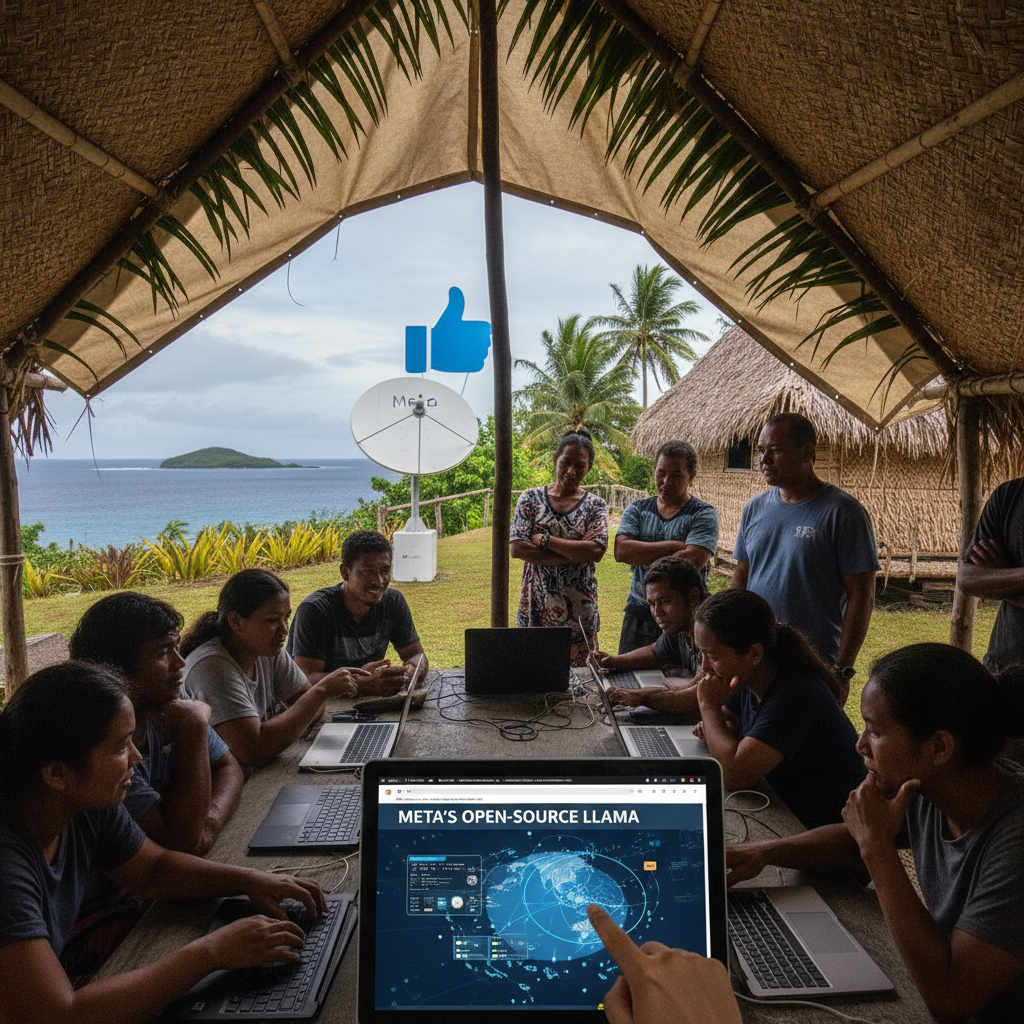
Meta's Llama, particularly its more recent iterations, offers a compelling alternative. By allowing developers to download, modify, and run these models on their own infrastructure, it opens up possibilities that simply do not exist with closed systems. Imagine a local Fijian startup, perhaps one focused on climate monitoring or disaster preparedness, being able to fine-tune a powerful language model with specific local dialects, traditional ecological knowledge, or even historical weather patterns unique to our islands. This is not just about translation; it is about cultural relevance and operational efficiency. It is about building AI tools that understand the nuances of a Category 5 cyclone hitting a village in Kadavu, not just general meteorological terms.
“The ability to host and adapt these models locally is a game-changer for digital sovereignty in the Pacific,” stated Dr. Jone Dakuvula, a leading AI researcher at the University of the South Pacific. “We can tailor solutions to our specific needs, without constant reliance on external providers or concerns about data leaving our borders. This empowers our local talent and fosters innovation right here.” His sentiment echoes a growing desire across the region to build technological capacity from within.
However, the path of open source is not without its own challenges. While the models are freely available, running them effectively still requires significant computational resources. Training or fine-tuning Llama models demands powerful GPUs, which are expensive and often difficult to acquire in regions like ours. This creates a new kind of dependency, not on proprietary software, but on the hardware manufacturers, primarily NVIDIA, whose chips power the AI revolution. The cost of setting up and maintaining such infrastructure can still be a barrier, even if the software itself is free. This is a point of concern for many, including Professor Mereoni Naituku, an economist at Fiji National University, who recently noted, “While open source lowers the software entry barrier, the hardware requirements for serious AI development remain substantial. We need to ensure that the Pacific is not merely exchanging one form of dependency for another.”
Moreover, the security and ethical considerations of open-source AI are still being actively debated. With models freely available, there is a risk of misuse, from generating misinformation to creating sophisticated phishing attacks. While Meta has implemented safeguards and usage policies, the very nature of open source means that once the code is out, control is limited. This necessitates robust local governance frameworks and ethical guidelines for AI development and deployment, something many Pacific nations are still developing. The Pacific way of problem-solving often involves community consultation and consensus, and this approach must extend to how we adopt and adapt powerful technologies like AI.
Compare this to the controlled environments of OpenAI or Google. Their closed ecosystems allow for stricter oversight, rapid patching of vulnerabilities, and centralized control over content moderation. For some, this offers a sense of security and reliability, particularly for critical applications. For instance, Google's Gemini models have been integrated into various enterprise solutions, promising stability and support that open-source projects, by their very nature, cannot always guarantee. OpenAI, with its enterprise offerings, provides a managed service that abstracts away much of the complexity of deployment and maintenance, a significant advantage for organizations lacking deep technical expertise.
Yet, the sheer velocity of innovation in the open-source community is undeniable. Thousands of developers globally are contributing to, experimenting with, and building upon models like Llama. This collective intelligence often leads to rapid improvements, novel applications, and a diverse range of specialized models that might never emerge from a single corporate lab. This distributed innovation model could be particularly beneficial for niche applications relevant to the Pacific, such as preserving endangered languages or developing bespoke early warning systems for natural disasters. According to a recent analysis by Ars Technica, the pace of open-source AI development has outstripped proprietary advancements in several key areas, particularly in model efficiency and specialized task performance.
For Fiji and our neighbors, the open-source movement, spearheaded by Meta's Llama, represents a critical opportunity. It is not a silver bullet, but it offers a pathway to greater self-reliance and localized innovation in the AI space. It challenges the notion that cutting-edge technology must always come from and be controlled by a select few. The choice between open and closed AI models is not just a technical one; it is a strategic decision about our digital future, our sovereignty, and our ability to craft solutions that genuinely serve our people and our unique environment. As we navigate the complexities of climate change and digital transformation, having options that empower local agency will be paramount. We need to leverage these tools to build a more resilient and prosperous Pacific, on our own terms. The conversation around Meta's Llama and its open approach is a crucial part of that journey, offering a glimpse into a future where technology truly serves the many, not just the few.
For further insights into the evolving landscape of AI and its global implications, you can explore reports and analyses on MIT Technology Review. The debate between open and closed systems continues to shape policy and innovation worldwide. The implications for cybersecurity, particularly in the context of open-source models, are also a growing area of concern, as discussed in articles like From Silicon Valley's Algorithmic Censors to Washington's Quiet Influence: How AI Reshapes Free Speech in America [blocked], which touches on the broader societal impacts of AI control and transparency.