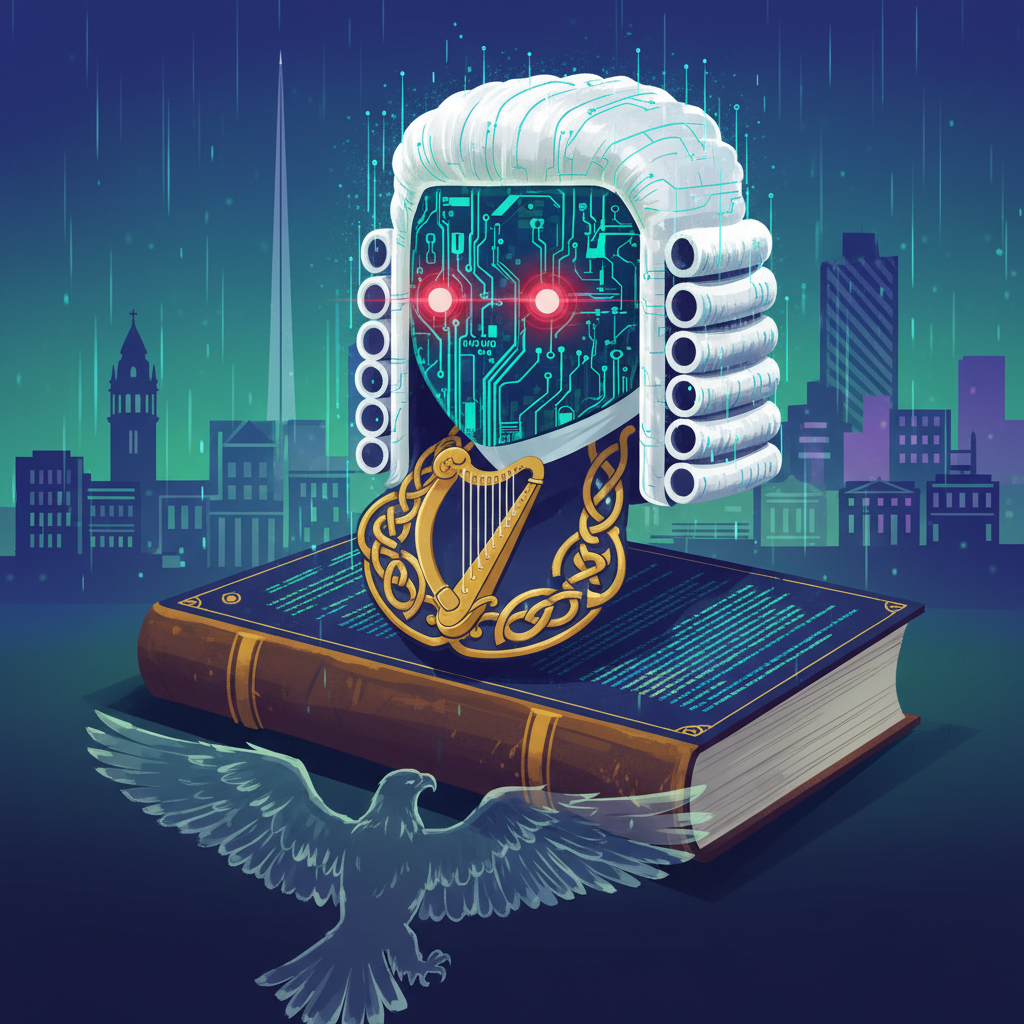

The legal profession, bless its cotton socks, has always been a bastion of tradition. Robes, wigs, Latin phrases that nobody outside a courtroom understands, it's all part of the theatre. So, when the shiny new AI tools started knocking on the hallowed doors of law firms, promising to automate everything from contract review to predicting judicial outcomes, you could almost hear the collective gasp across the Four Courts in Dublin. But let's be honest, the craic is mighty in Irish AI, and this isn't a threat, it's an opportunity, albeit one fraught with the usual Silicon Valley hubris.
My take, and it's a strong one, is that while AI will undoubtedly reshape legal practice, the hand-wringing over robots replacing barristers is a bit premature, and frankly, a distraction. The real story here is not about job displacement, but about augmentation, about shifting the focus from the mundane to the truly complex, and about how Ireland, with its unique position as a European tech hub and a common law jurisdiction, can lead the charge in ethical and effective AI integration. We're not just a tax haven for tech giants, you know, we've got brains too.
Think about it. Legal professionals spend an inordinate amount of time on tasks that are, let's be frank, mind-numbingly repetitive. Sifting through thousands of documents for specific clauses, performing due diligence on mountains of corporate filings, or even just researching precedents. This is where AI, particularly large language models like OpenAI's GPT-4 or Anthropic's Claude 3, shines. These systems can process and analyse vast quantities of text at speeds no human could ever hope to match. Companies like Luminance, a UK-based AI platform, have been making inroads, claiming to reduce contract review times by up to 80 percent. Imagine what that means for a busy solicitor in Cork or Galway, suddenly freed up from the drudgery of document review to focus on client strategy, negotiation, or actually, you know, practicing law.
"The legal sector has always been ripe for technological disruption, but the sheer scale and capability of current AI models are unprecedented," stated Dr. Catriona O'Rourke, a leading expert in legal technology at University College Dublin. "We're moving beyond simple e-discovery to predictive analytics that can genuinely inform legal strategy. The challenge is not just adopting the technology, but adapting our legal education and ethical frameworks to accommodate it." And she's spot on. It's not just about the tools, it's about the mindset.
Now, I can hear the objections already, bubbling up like a good pint of Guinness. "But Aoifè, what about the nuances of human judgment? The empathy? The ability to read between the lines, to understand the human story behind the legal dispute?" And yes, you'd be right to ask. A machine can analyse a contract, but can it truly understand the emotional toll of a family law case or the complex moral dilemmas of a criminal trial? Not yet, and perhaps never in the way a human can. The legal system, at its core, is a human system, built on human interactions, human conflicts, and human interpretations of justice.
Furthermore, there are legitimate concerns about bias. If the AI is trained on historical legal data, which inevitably reflects societal biases, then the AI will simply perpetuate and amplify those biases. We've seen this play out in other sectors, and the legal world is far too important to allow for such systemic flaws. As Professor Frank Pasquale of Brooklyn Law School, a prominent voice on AI ethics, has often warned, "Algorithmic systems, if not carefully designed and overseen, can embed and exacerbate existing inequalities, particularly in areas like criminal justice." This is a critical point, and one that requires rigorous oversight and continuous auditing, not just a shrug and a hope for the best.
But here's my rebuttal, and it's a simple one: these are not reasons to reject AI, but reasons to embrace it thoughtfully and critically. The human element will remain indispensable. AI will be a powerful assistant, a co-pilot, not the pilot. It will handle the data crunching, the pattern recognition, the first pass at document review, freeing up lawyers to do what they do best: apply judgment, strategise, negotiate, and advocate with that uniquely human touch. Imagine a junior solicitor, instead of spending weeks manually reviewing documents, using an AI to flag relevant clauses in hours, allowing them to focus on the truly complex legal arguments. That's not replacing a lawyer, that's making them a better, more efficient lawyer.
And let's not forget the access to justice argument. Legal services are notoriously expensive, often out of reach for ordinary people. If AI can drive down the cost of routine legal tasks, it could potentially democratise access to legal advice. This is particularly relevant in a country like Ireland, where legal aid resources are often stretched thin. Imagine an AI-powered platform helping individuals navigate simple legal processes, drafting basic documents, or providing initial advice, supervised by human lawyers. That's a game-changer for countless people.
Dublin's Silicon Docks have a story to tell, not just about Big Tech's European headquarters, but about a burgeoning ecosystem of Irish startups and researchers pushing the boundaries of AI. We have the talent, the regulatory foresight, and a legal system deeply rooted in common law principles, making us an ideal testbed for ethical legal AI. The Irish Law Society and the Bar Council are already engaging with these technologies, and rightly so. "We must ensure that the adoption of AI in legal practice upholds the fundamental principles of justice, fairness, and client confidentiality," remarked Maura Hurley, a prominent Irish legal tech entrepreneur. "The opportunity is immense, but so is the responsibility to get it right." Her words ring true, a cautious optimism is what's needed.
So, what's the call to action here? It's not to barricade the doors of our courthouses against the march of progress. It's to open them, but with a healthy dose of Irish skepticism and a clear vision for how AI can serve justice, not undermine it. We need investment in legal tech education, robust ethical guidelines, and a commitment to ensuring that these powerful tools augment human capability, rather than diminish it. Let's not be passive observers. Let's shape this future, ensuring that when the algorithms don the wig, they do so under the watchful eye of human wisdom and integrity. The legal landscape is changing, and Ireland, with its blend of tradition and innovation, is perfectly placed to show the world how to navigate these choppy waters. The future of law, much like a good Irish stew, will be a blend of the old and the new, hearty and nourishing, with a bit of unexpected spice thrown in for good measure. For more on how AI is transforming various industries, you might find articles on TechCrunch or Wired's AI section quite illuminating. The conversation around AI's impact on society, and particularly on professions like law, is only just beginning, and we in Ireland have a crucial part to play in steering it towards a just outcome. And for a deeper dive into the technical aspects and research, MIT Technology Review often has excellent pieces.