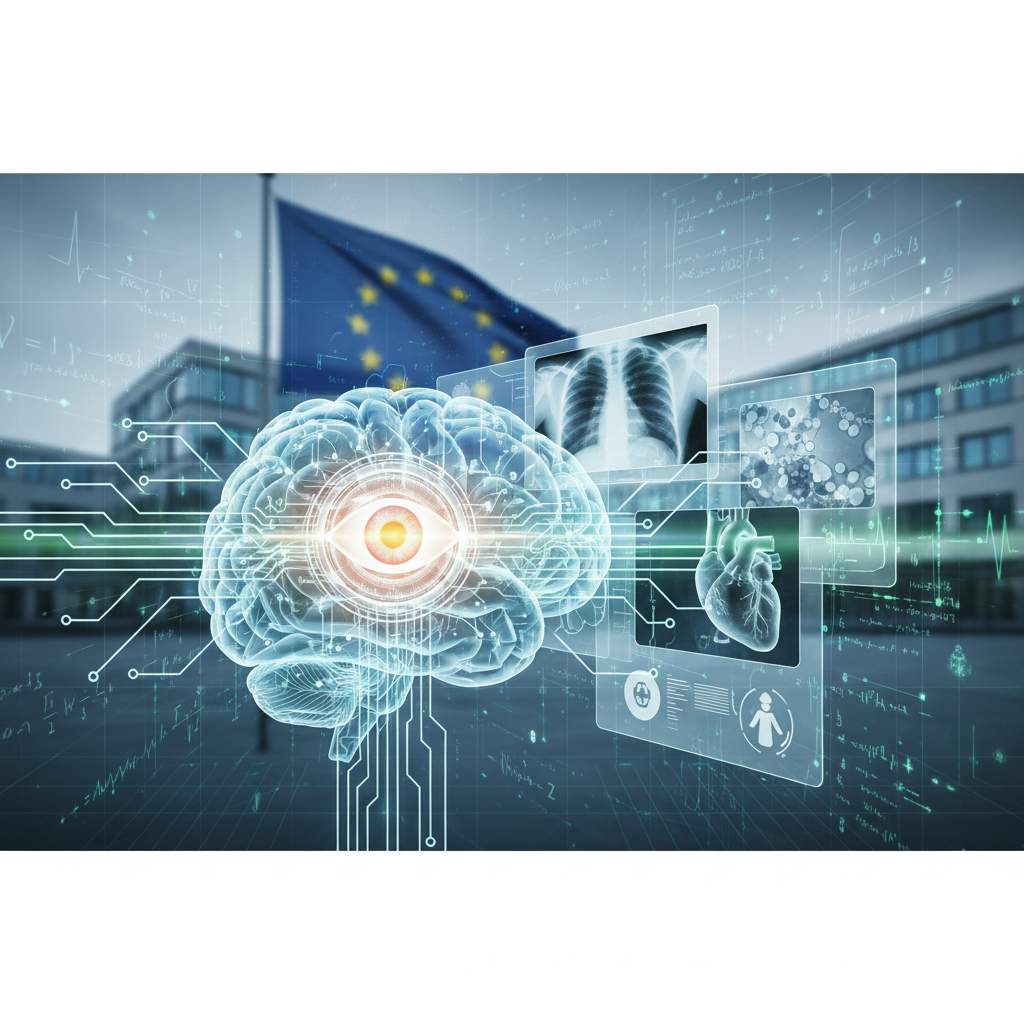

The global race for artificial intelligence supremacy continues unabated, a technological sprint defined by incremental advances and ambitious declarations. Yet, amidst the clamour, certain developments stand out, demanding closer inspection. Google's Gemini, with its much-touted multimodal capabilities, represents one such inflection point, particularly its potential to transform the landscape of healthcare AI. For those of us observing from Brussels, the question is not merely about technological prowess, but about how these innovations will integrate into a highly regulated, patient-centric environment like Belgium's healthcare system.
At its core, the breakthrough with Gemini lies in its ability to process and understand information across different modalities simultaneously. Unlike earlier models that might process text and images separately, Gemini was designed from the ground up to integrate these inputs, allowing it to interpret complex visual data, such as medical scans, in conjunction with textual patient histories or clinical notes. This is not simply a matter of stitching together two separate AI systems, but rather a deeper, more integrated architectural approach, as detailed in various research papers from Google DeepMind and Google Brain teams. Their work often highlights the fine-tuning on diverse datasets, including medical imaging, to enhance diagnostic accuracy and contextual understanding.
Why This Matters for Healthcare
Consider the traditional diagnostic process. A radiologist examines an MRI scan, a pathologist reviews tissue slides, and a physician synthesises these visual findings with a patient's symptoms, medical history, and laboratory results. This is inherently a multimodal task, requiring expert interpretation across disparate data types. Current AI tools often excel in one domain, for example, identifying anomalies in X-rays, but struggle to connect these findings holistically with other patient data without significant human intervention. Gemini's promise is to bridge this gap, offering a unified AI assistant capable of understanding the full clinical picture.
Dr. Erik Van der Linden, a leading medical imaging specialist at UZ Leuven, articulated this challenge recently, stating, "The fragmentation of AI tools in medicine is a significant hurdle. We need systems that can truly act as intelligent co-pilots, not just isolated calculators. The ability to correlate a suspicious lesion on an image with a specific genetic marker from a patient's record, and then suggest relevant literature, would be transformative." This sentiment underscores the profound impact such integrated AI could have, moving beyond mere pattern recognition to more nuanced, context-aware clinical reasoning.
The Technical Underpinnings: A Glimpse Behind the Curtain
While the precise architectural details of Gemini remain proprietary, public research and academic discussions offer insights into its operational principles. The model employs a transformer-based architecture, similar to those found in large language models like GPT, but with significant modifications to handle visual tokens alongside textual ones. This involves sophisticated embedding techniques that convert pixels and words into a common representational space, allowing the model to learn relationships between them. For instance, a model might learn that certain visual patterns in a lung scan are frequently associated with specific terms in a patient's discharge summary, such as 'pulmonary fibrosis.'
One of the key challenges, and indeed a focus of ongoing research, is the sheer scale of training data required. Multimodal models need vast quantities of paired data, where images are accurately labelled and correlated with text descriptions. In healthcare, this translates to millions of anonymised medical images linked to corresponding clinical reports, pathology findings, and electronic health records. The ethical acquisition and curation of such datasets are monumental tasks, particularly under stringent European data protection regulations like GDPR. Researchers at institutions like Stanford University and Google DeepMind frequently publish on methods for efficient multimodal learning and data synthesis, often exploring techniques like self-supervised learning to reduce reliance on purely human-annotated datasets. You can find many of these cutting-edge papers on arXiv.
Who is Driving This Research?
The primary impetus for Gemini's development, and indeed the broader multimodal AI push, comes from major technology companies with substantial research arms. Google DeepMind and Google Brain have been at the forefront, investing billions into developing these foundational models. Their competitive rivalry with OpenAI's GPT series, and Anthropic's Claude, serves as a powerful accelerator for innovation. While OpenAI initially focused heavily on language, their recent moves, such as integrating Dall-e capabilities and exploring video generation, clearly indicate a strategic shift towards comprehensive multimodal understanding, mirroring Google's trajectory. Meta AI, with its Llama models, is also making significant strides in this domain, often emphasising open-source contributions to foster broader research. For a broader perspective on AI research and industry news, MIT Technology Review often provides excellent coverage.
However, it is crucial to recognise that academic institutions and specialised medical AI startups also play a vital role. European initiatives, often supported by Horizon Europe funding, are actively exploring multimodal AI for specific medical applications, from oncology to neurology. These collaborations are essential for grounding abstract technological capabilities in real-world clinical needs and ensuring that the resulting tools are tailored to European healthcare contexts.
Implications and Next Steps for Belgium and Europe
The potential benefits of advanced multimodal AI in healthcare are undeniable: earlier and more accurate diagnoses, personalised treatment plans, and reduced burden on overstretched medical professionals. Imagine an AI system that can flag subtle changes in a patient's imaging over time, cross-reference them with genetic predispositions, and alert clinicians to potential risks long before symptoms manifest. This is the future being envisioned.
However, Belgian pragmatism meets AI hype at the intersection of innovation and regulation. The EU's AI Act, set to be fully implemented, classifies AI systems in healthcare as 'high-risk,' subjecting them to rigorous conformity assessments, human oversight requirements, and transparency obligations. This is not a barrier to innovation, but a necessary safeguard. As Professor Lenaerts, a legal scholar specialising in AI ethics at KU Leuven, noted, "The ethical deployment of AI in healthcare is paramount. We cannot allow technological ambition to outpace our commitment to patient safety and data privacy. Brussels has questions, and so should you, about accountability, bias, and the ultimate decision-making authority when AI is involved." Her point is well taken; the legal and ethical frameworks must evolve in parallel with the technology.
Furthermore, the multilingual nature of Belgium and Europe presents another layer of complexity. While current multimodal models show impressive performance in English, their capabilities in Dutch, French, or German, especially when dealing with nuanced medical terminology, require extensive validation. Ensuring equitable access to these advanced tools across all linguistic communities is a critical consideration for European policymakers and researchers. The EU's approach deserves more credit than it gets for grappling with these multifaceted challenges, aiming for a human-centric AI ecosystem rather than a purely market-driven one.
Looking ahead, the integration of Gemini-like multimodal AI into Belgian hospitals will require significant investment in infrastructure, robust data governance frameworks, and comprehensive training for healthcare professionals. Pilot projects, perhaps focusing on specific high-volume diagnostic areas like radiology or pathology, could provide invaluable insights into real-world performance and user acceptance. The journey from a research paper to a trusted clinical tool is long and arduous, demanding collaboration between tech giants, medical institutions, regulators, and the public. The promise is immense, but the path requires careful navigation, ensuring that these powerful tools serve humanity, rather than merely advancing technological frontiers.