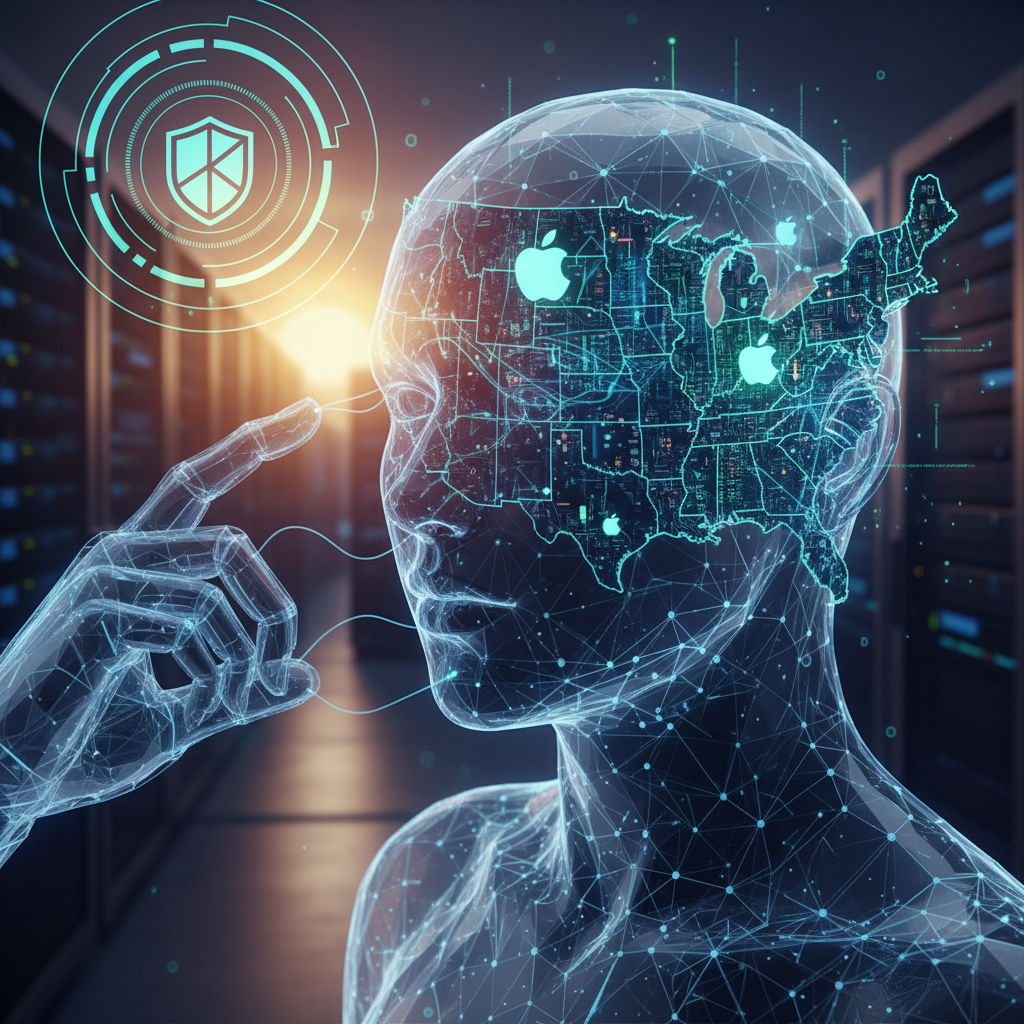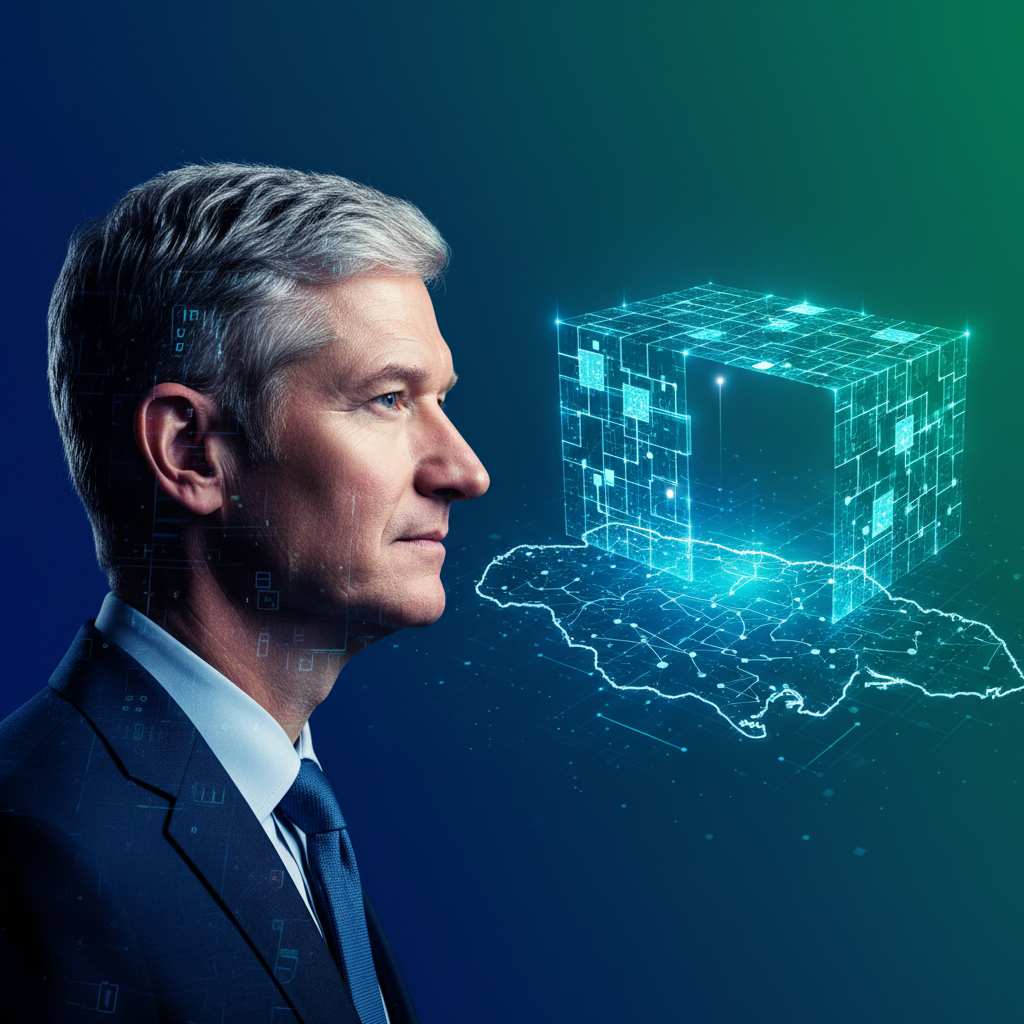

Alright, listen up. In a world gone absolutely bonkers for generative AI, where every tech giant is practically tripping over themselves to hoover up your data and feed it to their next-gen algorithms, there is Apple, doing its usual Apple thing. While everyone else is shouting about cloud-powered super-brains, Tim Cook and his crew are whispering 'privacy' and 'on-device.' And let me tell you, that whisper is getting louder, especially for those of us who believe in small island, big ideas.
For years, the tech world has been pushing us towards the cloud, telling us it is faster, more scalable, more everything. But then you have the privacy nightmares, the data breaches, the constant feeling that someone, somewhere, is listening in. Apple, bless their cotton socks, has always tried to carve out a different path, at least publicly. Their latest push into AI, particularly with their M-series chips, is a masterclass in trying to have their cake and eat it too. They want powerful AI experiences, but they want them to happen on your device, not on some server farm in a cold, distant land. This isn't just a marketing gimmick; it is a fundamental architectural decision with serious implications for how we build and deploy AI, especially for developers and data scientists who are tired of the data-hungry status quo.
The Technical Challenge: AI Without the Data Drain
The core problem Apple is trying to solve is this: how do you deliver cutting-edge AI features, like advanced natural language processing or sophisticated image recognition, without sending every single byte of user data to a remote server for processing? The traditional approach relies on massive cloud infrastructure, where models are trained on colossal datasets and inference happens remotely. This is great for scale and rapid iteration, but it is a privacy minefield. Every query, every photo, every voice command becomes a potential data point that leaves your device.
Apple's solution is to push as much of that processing as possible to the 'edge,' meaning directly onto the user's device. This requires highly optimized models, efficient hardware accelerators, and clever data handling. It is a technical tightrope walk, balancing performance with strict privacy guarantees. For a small nation like Jamaica, where data sovereignty and digital security are becoming increasingly important, this approach holds a certain appeal. We do not want our local data floating around in the ether, subject to foreign laws and corporate whims.
Architecture Overview: Silicon, Secure Enclaves, and Federated Learning
At the heart of Apple's on-device AI strategy are two key components: their custom silicon, specifically the M-series chips, and the Secure Enclave. These chips are not just fast CPUs and GPUs; they include dedicated Neural Engines designed for accelerated machine learning tasks. These Neural Engines are optimized for matrix multiplications and other operations common in neural networks, allowing for efficient inference without draining the battery or overheating the device.
Beyond raw processing power, the Secure Enclave plays a crucial role. This is a dedicated, isolated hardware subsystem that handles cryptographic keys and other sensitive data, ensuring that even if the main processor is compromised, your most private information remains secure. When AI models need to access or process highly sensitive data, they can do so within the confines of the Secure Enclave, with results returned without ever exposing the raw data.
For model improvement, Apple employs a technique called federated learning. Instead of collecting raw user data, models are trained locally on individual devices. Only the updates to the model, in the form of weight changes, are aggregated in the cloud. These updates are anonymized and differentially private, meaning that no single user's contribution can be identified. This allows for continuous model improvement without compromising individual privacy. It is a sophisticated dance between local computation and global aggregation, designed to keep your secrets safe while still making Siri a little less… well, Siri.
Key Algorithms and Approaches: Quantization and Differential Privacy
To make large AI models run efficiently on constrained device hardware, Apple heavily relies on model quantization. This involves reducing the precision of the model's weights and activations, often from 32-bit floating-point numbers to 8-bit integers or even lower. While this can introduce a slight loss in accuracy, it dramatically reduces model size and computational requirements. For example, a common quantization approach might look conceptually like this:
def quantize_weights(weights, scale, zero_point):
 # Scale and shift weights to fit into an 8-bit integer range
 quantized_weights = round(weights / scale + zero_point)
 return clamp(quantized_weights, -128, 127)

def dequantize_weights(quantized_weights, scale, zero_point):
 # Reverse the process to use weights in computation
 return (quantized_weights - zero_point) * scale
def quantize_weights(weights, scale, zero_point):
 # Scale and shift weights to fit into an 8-bit integer range
 quantized_weights = round(weights / scale + zero_point)
 return clamp(quantized_weights, -128, 127)

def dequantize_weights(quantized_weights, scale, zero_point):
 # Reverse the process to use weights in computation
 return (quantized_weights - zero_point) * scale
This allows models that might be gigabytes in size to shrink down to hundreds of megabytes, making them feasible for on-device deployment. The Neural Engine is specifically designed to perform these quantized operations at high speed.
Differential privacy is another cornerstone. This mathematical framework adds carefully calibrated noise to data or model updates, ensuring that the presence or absence of any single individual's data in a dataset does not significantly affect the outcome of an analysis. This provides a strong, provable guarantee of privacy. In federated learning, this means that even when model updates are aggregated, it is computationally infeasible to reverse-engineer individual contributions. This is not just obfuscation; it is a rigorous privacy guarantee that other companies often struggle to match.
Implementation Considerations: Core ML and Private Access
For developers, Apple provides the Core ML framework, which allows easy integration of machine learning models into iOS, macOS, watchOS, and tvOS apps. Core ML supports a wide range of model types and can leverage the Neural Engine automatically. The key here is that Core ML models run entirely on the device, respecting user privacy by default. Developers can convert models from popular frameworks like TensorFlow and PyTorch into the Core ML format, .mlmodel.
Apple has also introduced APIs like Private Access, which allows developers to tap into system-level AI capabilities, like on-device image analysis or speech recognition, without ever gaining direct access to the raw user data. The system processes the data locally, and only abstract, privacy-preserving results are returned to the app. This is a game-changer for building privacy-centric features, as it shifts the burden of privacy protection from the app developer to the platform itself.
Benchmarks and Comparisons: A Different Metric of Success
When comparing Apple's on-device AI to cloud-based solutions from Google or OpenAI, it is not always an apples-to-apples comparison. Cloud models like OpenAI's GPT-4 or Google's Gemini often boast superior accuracy and generalizability due to their immense scale and training data. However, Apple's models excel in latency, offline capability, and, crucially, privacy. For tasks where immediate response and data sensitivity are paramount, on-device inference often outperforms cloud alternatives, even if the model itself is slightly less sophisticated.
For instance, Apple's on-device speech recognition, while perhaps not as nuanced as a cloud-based model, is incredibly fast and works without an internet connection. Similarly, on-device image analysis for features like object detection in photos is near-instantaneous and keeps your personal photos off the cloud. The benchmark here isn't just raw accuracy; it is accuracy under privacy constraints and without network dependency.
Code-Level Insights: Core ML Tools and MLProgram
Developers working with Core ML will use coremltools for model conversion. A common workflow involves training a model in PyTorch, then exporting it:
import coremltools as ct
import torch

# Assuming 'my_model' is a trained PyTorch model
# and 'example_input' is a dummy input tensor

traced_model = torch.jit.trace(my_model, example_input)
mlmodel = ct.convert(
 traced_model,
 inputs=[ct.TensorType(shape=example_input.shape)],
 convert_to='mlprogram' # MLProgram for better Neural Engine utilization
)

mlmodel.save('MyOnDeviceModel.mlmodel')
import coremltools as ct
import torch

# Assuming 'my_model' is a trained PyTorch model
# and 'example_input' is a dummy input tensor

traced_model = torch.jit.trace(my_model, example_input)
mlmodel = ct.convert(
 traced_model,
 inputs=[ct.TensorType(shape=example_input.shape)],
 convert_to='mlprogram' # MLProgram for better Neural Engine utilization
)

mlmodel.save('MyOnDeviceModel.mlmodel')
The mlprogram format is particularly important as it allows Core ML to better optimize models for the Neural Engine, providing significant performance gains over older formats. This is where the rubber meets the road for on-device efficiency.
Real-World Use Cases: Beyond Siri
- On-Device Photo Analysis: Your iPhone categorizes your photos, identifies faces, and even suggests memories, all without uploading your entire photo library to Apple's servers. This is a prime example of privacy-preserving AI at scale.
- Keyboard Predictions and Autocorrection: The predictive text on your keyboard learns your typing habits and vocabulary locally. This personalized model stays on your device, improving your typing experience without sharing your private conversations.
- Health App Data Analysis: The Health app can analyze activity patterns, sleep data, and other sensitive health metrics to provide insights, with all processing occurring on the device and data encrypted at rest and in transit.
- Live Voicemail Transcription: When someone leaves a voicemail, your iPhone transcribes it in real-time on the device, giving you a preview without sending the audio to a server for processing. This feature is a testament to the power of on-device AI for immediate, sensitive tasks.
Gotchas and Pitfalls: Not a Panacea
While Apple's approach is commendable, it is not without its limitations. On-device models are inherently constrained by the device's hardware. This means they might not be as large or as capable as their cloud counterparts. Training is also more complex; while federated learning helps, it is slower and requires careful management of model updates. Debugging on-device issues can be trickier, and the ecosystem is, of course, a bit of a walled garden. You are playing by Apple's rules, which sometimes means less flexibility than an open-source, cloud-agnostic approach.
For Jamaican developers, this means a choice. Do you commit to the Apple ecosystem for the privacy benefits and hardware optimization, or do you stick with more open, cloud-based solutions that might offer broader reach but demand more vigilance on data privacy? Jamaica's tech scene is like reggae, it will surprise you with its adaptability, but we need to weigh these trade-offs carefully.
Resources for Going Deeper
For those looking to dive deeper into the technicalities, Apple's developer documentation on Core ML and their machine learning frameworks is an excellent starting point. You can find detailed guides and sample code on their developer site. For a broader perspective on privacy-preserving AI techniques like federated learning and differential privacy, MIT Technology Review often publishes insightful articles. Additionally, research papers on these topics are frequently found on arXiv, offering a glimpse into the bleeding edge of academic research.
This privacy-first approach by Apple is more than just a tech trend; it is a philosophical statement about the future of AI. It challenges the prevailing wisdom that bigger models and more data are always better. In a world increasingly concerned with digital sovereignty and personal data protection, perhaps Apple's seemingly conservative stance is actually the most radical. It is certainly something that resonates here in the Caribbean, where we understand the value of self-reliance and protecting what is ours. The Caribbean has entered the chat, and we are listening closely to how these privacy discussions unfold, because our digital future depends on it.