
India's AI Policy: Balancing Innovation with 'Bharat's' Values, Says Minister
India is crafting an AI policy aimed at fostering innovation while safeguarding societal values, with ministers emphasizing a 'Bharat-centric' approach to digital transformation.
Click play to listen to this article read aloud using text-to-speech.
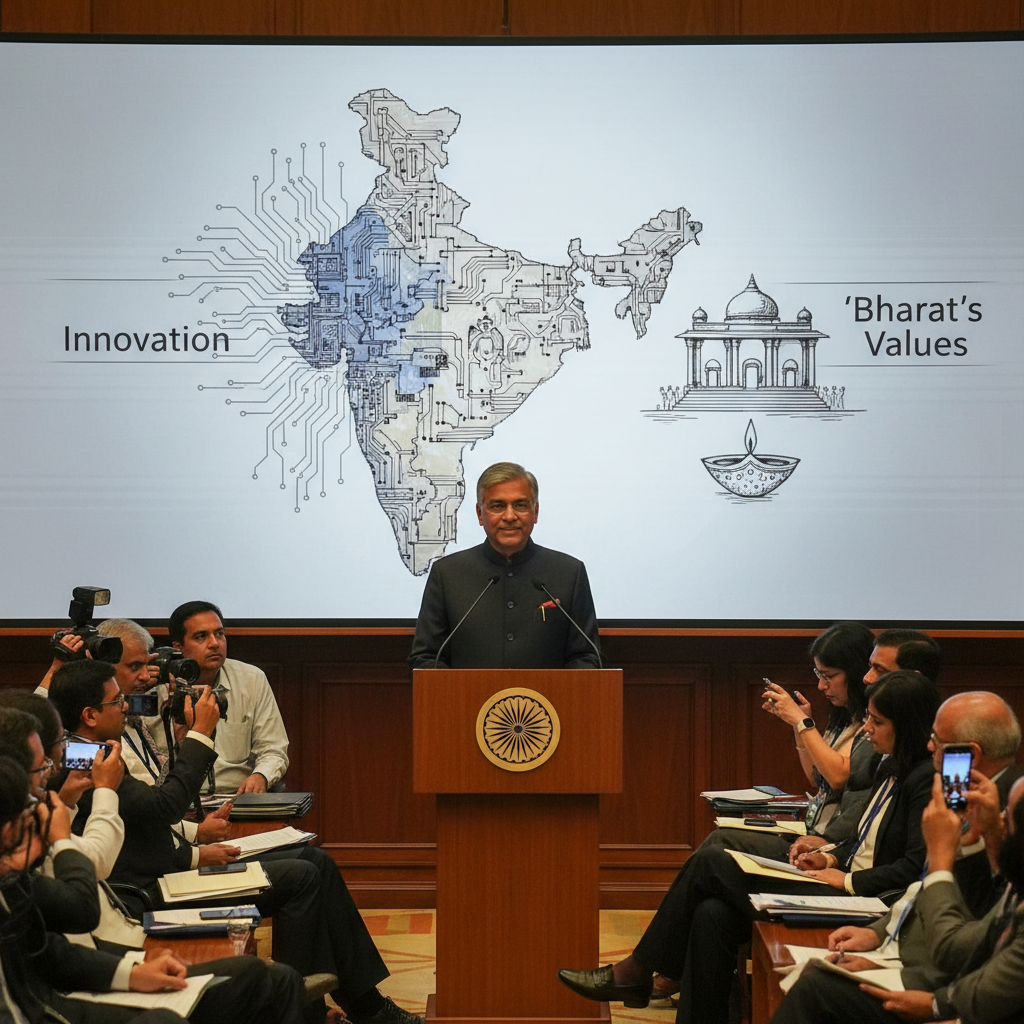

NEW DELHI – As the global race for Artificial Intelligence dominance intensifies, India is meticulously charting its own course, prioritizing a 'Bharat-centric' approach that marries technological advancement with the nation's unique cultural and societal fabric. This was the resounding message from Union Minister for Electronics and Information Technology, Shri Ravi Shankar Prasad, during a recent digital summit in Bengaluru, a city often dubbed India's Silicon Valley.
“Our vision for AI is not merely about algorithms and data; it is about empowering every 'gaon' (village) and every 'nagar' (city) of India,” stated Minister Prasad, his words echoing the government's long-standing commitment to inclusive growth. “We must ensure that AI serves the common man, the 'aam aadmi,' and does not become a tool for digital divide. This is not just a technological imperative, but a 'rajneetik' (political) and social responsibility.”
The Minister highlighted the ongoing consultations with various stakeholders, including leading tech companies, academic institutions like the IITs, and civil society groups, to draft a comprehensive National AI Strategy. Sources within the Ministry indicate that the policy, expected to be unveiled later this year, will focus on three key pillars: 'Jai Vigyan' (hailing science) for research and development, 'Jai Kisan' (hailing the farmer) for agricultural applications, and 'Jai Jawan' (hailing the soldier) for national security.
Dr. Preetpal Singh, a renowned AI ethicist and professor at the Indian Institute of Technology, Delhi, emphasized the importance of local context. “Unlike Western models, our AI development must account for India's linguistic diversity, socio-economic disparities, and the vast informal sector. A 'desi' (local) approach means building models that understand Hindi, Punjabi, Tamil, and all our regional languages, not just English. It's about 'loktantra' (democracy) in data.” Dr. Singh, whose family hails from Ludhiana, often speaks about the need for AI to respect India's pluralistic ethos.
The government is particularly keen on leveraging AI for public service delivery, from improving healthcare access in remote areas through AI-powered diagnostics to enhancing agricultural productivity via predictive analytics for crop management. Concerns about data privacy and algorithmic bias, however, remain at the forefront of policy discussions. “We are committed to establishing robust regulatory frameworks,” assured a senior official from the Ministry, speaking on condition of anonymity. “The 'dharma' (righteous conduct) of AI must be upheld, ensuring fairness and transparency, especially when dealing with citizens' data.”
As India positions itself as a global leader in the digital age, its unique approach to AI policy, rooted in its cultural values and democratic principles, could set a precedent for other developing nations. The coming months will reveal how successfully 'Bharat' navigates this complex technological landscape, ensuring that AI truly becomes a 'saathi' (companion) for progress, not a 'shatru' (enemy) to its people. The 'pariksha' (test) for this policy will be its real-world impact on the lives of millions.```
Related Articles

Chinese Women Entrepreneurs Drive AI Innovation in Smart Manufacturing
 Mei-Líng Zhāng
AI Ethics Bill Stalls in Senate Amidst Bipartisan Wrangling Over Oversight
 Amèlia Whitè
Tahiti Embraces AI: Digital Sovereignty and Cultural Preservation at Forefront of New Policy
 Tiàre Teriifaàtia
Serbia's AI Strategy: Balancing Innovation and Sovereignty in a Digital Europe
 Nikolàs Petrovicì