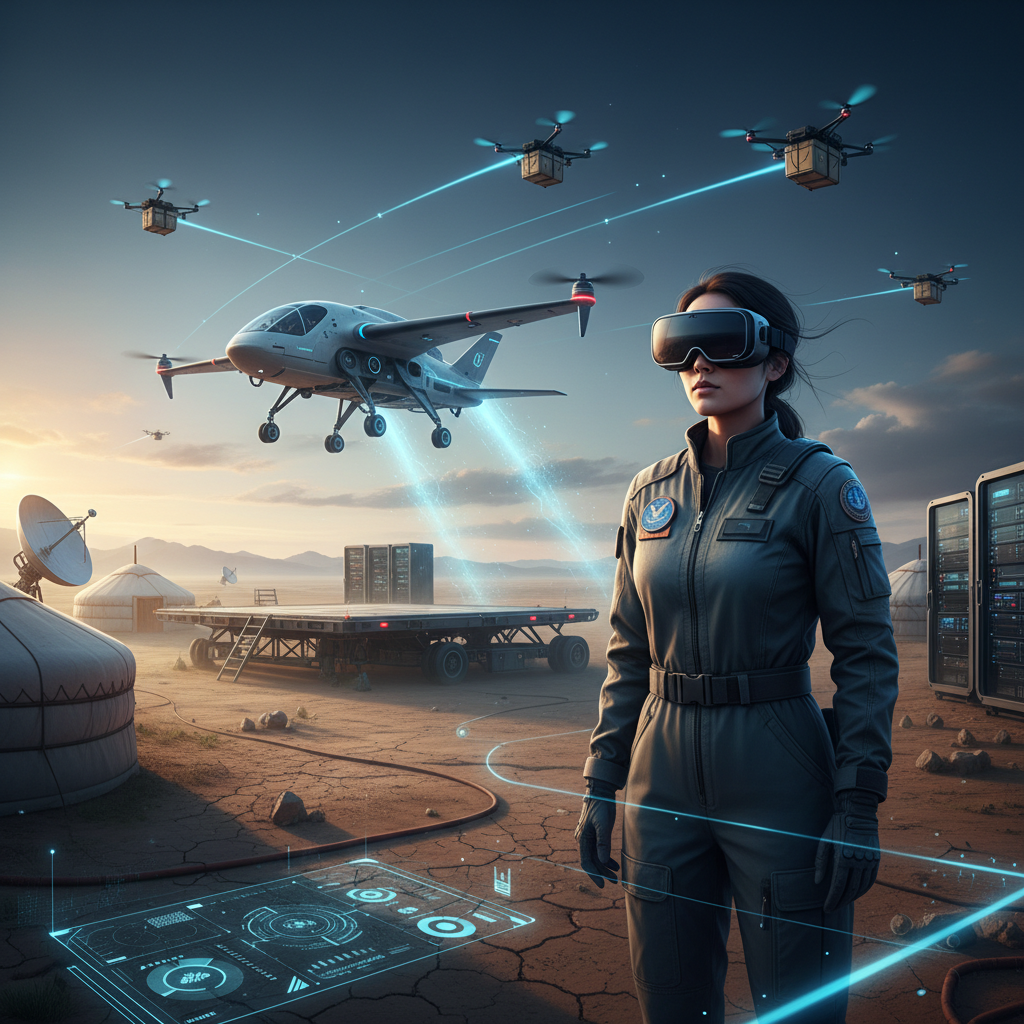

The wind whips across the steppe, carrying dust from the Gobi. Here, in Mongolia, you learn quickly that technology isn't about fancy slogans or venture capital valuations. It's about whether it works, reliably, when the mercury drops to minus 40 degrees Celsius or when a sandstorm blinds the horizon. So, when I hear about AI transforming aviation, my first thought isn't about sleek autonomous jets. It's about the practical realities of keeping planes in the sky, safely and efficiently, across vast, challenging landscapes.
For decades, aviation has been a meticulously human-controlled domain, and for good reason. The stakes are impossibly high. But the sheer complexity of modern air travel, with its ever-increasing traffic, intricate logistics, and the constant need for fuel efficiency, is pushing even this conservative industry towards artificial intelligence. We are talking about AI not as a replacement for pilots or air traffic controllers, but as a powerful assistant, a co-pilot for the entire system, from the ground up.
One of the most immediate impacts of AI is in flight optimization. Airlines are always looking to shave off minutes and conserve fuel. Even a small percentage reduction across thousands of flights translates into massive savings and lower emissions. Companies like Amadeus and Sabre have been integrating AI algorithms into their flight planning software for years. These systems analyze a staggering amount of data in real time: weather patterns, air traffic congestion, aircraft performance characteristics, even geopolitical no-fly zones. They then recommend optimal flight paths, altitudes, and speeds. For example, a major European carrier recently reported a 2.5% fuel saving across its fleet after implementing an AI-driven flight optimization system, which, for an airline operating hundreds of flights daily, can mean millions of dollars annually. This isn't just about money; it is about reducing the carbon footprint, a critical concern for our planet.
Then there is predictive maintenance. In Mongolia, where spare parts can take days to arrive and maintenance facilities are few and far between, anticipating equipment failure is not just smart business; it is a matter of operational survival. Globally, airlines are grappling with aging fleets and the immense costs of unscheduled repairs. This is where AI truly shines. Sensors on modern aircraft collect terabytes of data during every flight, monitoring everything from engine performance and hydraulic pressure to cabin temperature fluctuations. AI models, trained on historical data of component failures and maintenance records, can detect subtle anomalies that human eyes might miss. They can predict, with increasing accuracy, when a specific part is likely to fail, allowing airlines to schedule maintenance proactively during planned downtime. This shifts the paradigm from reactive repairs to preventative action.
GE Aerospace, for instance, has been a leader in this space, using AI to monitor its jet engines. Their systems analyze data from thousands of engines worldwide, identifying patterns that precede mechanical issues. According to a recent report, these predictive analytics have helped airlines reduce unscheduled maintenance events by up to 10%, leading to fewer delays and cancellations. As Mr. Tuvshinbayar Ganbaatar, head of engineering at Miat Mongolian Airlines, told me during a recent visit to Ulaanbaatar's Chinggis Khaan International Airport,