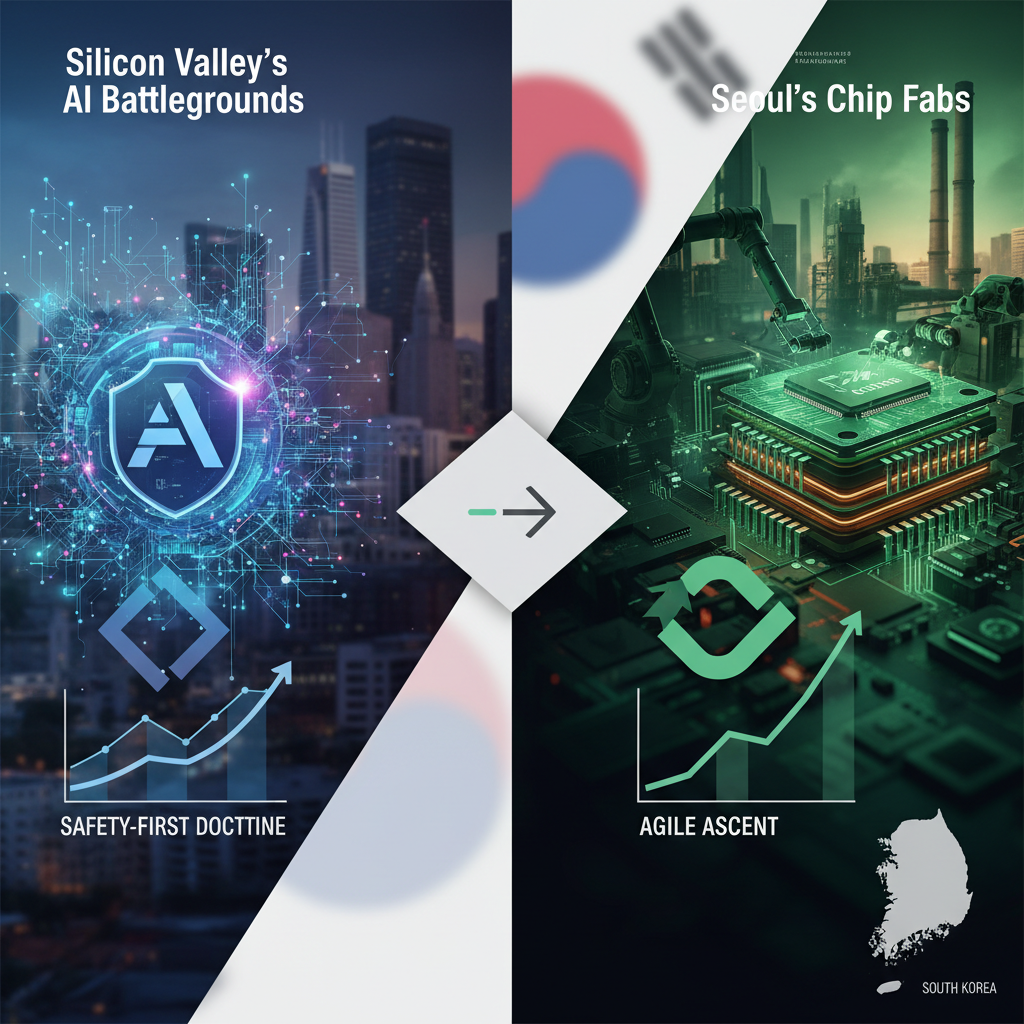
Is the philosophical chasm between Anthropic and OpenAI merely a strategic marketing ploy, or does it represent a fundamental, enduring divergence in how humanity approaches the development of artificial general intelligence? This question, far from being an academic exercise, carries profound implications for the future of technology, policy, and even the very fabric of our societies. As a journalist observing from the dynamic tech hub of South Korea, I see this debate not as a distant Silicon Valley skirmish, but as a critical determinant for our own innovation trajectory.
Historically, the pursuit of artificial intelligence has been a tale of two impulses: the utilitarian drive for capability and the cautious whisper of control. From Alan Turing's conceptual machines to the early expert systems of the 1980s, researchers grappled with how much autonomy to grant their creations. The current era, characterized by large language models, has amplified this tension to an unprecedented degree. OpenAI, initially founded with a non-profit mission to develop safe AGI, famously shifted its structure to a capped-profit model, accelerating its development pace and bringing products like ChatGPT to the masses with astonishing speed. This move, while undeniably successful in terms of market penetration and technological advancement, also signaled a more pragmatic, perhaps even aggressive, approach to deployment.
Anthropic, on the other hand, emerged from a cohort of OpenAI researchers who departed over concerns about the direction and safety protocols. Their very inception was a testament to a deep-seated belief that safety and ethical alignment must be paramount, not merely an afterthought. Their 'Constitutional AI' approach, which involves training models to adhere to a set of principles derived from documents like the Universal Declaration of Human Rights, is a direct manifestation of this philosophy. It is an attempt to imbue AI with an internal moral compass, rather than relying solely on external guardrails. This is not simply a matter of branding; it is a technical architectural choice with far-reaching implications.
Consider the data. OpenAI's GPT models have demonstrated unparalleled versatility, driving adoption across various industries, from content creation to coding assistance. Reports from early 2026 suggest OpenAI's annualized revenue run rate has surged past $2 billion, a testament to its aggressive commercialization strategy. Its partnerships with Microsoft, notably the multi-billion dollar investment, have provided immense computational resources and market access. This rapid expansion, however, has also been accompanied by public debates surrounding data privacy, intellectual property, and the potential for misuse, as evidenced by various legal challenges and ethical discussions detailed by outlets like Reuters.
Anthropic, while not matching OpenAI's sheer scale of public deployment, has garnered significant investment from tech giants like Amazon and Google, reportedly securing billions of dollars. Their Claude models are often lauded for their reduced propensity for generating harmful or biased content, a direct outcome of their Constitutional AI training. While their market share might be smaller, their influence on the discourse around AI safety and responsible development is profound. They are, in essence, building a different kind of product, one where trustworthiness is a primary feature, not a secondary patch. This is a critical distinction, particularly for sensitive applications in healthcare, finance, and government.
Here's the technical breakdown: OpenAI's strategy often involves pushing the boundaries of model scale and emergent capabilities, then iterating on safety mechanisms. It is a 'build first, refine fast' methodology. Anthropic, conversely, integrates safety and alignment principles into the foundational training process itself. It is a 'build safe, then scale' approach. Imagine building a skyscraper: OpenAI might focus on constructing the tallest, most innovative structure quickly, then adding advanced fire suppression and earthquake resistance. Anthropic would spend more time on the foundational engineering, ensuring every beam and rivet is inherently designed for maximum resilience before the first floor is even complete. Both approaches have merits, but their risk profiles and deployment philosophies diverge significantly.
This dichotomy resonates deeply in South Korea, a nation that has historically balanced rapid technological advancement with a strong emphasis on societal stability and ethical considerations. The Korean approach to AI is fundamentally different in its integration with hardware innovation. Samsung, for instance, is not merely a consumer electronics giant; it is a semiconductor powerhouse, deeply invested in the NPU and memory technologies that power these large models. Their strategy involves not just consuming AI, but producing the very infrastructure for it. "Our focus is on developing AI that enhances human life while upholding our values of trust and responsibility," stated Dr. Kye Hyun Kyung, CEO of Samsung Electro-Mechanics, in a recent industry forum. "This requires not only cutting-edge hardware but also robust ethical frameworks embedded from the ground up." This sentiment aligns more closely with Anthropic's foundational safety ethos, suggesting a preference for integrated, responsible development.
Conversely, Hyundai Motor Group, while embracing AI for autonomous driving and smart factories, also understands the imperative of rapid iteration and competitive advantage. Their partnerships and internal AI initiatives often reflect a pragmatic blend of speed and safety, leaning into the capabilities offered by models like those from OpenAI for rapid prototyping and deployment, while maintaining stringent internal review processes. "The global race for AI leadership demands agility," remarked Chang-hyeon Song, President and Head of Hyundai's Advanced Air Mobility Division, in an interview last year. "But agility without responsibility is a recipe for disaster. We must find the optimal balance." This reflects the tension between the two philosophies.
My verdict is that this divergence is far from a fad; it is the new normal, a foundational split that will shape the AI landscape for decades. The choice between Anthropic's safety-first, Constitutional AI and OpenAI's capability-driven, agile deployment represents more than just business models; it reflects differing visions for humanity's relationship with its most powerful creation. For nations like South Korea, deeply embedded in both hardware manufacturing and AI application, understanding this distinction is paramount. It informs investment decisions, shapes regulatory frameworks, and ultimately determines the kind of future we are building. The influence of companies like Anthropic, pushing for inherent safety, and OpenAI, demonstrating unprecedented capability, will continue to sculpt the global AI narrative, compelling us all to consider not just what AI can do, but what it should do. The lessons learned from this ongoing philosophical debate will undoubtedly influence the next generation of AI development, from the smallest embedded systems to the most expansive cloud-based supercomputers, a topic frequently explored by publications like MIT Technology Review. The future of AI, much like a well-designed Korean automobile, must be both powerful and inherently safe.