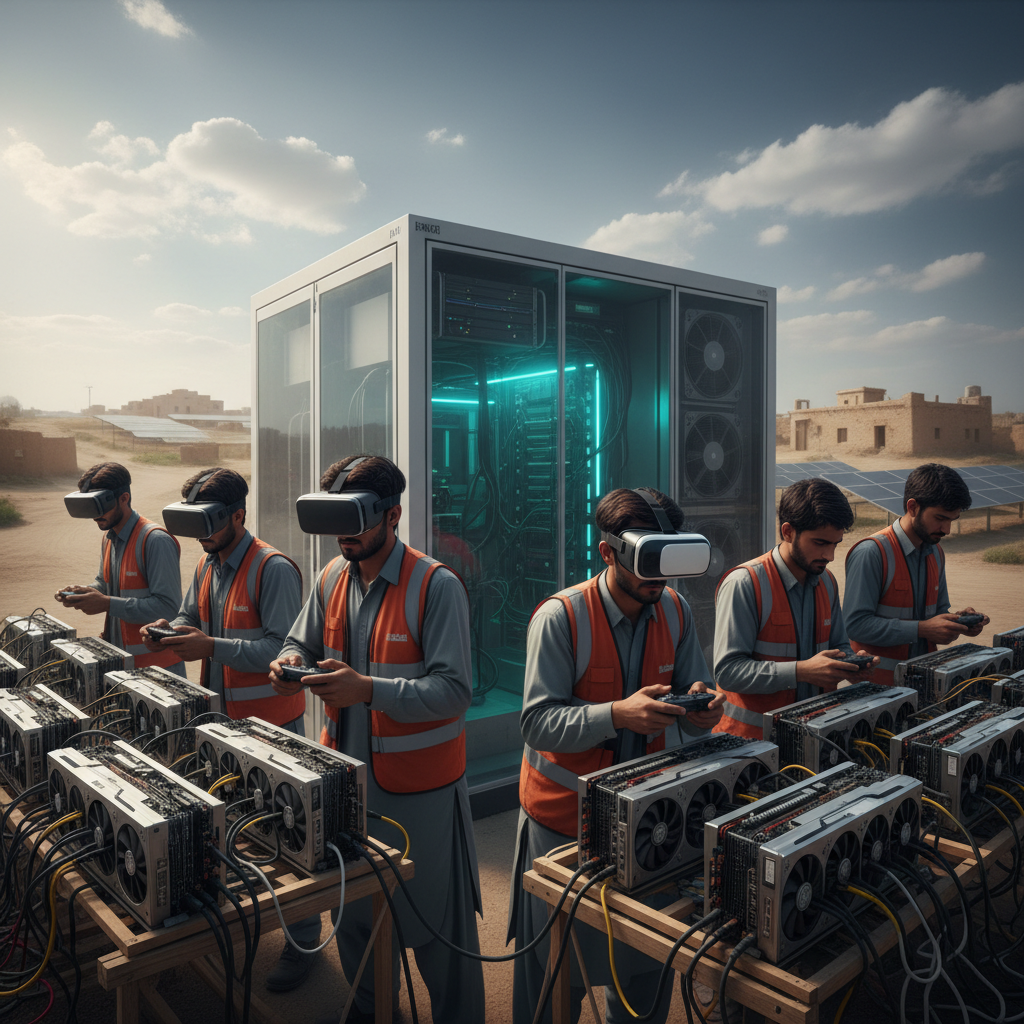

The earth beneath our feet holds immense wealth, from copper and gold to rare earth minerals essential for the very AI chips that power this new revolution. For centuries, extracting these treasures has been a grueling, dangerous business, often exploiting human labor and devastating natural landscapes. Now, a new player has entered the field: artificial intelligence. Companies like NVIDIA, with their powerful GPUs, are not just building the brains of AI, they are also enabling its deployment in the most rugged environments, including deep underground in mines. This is not just a tech story, it is a human rights issue disguised as a tech story, and it demands our urgent attention, especially here in Pakistan.
The Headline Development: AI Goes Deep Underground
Barely a week goes by without news of another AI breakthrough, but the quiet revolution happening in mining and natural resource extraction often escapes the headlines. While we are busy discussing large language models and autonomous vehicles, AI systems are being deployed to map geological formations with unprecedented accuracy, optimize drilling paths, predict equipment failures, and even manage entire mining operations from afar. Think about it: drones equipped with AI-powered sensors are surveying vast, remote areas for mineral deposits, identifying anomalies that human geologists might miss. Autonomous haul trucks, guided by AI, are moving tons of ore without a driver, 24 hours a day. Predictive maintenance algorithms are analyzing sensor data from machinery, flagging potential breakdowns before they happen, theoretically preventing accidents and costly downtime. Major players like Rio Tinto and BHP have been at the forefront, investing billions in AI and automation, seeing it as the inevitable future of an industry grappling with rising costs, dwindling high-grade deposits, and increasing safety and environmental regulations. Even smaller, specialized firms are emerging, offering AI solutions for everything from mineral processing to water management in arid regions, a critical concern for us in Pakistan.
Why Most People Are Ignoring It: The Attention Gap
Why aren't more people talking about this? Perhaps it is because mining feels distant, an industry out of sight, out of mind for many urban dwellers. It is not as glamorous as generative AI creating art or writing code, nor as immediately terrifying as autonomous weapons. The narrative around AI in mining often focuses on efficiency, profitability, and safety improvements, which are undeniably attractive to investors and company executives. The human element, the lives and livelihoods intertwined with these operations, often gets lost in the technical jargon and financial projections. For people in countries like Pakistan, where mining, though smaller in scale compared to giants like Australia or Chile, still provides crucial employment in remote, underserved regions, this silence is deafening. We are often the last to hear about these technological shifts, but the first to feel their impact.
How It Affects YOU: More Than Just Minerals
Even if you do not work in a mine, the implications of AI in natural resources will touch your life. Consider the price of the copper in your smartphone, the lithium in your electric vehicle, or the rare earths in your laptop. More efficient extraction, theoretically, could lead to lower costs for these essential materials, making technology more accessible. But what about the human cost? What happens to the thousands of miners whose jobs are replaced by autonomous machines? In Pakistan, where skilled labor is abundant but opportunities are scarce, the displacement of even a few hundred workers can send ripples of economic instability through entire communities. Will these workers be retrained for the new AI-driven roles, or will they be left behind, their skills rendered obsolete? This is a question of dignity and survival. Moreover, AI promises enhanced safety, a noble goal in an industry notorious for accidents. But will the algorithms truly prioritize human life over profit margins? And who will be accountable when an AI system makes a fatal error?
The Bigger Picture: A Global Power Shift
Globally, the stakes are even higher. AI in mining is not just about digging up rocks; it is about geopolitical power, environmental stewardship, and equitable development. Nations with rich mineral deposits, like Pakistan with its vast reserves of copper, gold, and coal, stand at a crossroads. Will we leverage AI to develop our resources responsibly, creating sustainable wealth and skilled jobs? Or will we become mere suppliers of raw materials, with the profits and advanced technology flowing elsewhere? The environmental impact is also immense. AI can help reduce waste, optimize water usage, and monitor pollution more effectively. However, it can also accelerate extraction, potentially leading to faster depletion of resources and increased ecological damage if not managed with extreme care and robust regulation. The decisions made today, often by distant corporations and governments, will determine the future of our planet's most precious resources and the communities that depend on them. According to Reuters, investments in mining automation and AI are projected to grow significantly in the coming decade, underscoring the urgency of these considerations.
What Experts Are Saying: A Spectrum of Views
Experts offer a range of perspectives on this unfolding drama. Dr. Aisha Khan, a leading environmental policy analyst in Pakistan, recently stated, "While AI offers tantalizing prospects for efficiency and safety in mining, we must ensure that its deployment is guided by principles of environmental justice and social equity. Without strong regulatory frameworks and community engagement, this technology could exacerbate existing inequalities and environmental degradation." Her concerns echo those of many in developing nations.
On the other hand, Mark Cutifani, the former CEO of Anglo American, a global mining giant, has often championed the transformative potential of technology. He once remarked, "Digitalization and automation are not just about cutting costs; they are about making mining safer, more sustainable, and more attractive for the next generation of talent." This perspective highlights the industry's drive for innovation and improved operational standards.
However, a different note is struck by Dr. Sarah O'Connell, a labor economist specializing in automation's impact. She warns, "The promise of retraining for displaced workers often falls short. Governments and corporations must invest proactively in education and alternative economic development, not just as an afterthought, but as an integral part of their AI adoption strategy." This is particularly relevant for countries like Pakistan, where educational infrastructure might struggle to keep pace with rapid technological shifts.
Finally, from a technological standpoint, Jensen Huang, CEO of NVIDIA, whose GPUs are central to much of this AI transformation, emphasizes the sheer power of their platforms. He has spoken about how AI and accelerated computing are enabling industries to tackle problems previously deemed intractable, including complex geological modeling and real-time operational optimization. His vision is one of boundless possibility, but it is up to us to ensure that this possibility serves all of humanity, not just a privileged few.
What You Can Do About It: Demand Accountability and Inclusion
So, what can you, a concerned citizen, do? First, educate yourself. Understand the technologies, their potential, and their pitfalls. Follow the news from reputable sources like Wired and MIT Technology Review to stay informed. Second, demand transparency from governments and corporations. Ask how AI deployments in mining will impact local communities, what measures are in place for worker retraining, and how environmental risks are being mitigated. Support organizations advocating for responsible technology use and digital inclusion. Here in Pakistan, we need to push for policies that prioritize local capacity building, ensuring that our youth, especially women, are equipped with the skills to participate in this new economy. Women in Pakistan are coding the future, and they deserve a seat at the table when these critical decisions are made. We need to invest in Stem education, making it accessible to all, not just a select few in urban centers. This is not just about technology; it is about shaping our national destiny.
The Bottom Line: Why This Will Matter in 5 Years
In five years, the landscape of natural resource extraction will be unrecognizable. AI will be integrated into every facet, from exploration to processing. The choices we make today will determine whether this transformation leads to a more equitable, sustainable world, or one where the digital divide deepens, and the vulnerable are left further behind. Will AI create new opportunities for skilled Pakistani workers, or will it simply automate away their livelihoods? Will it help us manage our precious resources more wisely, or accelerate their depletion? The future is not predetermined. It is being built right now, byte by byte, algorithm by algorithm, and we all have a role to play in ensuring it serves humanity. Don't look away. The mountains and minerals of Pakistan, and indeed the world, are watching.