
The air in Beijing these days crackles with a familiar energy. It is the same kind of ambitious, almost feverish, drive that once propelled our high-speed rail networks across vast distances and erected entire cities in record time. Today, that energy is focused squarely on artificial intelligence, and the question on everyone's lips, from Zhongguancun's startup founders to the politburo's economic strategists, is this: are we building a future, or inflating a bubble?
Globally, the AI sector has seen unprecedented investment. Companies like NVIDIA, the undisputed king of AI hardware, have seen their market capitalization surge past two trillion dollars. OpenAI, Anthropic, and a host of others command valuations in the tens of billions. This isn't just Silicon Valley hype; it is a global phenomenon, and China is very much at its heart. But the sheer scale of capital injection raises uncomfortable questions for anyone who remembers the dot-com bust of the early 2000s.
The Risk Scenario: Echoes of the Past, Amplified by AI
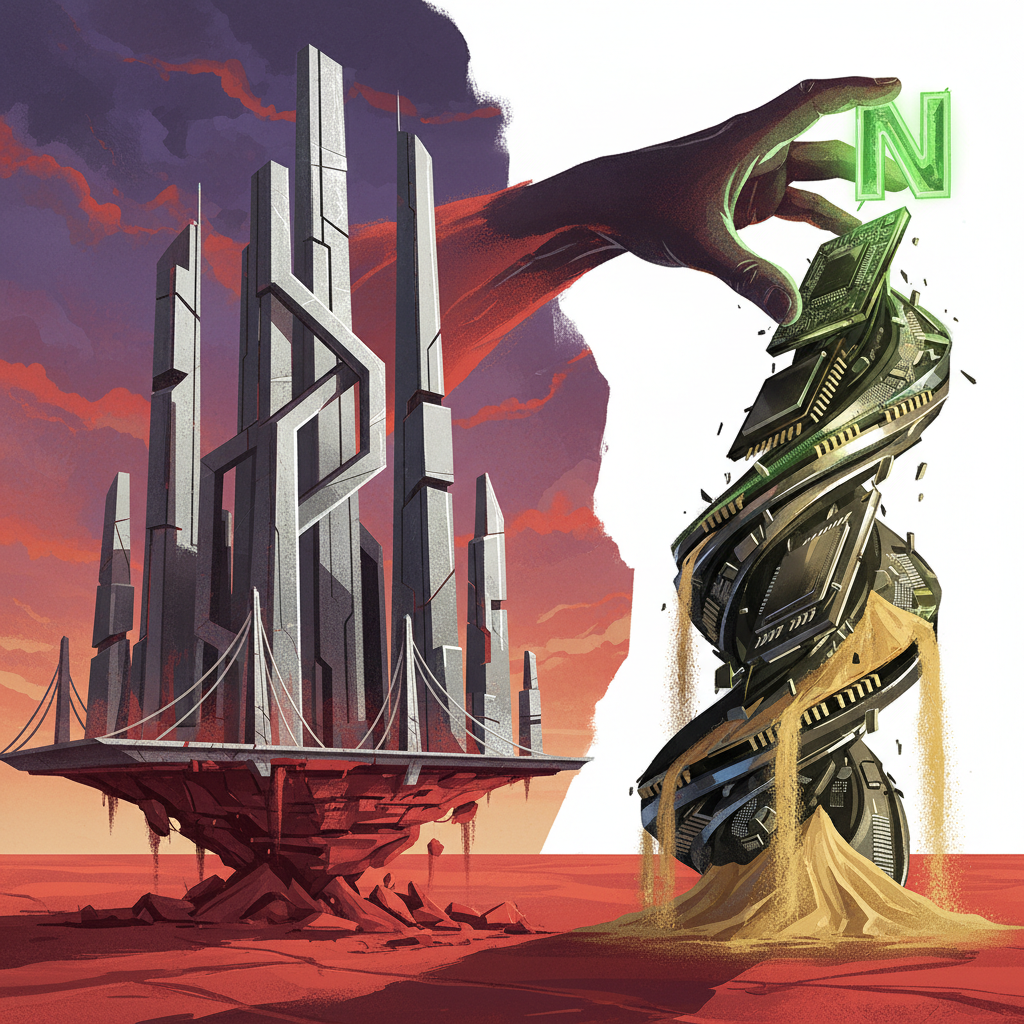
The most pressing risk is a classic economic bubble: asset prices detach from intrinsic value, fueled by speculative investment and irrational exuberance. When the bubble bursts, capital dries up, companies collapse, and innovation stalls. For AI, this scenario is particularly dangerous because so much of the current investment is speculative, betting on future capabilities and market dominance that are far from guaranteed. Unlike the dot-com era, where many companies offered services that were, at their core, relatively simple web interfaces, today's AI companies are building foundational technologies that require immense capital for research, development, and, crucially, compute power. If the funding disappears, the very infrastructure of future AI development could crumble.
In China, the stakes are even higher. A significant portion of AI investment comes from state-backed funds and local governments, driven by strategic imperatives to achieve technological self-sufficiency and global leadership. If these investments falter, it is not just private capital that takes a hit; it is national strategic goals. Beijing isn't saying this publicly, but the pressure to demonstrate tangible returns on these massive AI outlays is immense.
Technical Explanation: The GPU Bottleneck and the Talent Drain
The current AI boom is fundamentally driven by advancements in deep learning, which relies heavily on specialized hardware, primarily Graphics Processing Units, or GPUs. NVIDIA's A100 and H100 chips are the gold standard, and their scarcity, exacerbated by geopolitical tensions, creates a critical bottleneck. Training large language models like OpenAI's GPT-4 or Baidu's Ernie Bot requires thousands of these chips, running for months, consuming vast amounts of electricity. The cost of this compute power is staggering. According to some estimates, training a cutting-edge LLM can cost hundreds of millions of dollars.
This capital-intensive nature means that only well-funded entities can compete at the frontier. Smaller startups, even with brilliant ideas, struggle to secure the necessary compute resources. This creates a winner-take-all dynamic, where massive funding rounds are essential not just for growth, but for survival. Venture capitalists are pouring money into these firms, hoping to back the next OpenAI, but the underlying economics are precarious. The real story is in the supply chain, where access to advanced chips dictates who can play and who cannot.
Furthermore, the demand for top AI talent far outstrips supply. Researchers and engineers with expertise in large model training, reinforcement learning, and advanced AI architectures command exorbitant salaries, further driving up operational costs for AI companies. This talent drain is felt acutely in China, where companies are aggressively recruiting from both domestic universities and overseas, sometimes offering packages that rival those in Silicon Valley.
Expert Debate: Bubble or Transformation?
The debate rages on. On one side, optimists argue that this is a fundamental technological shift, akin to the internet's advent, but with far broader implications. Jensen Huang, NVIDIA's CEO, has repeatedly stated that we are at an inflection point, comparing AI to the invention of the printing press or the steam engine. He believes the investment is justified by the transformative potential across every industry. "We're seeing a re-platforming of computing," Huang told analysts recently, "and this requires massive investment in new infrastructure." His perspective, naturally, aligns with NVIDIA's soaring fortunes.
Conversely, skeptics point to the lack of clear, sustainable revenue models for many AI applications. While foundational models are impressive, turning them into profitable, widely adopted products beyond niche enterprise solutions remains a challenge. Gary Marcus, a prominent AI researcher and frequent critic of AI hype, has voiced concerns about the inflated valuations. He argues that many current AI systems are brittle and lack true understanding, making their long-term utility questionable. "We are seeing a lot of enthusiasm, but not enough critical assessment of what these systems can actually do reliably," Marcus noted in a recent interview with Wired. He suggests that much of the current 'intelligence' is superficial, and the path to truly robust general AI is still very long and uncertain.
In China, the official narrative emphasizes the strategic importance of AI. Dr. Kai-Fu Lee, a venture capitalist and AI expert, has long championed China's AI ambitions. He acknowledges the speculative nature of some investments but believes the underlying technological advancements are real and will drive significant economic growth. "China's approach to AI is driven by a national imperative," Lee explained at a recent forum in Shenzhen. "We are not just chasing valuations; we are building core capabilities that are essential for our future economy and national security." However, even within China, there are whispers of caution. Some local investors, burned by previous tech sector corrections, are privately questioning whether the current pace of investment is sustainable, especially given the US export controls on advanced chips.
Real-World Implications: From National Strategy to Everyday Life
If the AI bubble bursts, the consequences will be far-reaching. For China, a significant correction could derail ambitious national plans, including the goal of becoming a world leader in AI by 2030. State-backed funds might face pressure to pull back, impacting a vast ecosystem of startups and research institutions. This would not only slow down technological progress but could also have broader economic repercussions, affecting employment in the burgeoning AI sector and investor confidence.
Globally, a downturn would likely lead to a consolidation of power among the few companies with deep enough pockets to weather the storm, such as Microsoft, Google, and Meta. Smaller, innovative startups, which are often the engines of true breakthroughs, could be starved of capital. This would stifle diversity in AI development and potentially lead to a less competitive, less innovative landscape. The promise of AI democratizing access to advanced tools could be replaced by a reality where only a few giants control the technology.
The impact on everyday life might be less immediate but equally profound. Many of the AI-powered tools we are beginning to integrate into our work and personal lives, from advanced search engines to personalized assistants, rely on this continuous stream of innovation. A slowdown could mean stagnation, or even a retreat, in the development of these tools, affecting productivity, healthcare, and education.
What Should Be Done: Prudence, Transparency, and Diversification
To navigate these turbulent waters, a multi-pronged approach is necessary. First, investors, both private and state-backed, need to exercise greater prudence. Valuations must be grounded in realistic projections of revenue and market adoption, not just the promise of future breakthroughs. The emphasis should shift from chasing hype to identifying sustainable business models and genuine technological advancements. As one veteran investor in Shanghai told me, "We need to connect the dots between the technology's potential and its actual path to profitability, not just its ability to generate buzz."
Second, greater transparency is needed in reporting the actual costs and performance of AI systems. Benchmarks should be standardized and independently verified, moving beyond marketing claims to concrete, replicable results. Regulators, particularly in China, could play a role in promoting this transparency, ensuring that public and private investments are directed towards truly impactful research and development. The European Union's AI Act, while not perfect, is an attempt to introduce some guardrails, and other regions, including China, are exploring similar frameworks. More information can be found on Reuters' technology section.
Third, diversification of investment is crucial. Instead of solely focusing on large language models, capital should also flow into less glamorous but equally vital areas, such as AI safety research, explainable AI, and hardware innovation beyond just GPUs. Investing in alternative computing paradigms, like neuromorphic chips or quantum computing, could reduce reliance on current bottlenecks and foster long-term resilience. China's push into domestic chip manufacturing, while challenging, is a recognition of this need for diversification.
Finally, a global dialogue on AI's economic and societal impacts is essential. The AI bubble is not confined to one country; its potential burst would send ripples across the global economy. International cooperation on standards, ethical guidelines, and responsible investment practices could help mitigate risks and ensure that AI's transformative power is harnessed for collective good, not just speculative gain. The future of AI, much like the future of our economies, depends on a delicate balance between ambition and pragmatism. We must learn from history, or we are doomed to repeat its most painful lessons.