Is the era of artificial intelligence as a sophisticated pattern matcher drawing to a close, giving way to systems capable of genuine reasoning and understanding? This is the profound question confronting researchers and industry leaders alike as new architectural paradigms emerge, promising to elevate AI beyond mere correlation to a realm of deeper cognitive function. For decades, the triumphs of AI, particularly in areas like image recognition and natural language processing, have been built upon the bedrock of statistical pattern identification. While undeniably powerful, this approach often falls short when confronted with novel situations or the need for abstract thought. Now, a quiet revolution is underway, one that could redefine the very essence of what we call 'intelligence' in machines.
The historical trajectory of AI has been marked by cycles of ambition and recalibration. From the symbolic AI of the 1980s, which attempted to encode human knowledge and rules explicitly, to the connectionist resurgence of deep learning, the pursuit of intelligent machines has always grappled with the challenge of generalization. Early expert systems, for instance, were like meticulously crafted bonsai trees, beautiful and precise within their defined scope, but utterly incapable of adapting to even slightly different environments. The deep learning revolution, spearheaded by advancements in neural networks and vast datasets, offered a more adaptive, data-driven approach. It allowed systems to 'learn' intricate patterns from oceans of information, much like a skilled artisan learns to identify the perfect ceramic glaze through countless trials. However, this learning often remained superficial, lacking the causal understanding or common sense that underpins human cognition.
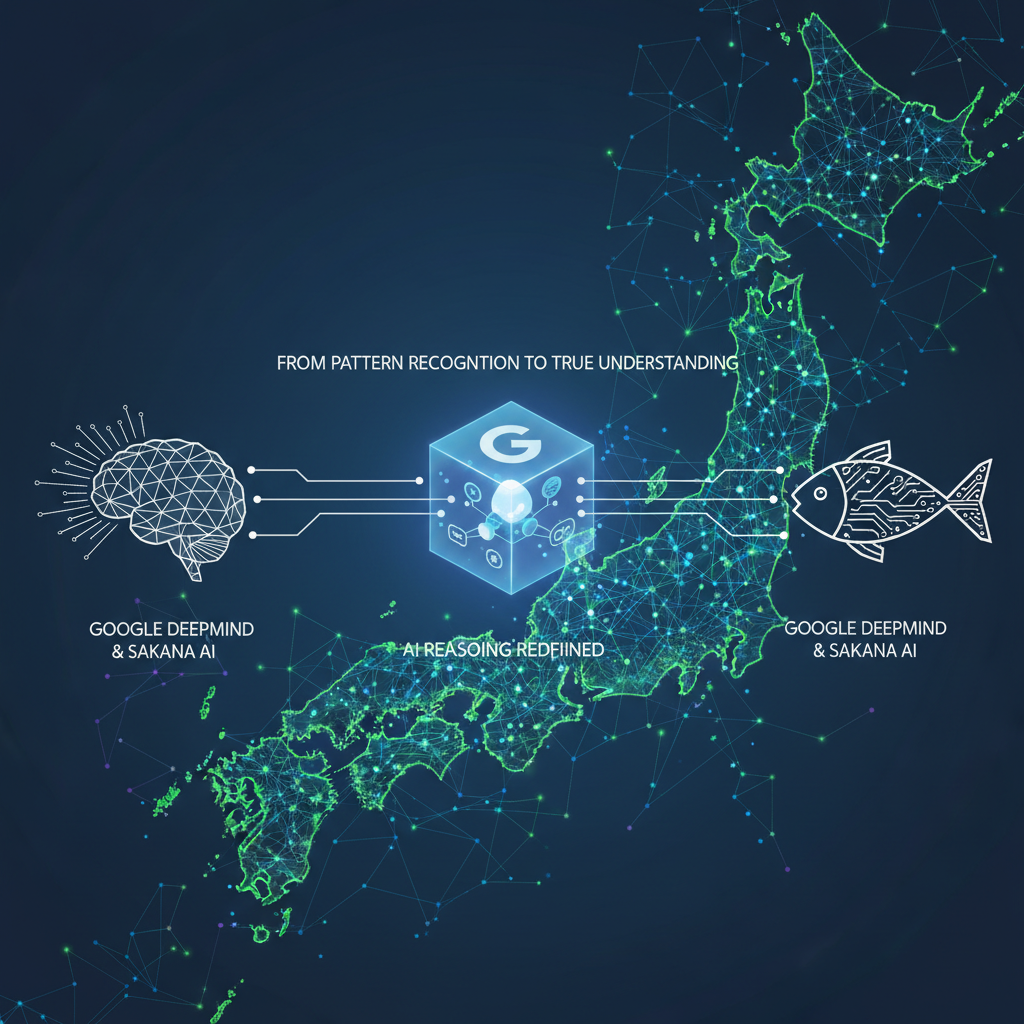
Today, we are witnessing the maturation of architectures designed to move beyond this purely associative learning. Companies like Google DeepMind, with its continued exploration into reinforcement learning and agentic systems, and newer entrants such as Tokyo-based Sakana AI, are at the forefront of this evolution. Their work is not merely about making models larger or training them on more data; it is about fundamentally altering how these systems process information and arrive at conclusions. Consider the leap from a system that can identify a cat in a picture to one that can understand the concept of 'catness' in a broader, abstract sense, including its biological function, its cultural significance, and its interactions within an ecosystem. This is the chasm that these new reasoning architectures seek to bridge.
Data points underscore this shift. Research papers appearing on platforms like arXiv increasingly detail hybrid models combining neural networks with symbolic reasoning, or architectures explicitly designed for planning and causal inference. Google DeepMind's recent work on 'AlphaGeometry', for instance, demonstrated an AI system capable of solving complex geometry problems at a level comparable to human Olympiad gold medalists. This was not achieved through brute-force pattern matching on existing solutions, but through a combination of a neural language model for generating constructions and a symbolic deduction engine for formal proofs. The engineering is remarkable, illustrating a synergistic approach that leverages the strengths of both data-driven and rule-based methods.
In Japan, a nation that has been quietly building a legacy of precision engineering and robotics, the implications of this shift are particularly profound. Our manufacturing sector, renowned for its meticulous processes and high-quality output, stands to gain immensely from AI that can not only optimize existing workflows but also reason about novel production challenges or design innovative materials. "The ability of AI to move from mere prediction to genuine understanding of underlying physical principles will unlock unprecedented levels of automation and discovery in fields like advanced materials and drug design," states Dr. Hiroaki Kitano, CEO of Sony AI and a leading figure in the field of systems biology and AI. "This is not just about efficiency; it is about accelerating scientific progress itself." His perspective highlights the transformative potential beyond simple optimization.
Another compelling example comes from Sakana AI, a Tokyo-based startup co-founded by Dr. David Ha, formerly of Google Brain. Sakana AI is exploring 'evolutionary AI' and 'foundation models for agents', aiming to create AI that can adapt and evolve in complex environments, much like biological organisms. Their approach emphasizes the development of AI systems that can learn to learn, a meta-cognitive capability that moves far beyond static pattern recognition. This is akin to teaching a child not just to memorize facts, but to develop critical thinking skills. "Our focus is on building AI that can discover new algorithms and architectures autonomously, rather than relying solely on human-designed frameworks," Dr. Ha explained in a recent interview. "This capacity for self-improvement and emergent intelligence is what will truly differentiate the next generation of AI." This vision aligns perfectly with Japan's long-standing dedication to continuous improvement, or kaizen.
However, this paradigm shift is not without its challenges. Developing architectures that can truly reason requires not only innovative algorithms but also new ways of evaluating AI performance. Traditional metrics like accuracy on classification tasks may no longer suffice. We need benchmarks that assess understanding, causal inference, and abstract problem-solving. Furthermore, the interpretability of these more complex reasoning systems becomes an even greater concern. If an AI can solve a problem but cannot explain how it arrived at the solution, its utility in critical applications, such as medical diagnosis or legal reasoning, remains limited. Precision matters, not just in the outcome, but in the clarity of the process.
Experts from various sectors echo this sentiment of cautious optimism. Dr. Fei-Fei Li, co-director of Stanford University's Human-Centered AI Institute, consistently emphasizes the need for AI to augment human intelligence rather than merely automate tasks. "The goal should be to build AI that can collaborate with humans, offering insights and explanations that empower our own reasoning, not replace it entirely," she remarked at a recent AI ethics conference. Her words serve as a crucial reminder that the ultimate purpose of these advanced systems must remain centered on human benefit and understanding. The integration of these new reasoning capabilities into practical applications will require careful consideration of ethical implications and societal impact.
My verdict is clear: this trend is far from a fad. It represents a fundamental, necessary evolution in the field of artificial intelligence. While the journey from pattern matching to true understanding is long and fraught with technical hurdles, the foundational work being done by entities like Google DeepMind and Sakana AI is laying the groundwork for a new generation of intelligent systems. These systems will not merely process data; they will interpret, infer, and innovate, bringing us closer to the long-held dream of artificial general intelligence. The shift will manifest in more robust autonomous systems, more insightful scientific discovery tools, and ultimately, AI that can engage with the world in a more nuanced and context-aware manner. Japan, with its deep-rooted culture of innovation and meticulous engineering, is uniquely positioned to both contribute to and benefit from this profound transformation, ensuring that precision matters at every step of this exciting new frontier. The future of AI will not just be about what it knows, but how it knows.