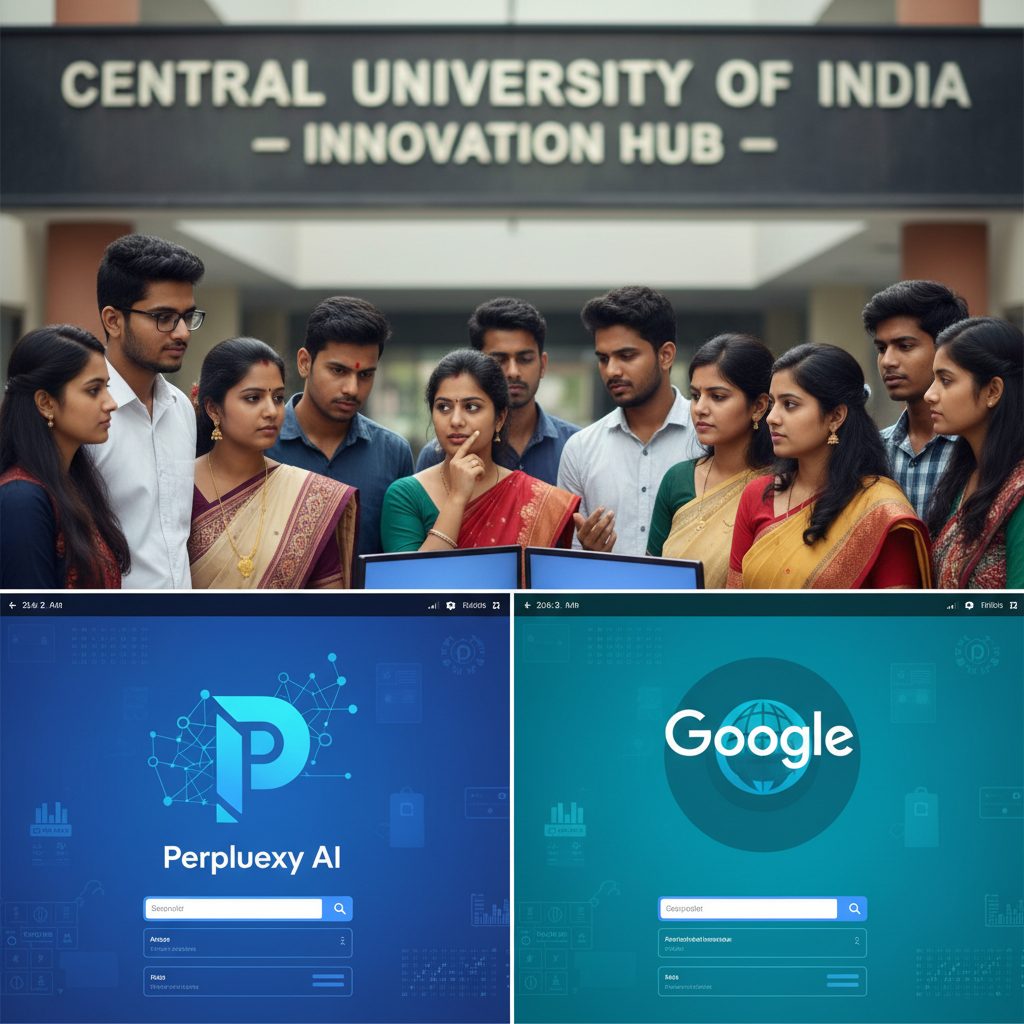

Let's be honest, for years, 'Google it' wasn't just a phrase, it was a reflex. It was the digital equivalent of asking your wise old auntie for advice, only with more algorithms and less unsolicited commentary on your marital status. But now, there's a new kid on the block, or rather, a rather intelligent upstart named Perplexity AI, which has reportedly soared to a $3 billion valuation. And suddenly, everyone is asking: Is this the beginning of the end for Google's search dominance, especially in markets like India?
Oh, the irony. For decades, we've been fed information in bite-sized, link-laden pieces, often sifting through pages of SEO-optimized fluff to find a single, coherent answer. Then along comes Perplexity, promising to give you a direct, cited answer, like a well-behaved student who actually read the textbook. It's a breath of fresh air, particularly for those of us who grew up with the cacophony of information and misinformation that the internet so generously provides.
Perplexity AI, founded by Aravind Srinivas, a name that resonates with many in India's tech diaspora, has been making waves. Srinivas, an alumnus of IIT Madras, knows a thing or two about complex problem solving. His vision for Perplexity is simple yet audacious: to provide accurate, up-to-date answers with sources, rather than just a list of links. It's like having a highly efficient research assistant who doesn't charge by the hour and never gets distracted by cat videos. This approach has clearly struck a chord with investors, including luminaries like Jeff Bezos and NVIDIA, who see the potential for a paradigm shift in how we access information. The company's recent funding rounds have pushed its valuation into the billions, a clear signal that the market is hungry for alternatives to the traditional search model.
Now, let's talk about India, a land where the internet is both a lifeline and a labyrinth. With hundreds of millions of internet users, and that number growing exponentially, the way information is consumed here is unique. Data is cheap, smartphones are ubiquitous, and the hunger for knowledge, entertainment, and connection is insatiable. Google has held a near-monopoly on search for so long that its name is practically a verb in every Indian language. Can Perplexity truly challenge that?
Consider the sheer scale. India's digital landscape is a vibrant, chaotic tapestry. From bustling metropolitan hubs like Bengaluru and Mumbai to the remotest villages where connectivity is still a luxury, the internet serves a myriad of purposes. For many, search isn't just about finding facts, it's about finding opportunities, connecting with government services, learning new skills, or even just figuring out the best recipe for sambar. The nuanced understanding of local context, language, and cultural references is paramount. This is where Google, with its decades of data and localized algorithms, has an undeniable edge.
However, Perplexity's approach might just be what the doctor ordered for a segment of the Indian user base. Imagine a student in a tier-two city, trying to research a complex engineering concept. Instead of wading through pages of potentially misleading or outdated information, they get a concise, sourced answer. This could be transformative for education, a sector that is constantly seeking efficient and reliable information dissemination. As Dr. Ritu Sharma, a professor of Computer Science at Delhi University, recently noted, “For academic research and fact-checking, a tool like Perplexity could be invaluable. It reduces the cognitive load and streamlines the information gathering process, something our students desperately need.”
But let's not get ahead of ourselves. The journey from a $3 billion valuation to widespread adoption in a market as diverse and demanding as India is fraught with challenges. Google's ecosystem is deeply entrenched, from Android phones to Chrome browsers, and its services are often bundled. Breaking that habit, that muscle memory of 'just Google it,' will require more than just a better search experience. It will require a fundamental shift in user behavior, something that rarely happens overnight.
Moreover, the question of language support is critical. While Perplexity is excellent in English, India is a land of over 22 official languages and countless dialects. For true mass adoption, it needs to be equally proficient in Hindi, Tamil, Bengali, Marathi, and many others. This is a monumental task, one that even Google has been working on for years, with varying degrees of success. The quality of AI-generated answers in regional languages needs to be impeccable, otherwise, it risks alienating a huge swathe of potential users. The nuances of Indian languages, the cultural specificities, and the sheer volume of data required to train these models effectively are staggering. It's not just about translation, it's about true linguistic and cultural understanding.
Another point to ponder is the business model. Perplexity offers a free tier and a Pro subscription. In a market where many users are accustomed to free services, convincing them to pay for a premium search experience will be an uphill battle. While the value proposition for professionals and researchers is clear, the average Indian internet user might be harder to sway. They might ask, and rightly so, why they should pay for something they've been getting for free, even if the free version is arguably less efficient. This is where the rubber meets the road, as they say.
This isn't just a tech story, it's a story about information access, about digital literacy, and about the future of knowledge itself. Will Perplexity AI become the trusted digital guru for the next generation of Indians, or will it remain a niche tool for the tech-savvy elite? The answer, like many things in India, is likely somewhere in the middle, a complex blend of adoption, adaptation, and perhaps a bit of good old-fashioned competition.
File this under 'things that make you go hmm.' The idea that a single company could disrupt Google's iron grip on search is tantalizing. It speaks to the relentless innovation within the AI space, where yesterday's research project is today's multi-billion dollar challenger. As TechCrunch often reports, the AI startup scene is a whirlwind of breakthroughs and bold ambitions, and Perplexity is certainly one of its shining stars.
For India, the rise of Perplexity AI could mean more than just a new search engine. It could mean a push for higher quality information, a greater emphasis on source verification, and potentially, a more equitable distribution of knowledge. Imagine a future where critical information, from health advisories to agricultural techniques, is instantly verifiable and easily accessible, without the need to navigate a maze of sponsored content and clickbait. That, my friends, would be a true revolution.
However, the path is not without its potholes. The challenge for Perplexity, and indeed for any AI company hoping to make a mark in India, will be to understand the diverse needs of its users, to localize its offerings effectively, and to build trust in a landscape where trust is often hard-won. It's a marathon, not a sprint, and Google isn't going to roll over easily. The search giant has its own formidable AI capabilities, including its Gemini models, and deep pockets to invest in further localization and innovation. The battle for the Indian search market is far from over, and it promises to be a fascinating one to watch. For more insights into the broader implications of AI on information access, you might want to read about Brazil's Digital Mirror: When Regulators Demand Transparency From OpenAI, Google, and Meta [blocked], which touches on similar themes of transparency and regulation.
Ultimately, whether Perplexity AI manages to carve out a significant slice of the Indian market will depend on its ability to offer not just better answers, but a better overall experience that resonates with the unique digital pulse of the nation. It's a tall order, but then again, who doesn't love a good underdog story, especially when it involves a homegrown talent taking on a global behemoth?