
AI's Promise for Jaffna's Economy: Bridging the Digital Divide in the North
AI integration holds immense potential for economic revival in Sri Lanka's Northern Province, particularly Jaffna, but requires targeted investment and inclusive policy to truly benefit all communities, especially the Tamil populace.
Click play to listen to this article read aloud using text-to-speech.
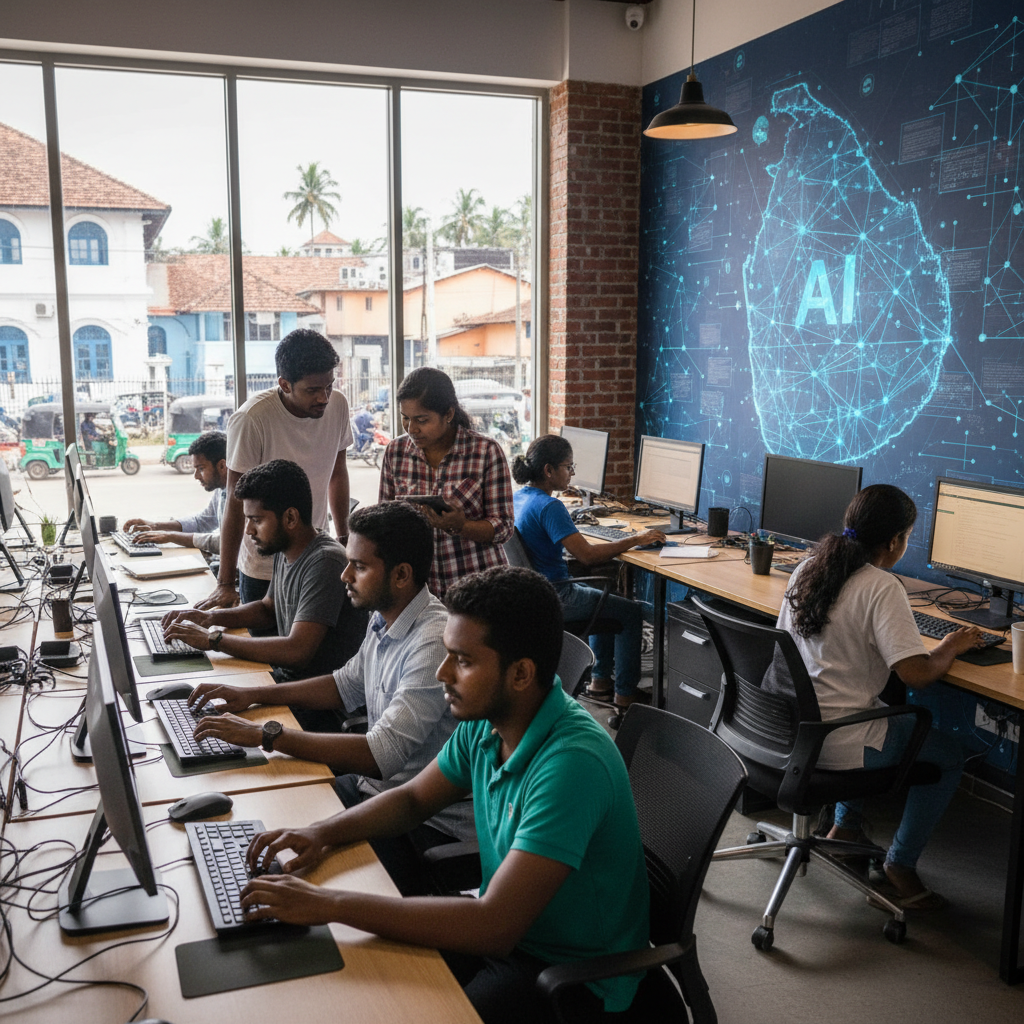

JAFFNA – The burgeoning global interest in Artificial Intelligence (AI) is increasingly finding resonance in Sri Lanka, with policymakers and industry leaders recognizing its potential to catalyze economic transformation. However, for a reporter like myself, deeply rooted in the experiences of the Sri Lankan Tamil community, the critical question remains: how will this technological wave truly benefit regions like the Northern Province, particularly Jaffna, which has long grappled with post-conflict economic disparities?
Recent discussions at the 'Digital Sri Lanka 2026' summit in Colombo highlighted AI's role in boosting productivity and creating new industries. While the focus often leans towards the Western Province's tech hubs, Dr. K. Thilagarajan, an economist and senior lecturer at the University of Jaffna, emphasizes the unique opportunities for the North. "AI-driven precision agriculture, for instance, could revolutionize our traditional farming practices, optimizing yields and reducing waste for our vayal (paddy fields) and thottam (gardens) in the Vanni and Jaffna peninsula," Dr. Thilagarajan stated in an exclusive interview. "But this requires not just technology transfer, but also culturally sensitive training modules and access to capital for our farmers, many of whom are still recovering from decades of conflict."
The challenge, as always, lies in equitable implementation. While initiatives like the 'IT-BPM Northern Province Development Project' have made strides in digital literacy, the leap to AI adoption demands more sophisticated infrastructure and skills. The lack of robust, affordable high-speed internet in many rural areas of the North remains a significant impediment. Furthermore, the absence of Tamil language datasets for AI model training could inadvertently lead to solutions that are less effective or even biased against the local context.
Mr. S. Mahendran, a software entrepreneur from Nallur who recently launched an AI-powered logistics platform for local fisheries, shared his perspective. "We're seeing a slow but steady growth in tech startups here, often driven by diaspora investments. However, attracting top AI talent to Jaffna, or even retaining local graduates, is tough without a supportive ecosystem. Government incentives, perhaps through the Northern Provincial Council, specifically for AI research and development in Tamil-speaking regions, could be a game-changer." He pointed to the potential for AI in preserving and digitizing Tamil literary heritage, a rich but often overlooked area.
The Central Bank of Sri Lanka's recent report on 'Digital Economy Growth Drivers' acknowledged the need for regional inclusivity. Yet, concrete policy frameworks that address the specific socio-economic realities and linguistic needs of the Tamil community in AI development are still nascent. For AI to be a true engine of economic growth in Jaffna and beyond, it must be built on foundations of accessibility, local relevance, and a genuine understanding of the community's aspirations and historical challenges. Otherwise, the digital divide, rather than narrowing, risks widening into an 'AI chasm'.
Related Articles

AI in the Diwan: Bridging Generations and Preserving Heritage in Jordan
 Hamzà Al-Khalìl
AI's Gentle Touch: Revolutionizing Maternal Healthcare in Vietnam
 Ngo Thi Huừngé
AI's Cultural Canvas: Kerala's Kalamkari Artisans Embrace Digital Weave
 Priyà Nairé
AI Revolutionizes Rural Healthcare in Punjab: A New Dawn for 'Pind' Clinics
 Arjùn Sharmà