
AI's Cultural Canvas: Kerala's Kalamkari Artisans Embrace Digital Weave
In a groundbreaking initiative, AI is revitalizing traditional Kalamkari art in Kerala, empowering women artisans and bridging ancient techniques with digital innovation. This fusion promises a global stage for South Indian heritage.
Click play to listen to this article read aloud using text-to-speech.
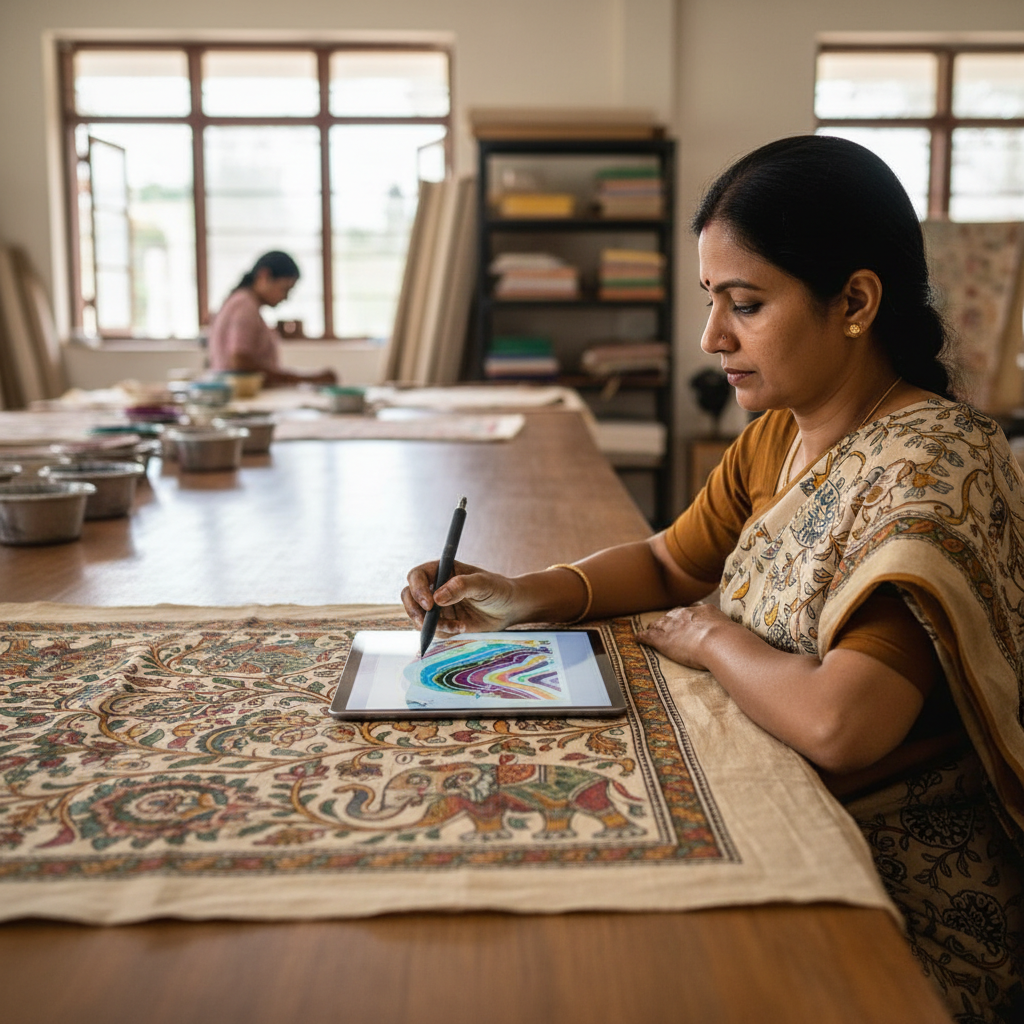

KOCHI, KERALA – The vibrant hues of Kalamkari, a traditional hand-painted or block-printed cotton textile art, are finding a new canvas: the digital realm, thanks to an innovative AI-driven project spearheaded by the Kerala State Handicrafts Development Corporation (KSHDC). This initiative, deeply resonant with the cultural fabric of South India, aims to empower women artisans, particularly those from marginalized communities, by integrating ancient craft with cutting-edge technology.
For generations, the intricate narratives of Kalamkari, often depicting mythological tales and flora, have been passed down through families, predominantly by women. However, market access and design innovation have remained persistent challenges. "Our mothers and grandmothers have kept this art alive with their nimble fingers and rich imaginations," explains Smt. Lakshmi Devi, a master Kalamkari artisan from Palakkad, her voice reflecting both pride and a hint of past struggle. "But reaching new patrons, understanding modern aesthetics – it's been difficult. This AI, it feels like a guiding hand, not a replacement."
The 'KalamAI' project, developed in collaboration with the Indian Institute of Information Technology and Management-Kerala (IIITM-K), utilizes machine learning algorithms to analyze vast datasets of traditional Kalamkari motifs, color palettes, and thematic elements. It then generates novel design suggestions, optimizes production patterns, and even helps artisans visualize their creations on different products, from saris to home decor. "The goal is not to automate the art, but to augment the artisan," states Dr. Anjali Menon, a lead researcher at IIITM-K, emphasizing the project's ethical framework. "We're providing tools for faster iteration, broader design exploration, and better market responsiveness, all while preserving the authenticity of the craft."
This cultural confluence is particularly significant for Kerala, a state renowned for its matriarchal heritage and vibrant arts scene. The KSHDC reports that over 70% of the artisans currently benefiting from KalamAI are women, many of whom are now able to manage their production more efficiently and access e-commerce platforms with greater ease. "The digital literacy component of this project is as crucial as the AI itself," notes Priyadarshini Rao, a cultural economist specializing in South Asian heritage, based in Chennai. "It's not just about technology; it's about empowering women economically and culturally, enabling them to be custodians and innovators of their own heritage in the global marketplace."
The success of KalamAI is sparking conversations across India about how AI can serve as a bridge between tradition and modernity, particularly in preserving and promoting indigenous arts. As the world increasingly values unique, handmade products, this Kerala initiative offers a compelling blueprint for how technology, when wielded with cultural sensitivity and a deep understanding of local contexts, can enrich lives and elevate heritage on a global stage. The intricate patterns of Kalamkari are now not just painted on fabric, but woven into the very future of digital cultural preservation.
Related Articles
AI in the Diwan: Bridging Generations and Preserving Heritage in Jordan
 Hamzà Al-Khalìl
AI's Gentle Touch: Revolutionizing Maternal Healthcare in Vietnam
 Ngo Thi Huừngé
AI Revolutionizes Rural Healthcare in Punjab: A New Dawn for 'Pind' Clinics
 Arjùn Sharmà
AI's Linguistic Embrace: Safeguarding Icelandic in the Digital Age
 Sigríður Björnsdóttìr