
AI's New Frontier: Preserving Thai Cultural Heritage in the Digital Age
Thailand is leveraging advanced AI to digitize and preserve its rich cultural heritage, from ancient texts to traditional performing arts, ensuring these treasures endure for future generations amidst rapid modernization.
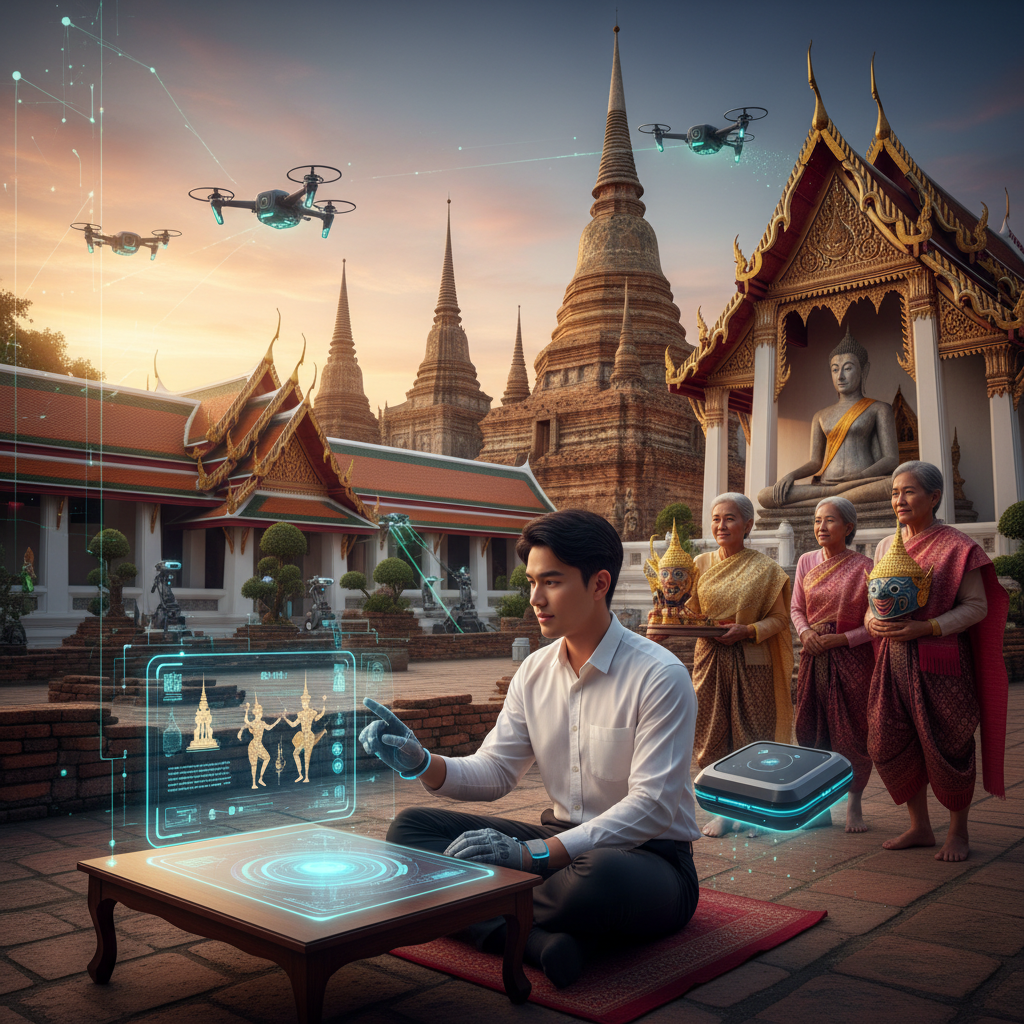

Bangkok, Thailand – As the Kingdom of Thailand hurtles into the digital future, a quiet revolution is underway to safeguard its invaluable past. Spearheaded by institutions like the Ministry of Culture and the National Digital ID (NDID) initiative, artificial intelligence is emerging as a crucial ally in preserving and promoting Thai cultural heritage, a topic close to the heart of every chai Thai (Thai man) who cherishes our roots.
The project, often dubbed 'Digital Wattanatham' (Digital Culture), focuses on using AI for high-fidelity digitization, linguistic analysis of ancient scripts, and even the reconstruction of traditional music and dance forms. "Our heritage is not just about old temples; it's about the living traditions, the wai kru ceremonies, the intricate patterns of pha sin (traditional skirts), and the nuanced storytelling of likay (folk theatre)," explains Dr. Anan Suttipong, Director of the Thai Cultural Digitalization Institute, an arm of the Ministry of Culture. "AI allows us to capture these ephemeral elements with unprecedented detail."
One significant application involves optical character recognition (OCR) for ancient palm-leaf manuscripts and stone inscriptions, many written in obscure scripts like Khom or Lanna. Traditional methods of transcription are painstakingly slow and prone to human error. "With advanced deep learning models, we can now process these texts much faster, making them accessible to scholars and the public," Dr. Anan elaborates. "This is vital for understanding our historical narratives and the wisdom passed down through generations of puyai (elders)."
Beyond texts, AI is also being deployed in the realm of performing arts. Researchers at Chulalongkorn University, in collaboration with the Department of Fine Arts, are developing AI models that can analyze and even simulate traditional Thai dance movements and musical compositions. By feeding vast datasets of performances by master artists, these systems can help document and teach the precise nuances of classical khon (masked dance-drama) or the intricate melodies of piphat ensembles.
"For a chai Thai, the continuity of our traditions is a source of immense pride and identity," says Professor Somsak Panyaroj, a cultural anthropologist specializing in Thai social structures. "The younger generation, often engrossed in global digital trends, might find these AI-powered cultural portals more engaging. It's about bridging the gap, making our heritage cool and accessible, rather than a dusty relic."
However, challenges remain. Ensuring data accuracy, addressing potential biases in AI algorithms, and securing adequate funding are ongoing concerns. The government's 'Thailand 4.0' vision, with its emphasis on digital transformation, provides a strong impetus, but the human element – the expertise of cultural custodians and the passion of the prachachon (people) – remains irreplaceable. As Thailand embraces AI, it does so with a clear understanding that technology is a tool to serve, not supplant, the soul of its vibrant culture.
Related Articles
AI's Silk Road: Preserving Uzbek Cultural Heritage Through Digital Innovation
 Bintà Yusupovà
AI's Economic Dawn: Malaysian Women Entrepreneurs Embrace Digital Transformation
 Siti Nurhalizah Rahimàn
Pakistani Women Entrepreneurs Embrace AI for Business Growth, Bridging Digital Divide
 Khalidà Sultàn
Tajikistan Navigates AI's Geopolitical Currents Amidst Regional Digital Push
 Ismaìlè Rahimovì