
AI's Green Promise: Nigerian Tech Tackles Environmental Decay in the Niger Delta
Nigerian innovators are deploying AI to combat environmental degradation in the Niger Delta, offering a beacon of hope against oil spills and climate change impacts. This localized tech approach is championed by experts as a vital step for regional sustainability.
Click play to listen to this article read aloud using text-to-speech.
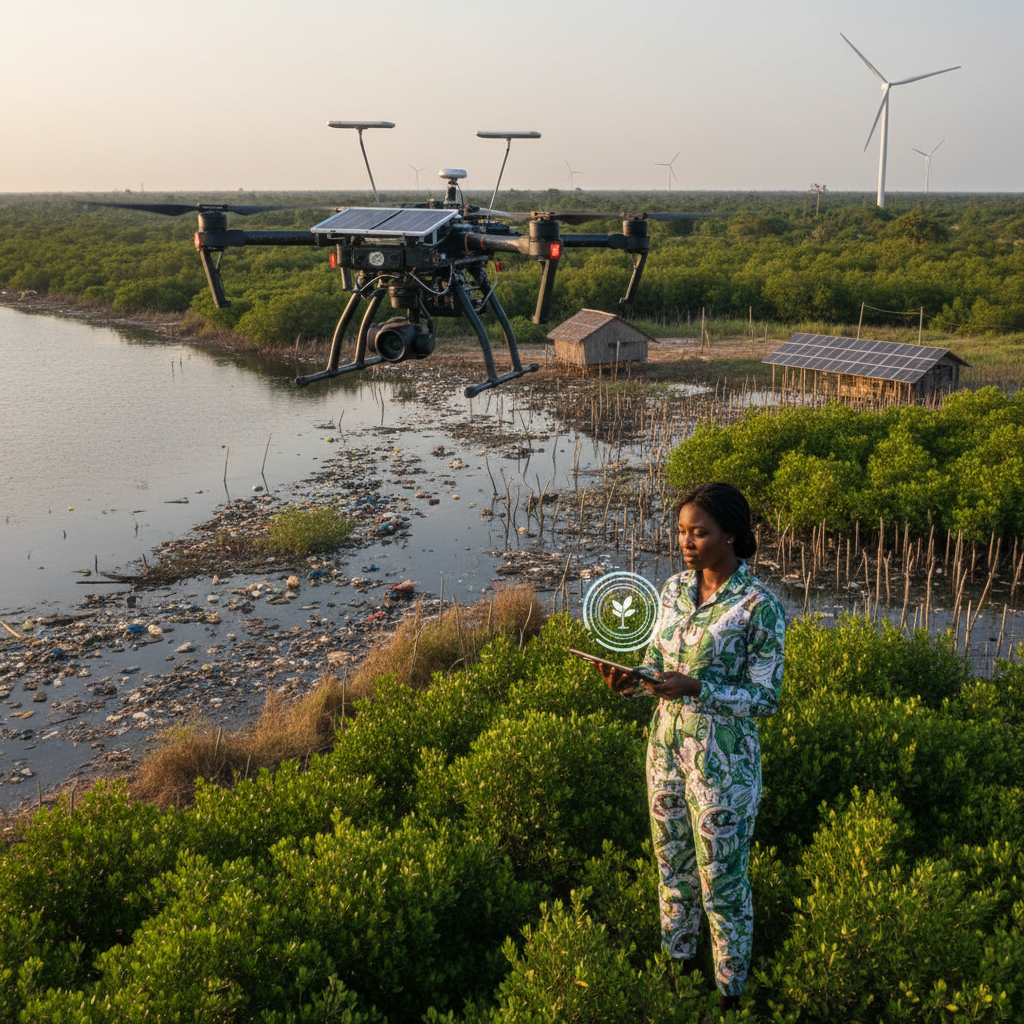

PORT HARCOURT, RIVERS STATE – The rhythmic pulse of life in the Niger Delta, long threatened by the twin scourges of oil pollution and climate change, is finding a new ally in artificial intelligence. From the bustling tech hubs of Lagos to the academic halls of Nsukka, Nigerian ingenuity is being harnessed to bring forth solutions that are not just cutting-edge, but deeply rooted in local realities.
Driving this green revolution is a growing consortium of startups and research institutions. One such pioneer is 'DeltaWatch AI,' a Port Harcourt-based firm that has developed an AI-powered satellite imagery analysis system. This system, according to its CEO, Dr. Nnamdi Okoro, an environmental data scientist and an alumnus of the University of Port Harcourt, can detect oil spills with unprecedented accuracy and speed. "Before now, monitoring spills was a laborious, often dangerous task, relying on eyewitness accounts or delayed aerial surveys," Dr. Okoro explained during a recent press briefing. "Our AI sifts through vast datasets, identifying anomalies that indicate spills almost in real-time, allowing for quicker response and mitigation. This is about reclaiming our environment, our heritage."
The initiative has garnered significant attention from both federal and state governments. Mrs. Chinwe Eze, Director-General of the National Environmental Standards and Regulations Enforcement Agency (NESREA), lauded these efforts. "The integration of AI into our environmental surveillance framework is a game-changer," she stated in an exclusive interview. "It enhances our enforcement capabilities, making polluters accountable and protecting the livelihoods of our people, especially those in the riverine communities whose existence is intertwined with the health of the delta."
Beyond spill detection, AI is also being explored for climate change adaptation. Researchers at the African University of Science and Technology (AUST) in Abuja are developing predictive models using machine learning to forecast extreme weather events, such as flooding and erosion, which are becoming more frequent in coastal regions. Professor Emeka Nwosu, a lead researcher in AI for sustainable development at AUST, emphasized the cultural significance. "Our traditional knowledge systems have always guided us in understanding our environment. AI provides a modern tool to augment this wisdom, helping us prepare and protect our ancestral lands and resources. It's about preserving 'ala' (land) for future generations, just as our forefathers would have wanted."
However, challenges remain. The high cost of deploying advanced AI infrastructure, coupled with the need for specialized technical expertise, means that widespread adoption is still a journey. Internet connectivity in remote areas also poses a hurdle. Yet, the momentum is undeniable. With increased investment from both public and private sectors, and a strong emphasis on local capacity building, Nigeria is poised to leverage AI not just for economic growth, but for the ecological restoration of its most vital natural assets. The future of the Niger Delta, it seems, might just be coded in algorithms.
Related Articles

Ghana's AI Leap: Local Startups Drive Innovation, Address Ethical Concerns
 Kwamé Asantè
AI-Powered Reforestation: Costa Rica's Green Future Takes Root
 Carlòs Ramirèz
AI's Green Promise: Ndebele Women Lead Climate Resilience in Matabeleland
 Zinhlée Khumàlo
AI's Healing Touch: Burkina Faso Explores Digital Diagnostics for Rural Health
 Youssoufaù Traoré