
AI's Dual Edge: Opportunity and Peril for Indigenous Entrepreneurs in Guatemala
Artificial intelligence presents both transformative business opportunities and significant ethical challenges for Indigenous communities in Guatemala, particularly concerning data sovereignty and cultural preservation. Experts urge a culturally sensitive approach to AI development.
Click play to listen to this article read aloud using text-to-speech.
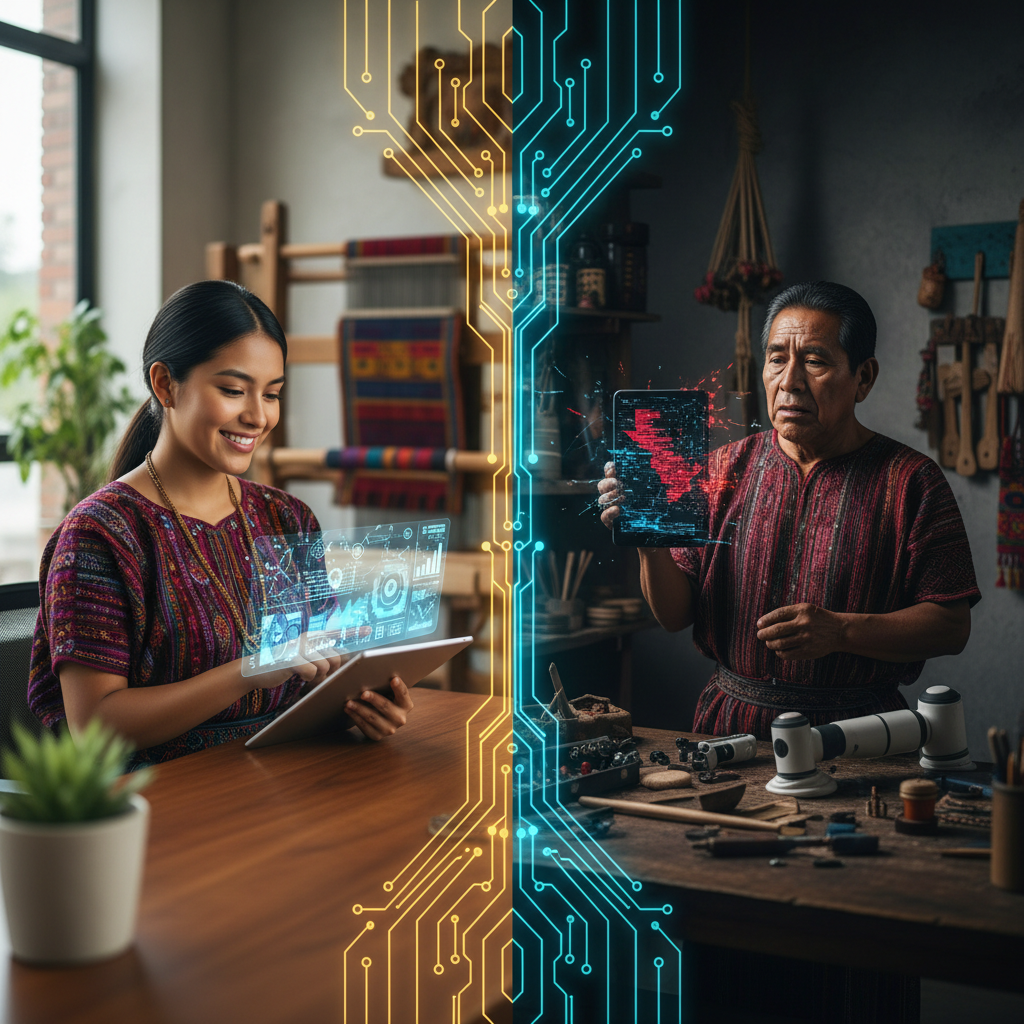

GUATEMALA CITY – The burgeoning landscape of Artificial Intelligence (AI) is casting a long shadow, both promising and complex, over Guatemala's vibrant Indigenous entrepreneurial ecosystem. While global discourse often centers on Silicon Valley innovations, here in the heart of the Corazón del Mundo Maya, the conversation is nuanced, deeply rooted in ancestral wisdom and the imperative of self-determination.
For many Ixchel (Mayan women) entrepreneurs, AI offers unprecedented tools for market access, efficiency, and cultural preservation. "Imagine an AI that helps artisans connect directly with international buyers, bypassing intermediaries and ensuring fair prices for our tejidos (weavings) or cerámica (pottery)," muses Doña Elena Ajpu, a respected K'iche' textile artist and founder of 'Manos Mayas Digitales,' a collective empowering Indigenous women through e-commerce. "Or an AI that translates ancient Mayan texts, making our history accessible to new generations, ensuring our cosmovisión (worldview) endures."
However, the promise is tempered by profound concerns. The issue of data sovereignty, or uk'u'x tzij (the heart of the word/data), is paramount. Who owns the data generated from Indigenous knowledge, art, and language? How can we prevent the digital appropriation of cultural heritage? "Without robust legal frameworks and community-led data governance models, AI could inadvertently become a tool for further exploitation, not empowerment," warns Dr. Ximena Chay, a leading expert in Indigenous technology ethics at the Universidad del Valle de Guatemala. "We must ensure that the algorithms are not trained on biased datasets that perpetuate stereotypes or misrepresent our communities. The spirit of Raxalaj Mayab' (the green Mayan land and people) must be respected in the digital realm."
Earlier this month, the Ministry of Economy, in collaboration with the Consejo de Pueblos Mayas (Council of Mayan Peoples), launched a pilot program, 'Tecnología con Rostro Maya,' aimed at developing AI tools tailored to Indigenous business needs. The initiative focuses on natural language processing for Mayan languages and AI-driven market analysis for traditional products. "This is a crucial first step," states Lic. Miguel Ixquiac, head of the program. "Our goal is to co-create AI solutions that respect Nawal (spiritual essence) and community protocols, ensuring that the benefits flow directly to the communities, not just external corporations."
Yet, challenges remain. Access to reliable internet infrastructure, digital literacy, and funding for Indigenous-led tech ventures are significant hurdles. The digital divide, or ch'ak'oj k'ak'al (the cutting of the digital path), disproportionately affects rural Indigenous communities. As AI continues its rapid ascent, the imperative for Guatemala is clear: to harness its power while safeguarding the cultural integrity and economic autonomy of its original peoples. The future of AI in the Tierra del Quetzal must be built on principles of equity, respect, and self-determination, ensuring that technology serves the people, not the other way around.
Related Articles

Bridging the Digital Divide: AI's Promise for HBCUs in the Age of Intelligent Learning
 Dontè Jacksoneè
Belgian SMEs Grapple with AI Adoption: A Call for Pragmatic Digitalisation
 Michèl Lambertè
Pakistani Women Entrepreneurs Harness AI for Economic Empowerment
 Khalidà Sultàn
Algorithmic Bias in AI: A New Frontier for Civil Rights in North America
Dontè Jacksoneè