
AI in Kimono: Bridging Tradition and Tech for Japan's Aging Workforce
Japan is exploring AI-powered solutions to support its aging female workforce, particularly in traditional crafts and caregiving, aiming to preserve cultural heritage while embracing digital transformation. This initiative seeks to empower *josei* in vital sectors.
Click play to listen to this article read aloud using text-to-speech.
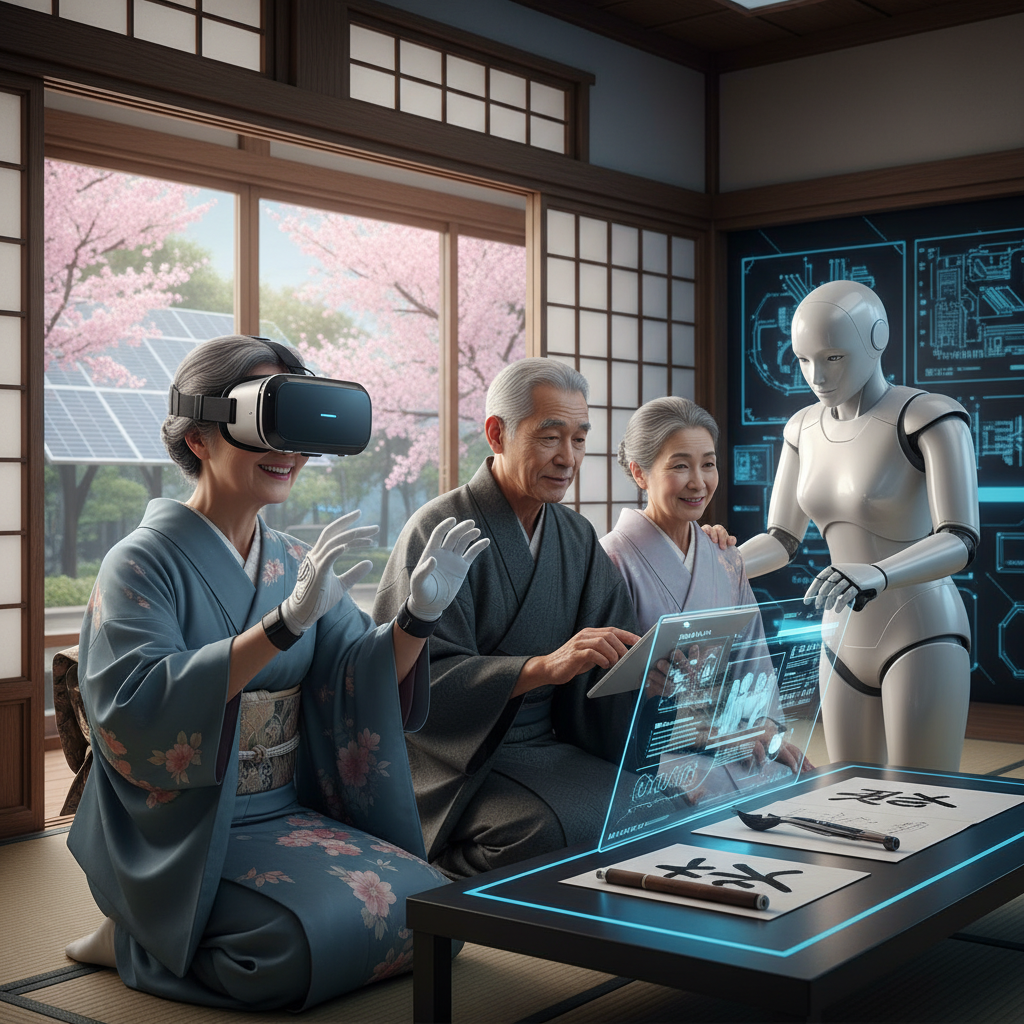

TOKYO – As Japan grapples with an unprecedented demographic shift, the integration of Artificial Intelligence (AI) into sectors traditionally reliant on human expertise, especially those dominated by josei (women), is becoming a critical national priority. The latest initiative, dubbed 'AI in Kimono,' seeks to leverage advanced AI to support and empower Japan's aging female workforce, particularly in areas like traditional crafts, hospitality, and caregiving.
Historically, Japanese women have been the custodians of many cultural traditions, from intricate textile arts like kimono weaving to the meticulous service standards of omotenashi. However, with a rapidly aging population, the transfer of these invaluable skills to younger generations is a growing concern. "Our obaa-san (grandmothers) hold a wealth of knowledge that is irreplaceable," states Dr. Akari Sato, a leading researcher at the National Institute of Advanced Industrial Science and Technology (AIST), specializing in human-AI collaboration. "AI can serve as a digital apprentice, documenting techniques, offering real-time assistance, and even training new artisans, ensuring these traditions don't vanish."
One pilot program, recently launched in Kyoto, focuses on Nishijin-ori (Nishijin weaving). Elderly female weavers are using AI-powered cameras and sensors to record their precise hand movements and techniques. This data is then fed into a generative AI model that can simulate weaving patterns and even provide holographic guidance to apprentices. "It's like having a master weaver always by your side, even when she's resting," comments Ms. Emi Tanaka, a 78-year-old Nishijin-ori artisan, through a translator. "It makes me feel that my life's work will continue."
Beyond traditional crafts, the 'AI in Kimono' initiative also targets the burgeoning caregiving sector, where josei form the backbone of the workforce. The Ministry of Health, Labour and Welfare (MHLW) is exploring AI tools for remote patient monitoring and personalized care plans, aiming to reduce the physical and emotional burden on caregivers. "The goal is not to replace human empathy, but to augment it," explains Ms. Yoko Suzuki, a senior official at the MHLW's Digital Transformation Bureau. "AI can handle routine tasks, allowing our dedicated caregivers to focus on the human connection, which is paramount in Japanese care philosophy, or kaigo."
Critics, however, raise concerns about data privacy and the potential for technological unemployment, particularly among older workers who may struggle with digital literacy. Dr. Sato acknowledges these challenges: "It's crucial that these AI solutions are developed with a human-centric design, prioritizing ease of use and providing comprehensive training. We must ensure that AI serves to enhance human dignity and preserve our cultural fabric, not erode it."
As Japan continues to navigate its unique demographic landscape, the 'AI in Kimono' initiative stands as a testament to the nation's innovative spirit, striving to merge cutting-edge technology with profound cultural respect, ensuring that the wisdom and contributions of its josei continue to flourish for generations to come.
Related Articles

AI in Healthcare: A New Dawn for Sri Lanka's Northern and Eastern Provinces
 Ravi Chandrasekharàn
Uzbek Women Lead AI Ethics Dialogue: Safeguarding Cultural Values in Digital Transformation
 Bintà Yusupovà
AI-Powered Mangrove Conservation: A 'Hijau Digital' Leap for Malaysia's Coastlines
 Siti Nurhalizah Rahimàn
NEOM's AI Ambitions: A New Horizon for Saudi Manpower and Digital Economy
 Barakà Al-Rashíd