
AI in Italian Schools: A Human-Centric Revolution or Digital Delusion?
Italy grapples with integrating AI into its hallowed educational institutions, balancing technological advancement with the preservation of humanistic values. Experts debate the future of learning in the digital age.
Click play to listen to this article read aloud using text-to-speech.
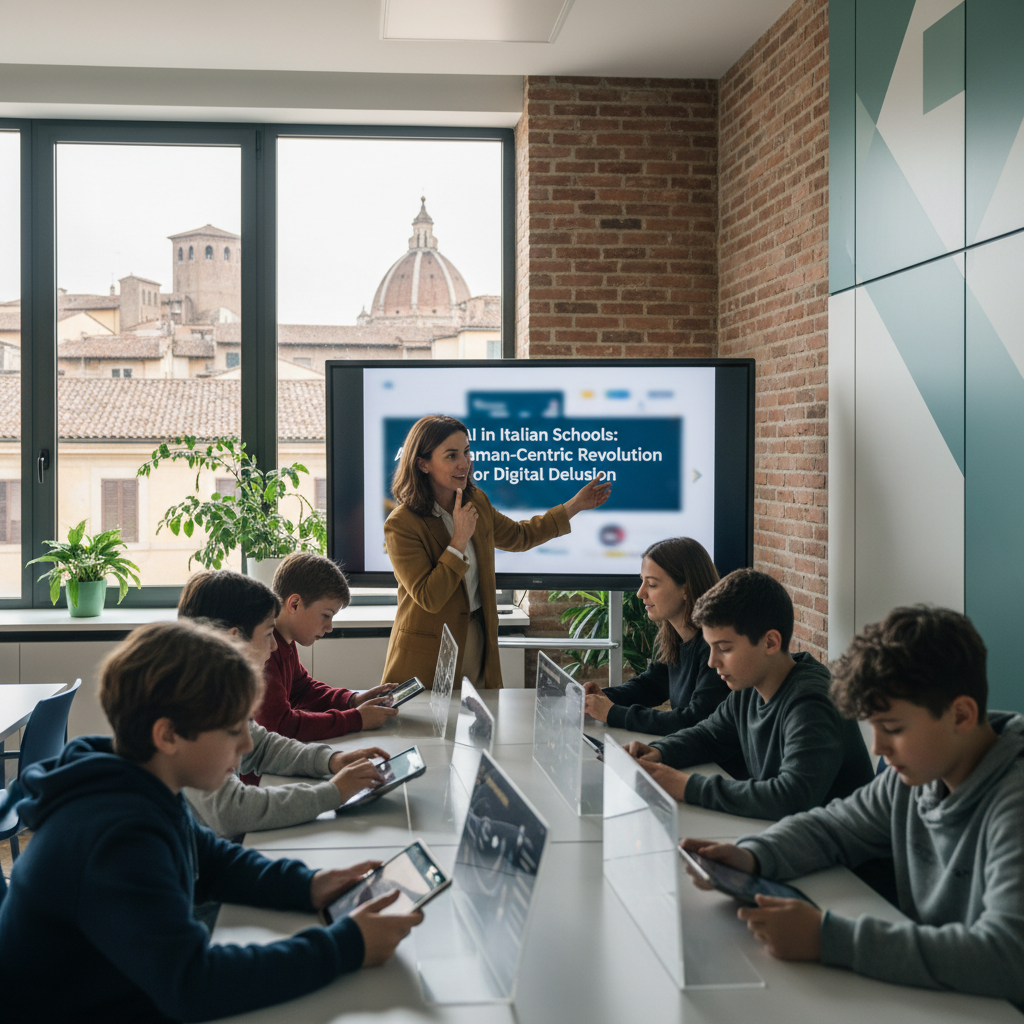
ROME, Italy – The hallowed halls of Italian education, long bastions of classical learning and humanistic tradition, are now echoing with the complex algorithms of Artificial Intelligence. As Europe, and indeed the world, hurtles towards a digitally-driven future, Italy finds itself at a crucial crossroads: how to embrace AI in its schools without sacrificing the very essence of its pedagogical heritage.
The Ministry of Education and Merit, under the watchful eye of Minister Valditara, recently unveiled a pilot program, 'Scuola Futura AI,' aimed at introducing generative AI tools into select licei and istituti tecnici across the peninsula. The initiative, while lauded by some as a necessary step to prepare the next generation for the global workforce, has also ignited a passionate debate among educators, parents, and cultural commentators.
“La nostra identità non può essere diluita dall’algoritmo,” declared Professor Enrico Rossi, a distinguished scholar of pedagogy from the Università di Bologna, during a recent symposium in Florence. “Our identity cannot be diluted by the algorithm. While AI offers powerful tools for personalized learning and administrative efficiency, we must ensure it serves as a strumento, a tool, not a replacement for the profound human interaction that defines true education. The maestro must remain at the heart of the classroom.”
This sentiment resonates deeply with the Italian psyche, where the personal touch, the rapporto umano, is considered paramount. The fear is not just about job displacement for teachers, but a more existential concern: the erosion of critical thinking, creativity, and the nuanced understanding that comes from direct human mentorship.
Dr. Sofia Moretti, a leading expert in educational technology at the Politecnico di Milano, offers a more optimistic, yet cautious, perspective. “We are not suggesting replacing teachers with robots, per carità! Instead, imagine AI as a sophisticated assistant, capable of tailoring learning paths for students with specific needs, identifying learning gaps, or even generating complex simulations for scientific experiments. This frees up the teacher to focus on higher-order thinking, ethical discussions, and fostering that uniquely human spark of curiosity.”
The 'Scuola Futura AI' program is currently monitoring its initial phase, focusing on teacher training and ethical guidelines. The goal is to develop a uniquely Italian model, one that leverages technological prowess while safeguarding the rich tapestry of human interaction and cultural values that have shaped generations. The challenge, as always in this beautiful, complex nation, lies in finding that delicate equilibrio – the perfect balance between tradition and innovation, between the wisdom of the past and the promise of the future. Only time will tell if Italy can truly master this digital arte.
Related Articles

AI Revolutionizes Portuguese Football: Benfica Leads the Charge with Data Analytics
 Luís Ferreiràs
AI's Linguistic Embrace: Safeguarding Icelandic in the Digital Age
 Sigríður Björnsdóttìr
Bridging the Digital Divide: AI's Promise for HBCUs in the Age of Intelligent Learning
 Dontè Jacksoneè
Belgian SMEs Grapple with AI Adoption: A Call for Pragmatic Digitalisation
 Michèl Lambertè