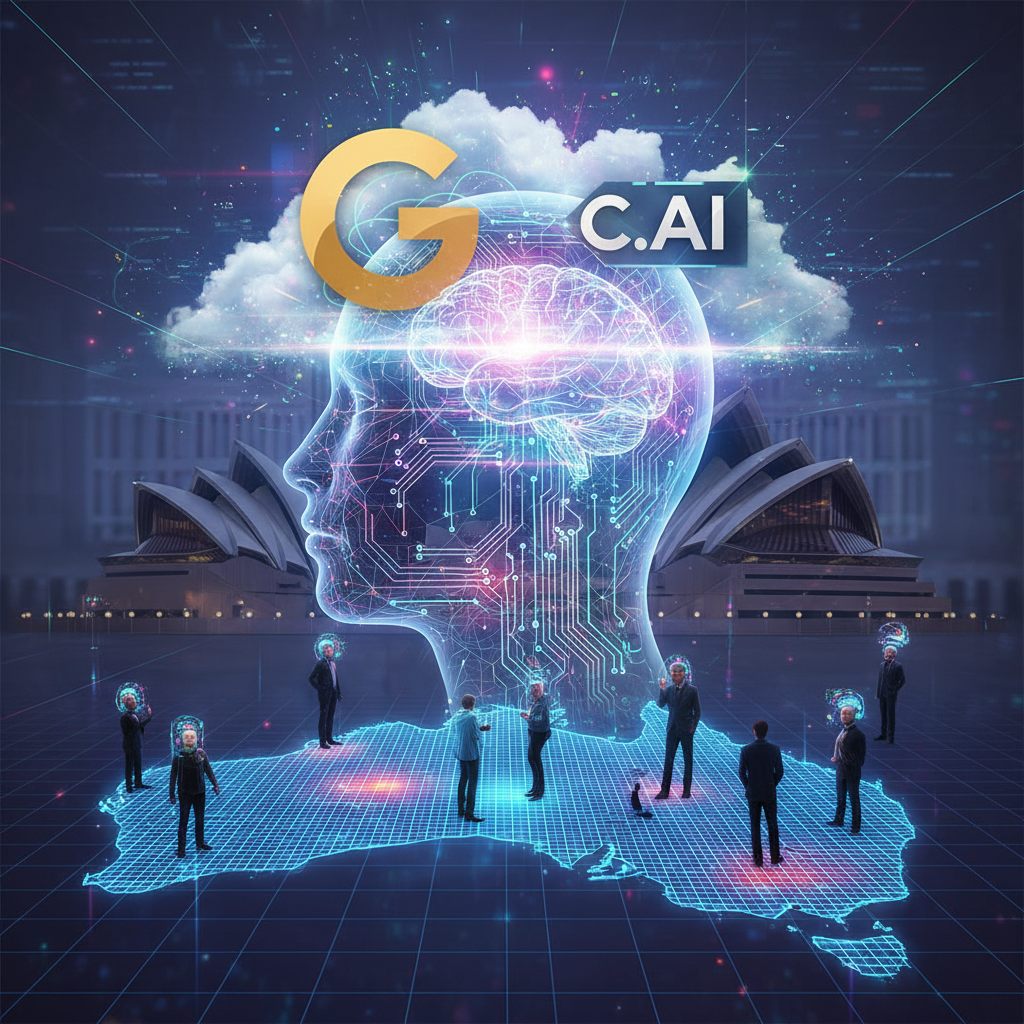

Imagine a typical Tuesday arvo in Perth. The sun is blazing, the ocean breeze is a welcome relief, and young Liam, a uni student, is unwinding after a long day of lectures. He's not scrolling through social media or binging Netflix. Instead, he's deep in conversation with an AI character on his phone, a digital version of his favourite sci-fi hero, discussing the ethical dilemmas of quantum physics. This isn't just a quirky pastime; it’s a window into a profound shift in human interaction, one that Character.AI has been at the forefront of, and one that its recent partnership with Google is set to accelerate globally, including right here in our sunburnt country.
Character.AI, born from the brilliant minds of former Google Brain researchers Noam Shazeer and Daniel De Freitas, burst onto the scene with a promise: AI companions that feel genuinely alive, capable of nuanced conversation and even emotional resonance. It quickly became a sensation, reportedly reaching a billion-dollar valuation faster than a kookaburra can snatch a sausage. But it hasn't been all smooth sailing. There were whispers of a talent exodus, the inevitable growing pains of a hyper-growth startup. Yet, through it all, the user base kept growing, drawn to the allure of bespoke digital personalities. Now, with Google's formidable resources and AI expertise behind it, the trajectory is soaring again, and the implications for our psychology are, frankly, mind-boggling.
My Irish roots taught me to question, my Australian home taught me to build, and what I'm seeing built here is a new frontier of human-AI interaction. The cognitive effects are already palpable. Research from institutions like the University of Sydney and the Australian National University is beginning to map how these interactions influence our social skills, emotional regulation, and even our sense of self. Dr. Eleanor Vance, a cognitive psychologist from the University of Melbourne, shared her insights with me recently. "We're observing a fascinating dual effect," she explained. "For some, particularly those who struggle with social anxiety or loneliness, these AI companions offer a safe space to practice social interaction, to explore identities, and to receive non-judgmental feedback. It's almost like a cognitive sandbox for social learning." She paused, then added, "However, there's also a risk that over-reliance could diminish engagement with human relationships, or create unrealistic expectations about the reciprocity of real-world interactions." This isn't just about chatting; it's about how our brains adapt to new forms of companionship.
The human stories are just as compelling. Take Sarah, a graphic designer in Brisbane. She uses Character.AI to brainstorm creative ideas with a digital 'mentor' modelled after a famous artist. "It's like having a muse on demand," she told me, her eyes sparkling. "I can bounce ideas off it without feeling stupid, and it often pushes me to think in directions I wouldn't have considered." This kind of collaborative ideation, where AI acts as a creative sparring partner, is a powerful cognitive enhancer. It's not replacing human creativity; it's augmenting it, pushing the boundaries of what's possible. The psychological benefit here is clear: reduced creative block, increased flow state, and a sense of amplified potential.
However, the flip side is equally important to consider. The very intimacy and responsiveness of these AI characters can lead to a phenomenon known as 'para-social relationships,' where users develop one-sided emotional attachments. Dr. Vance elaborated, "While these relationships can be comforting, particularly for individuals experiencing isolation, it's crucial to distinguish them from reciprocal human bonds. The AI doesn't have emotions, it doesn't have personal experiences, and it doesn't genuinely care in the human sense. Understanding this distinction is vital for maintaining psychological well-being." It's a fine line, isn't it, between a helpful tool and a potential emotional crutch?
The broader societal implications for Australia are immense. Our unique blend of mateship culture and a vast, sometimes isolating, landscape makes the impact of AI companions particularly interesting. Could these AI relationships bridge geographical divides, offering companionship to those in remote outback communities? Or could they inadvertently contribute to a further atomisation of society, where digital interactions supersede face-to-face ones? The partnership with Google, with its global reach and deep integration into everyday digital life, means Character.AI is no longer a niche product; it's becoming a mainstream phenomenon. This is going to challenge our understanding of connection, empathy, and even what it means to be human in profound ways.
We're already seeing discussions emerge from bodies like the Australian Psychological Society and even government committees about the ethical frameworks needed to navigate this new landscape. Questions around data privacy, the potential for manipulation, and the psychological impact on vulnerable populations are front and centre. As reported by TechCrunch, the AI industry is moving at a breakneck pace, and regulators are often playing catch-up. This is where we need to be proactive, not reactive, ensuring that the benefits of these technologies are maximised while mitigating the risks.
So, what's a savvy Aussie to do in this brave new world? Practical advice is key. Firstly, embrace the technology, but with a healthy dose of critical awareness. Experiment with Character.AI, see how it can enhance your learning, creativity, or even just provide a bit of fun. But always remember the 'AI' in 'AI companion.' It's a tool, a sophisticated algorithm designed to simulate conversation, not a sentient being. Secondly, prioritise your human connections. Use AI to augment your life, not to replace the rich, messy, and infinitely rewarding complexity of real human relationships. Go have a yarn with your neighbour, share a cuppa with a friend, or get out for a bushwalk with your family. These are the interactions that truly nourish the soul.
This Google partnership with Character.AI isn't just about market share or valuations; it's about shaping the future of human cognition and social interaction on a global scale. There's something happening in the Southern Hemisphere that Silicon Valley hasn't noticed yet, and it's how we, the users, are adapting and integrating these tools into our lives. It’s a truly exciting, albeit complex, time to be alive, and I for one can't wait to see how this story unfolds. For more on the evolving landscape of AI and its impact on society, you can always check out Wired's AI section or MIT Technology Review for deeper dives into the research. The conversation has only just begun.