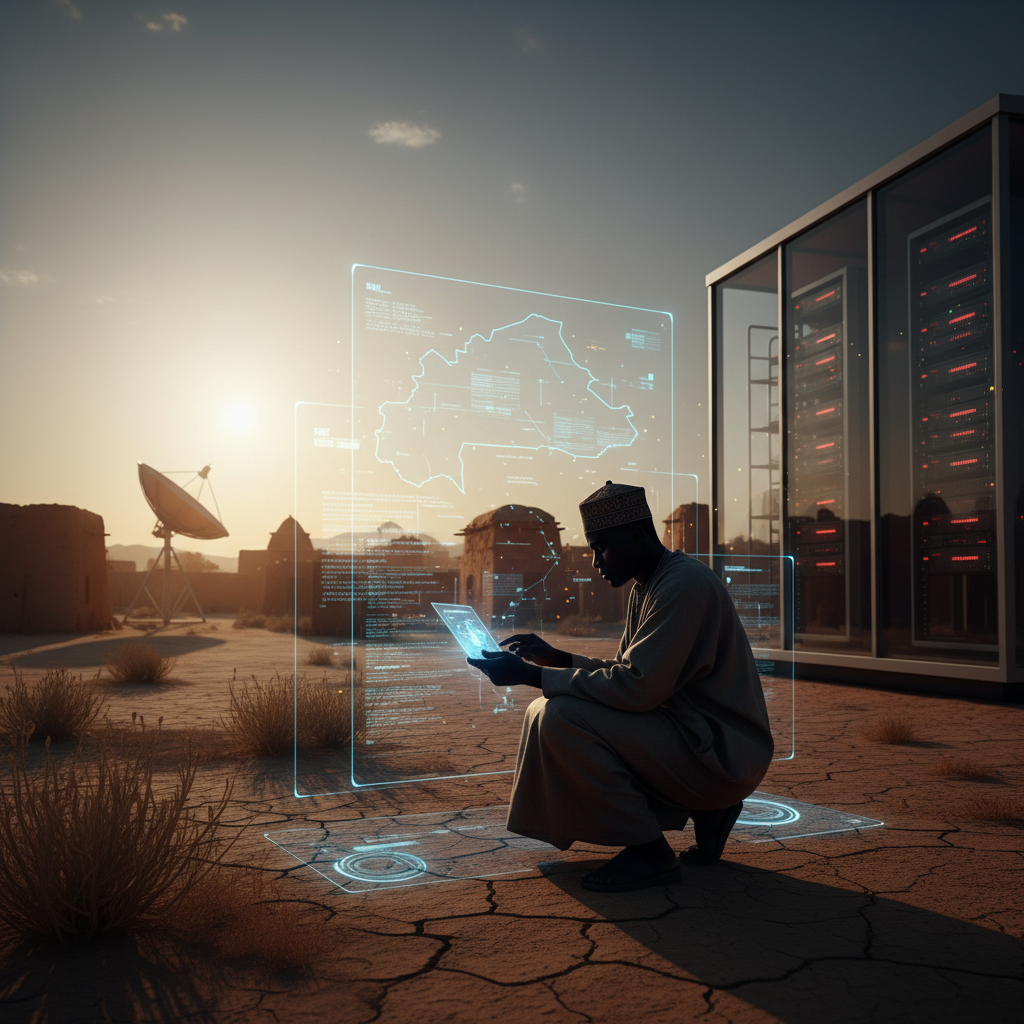
In the bustling market of Ouagadougou, where the scent of grilled brochettes mixes with the chatter of a thousand negotiations, the idea of a 'human-free business' feels as alien as a snowstorm in July. Yet, across the globe, the drumbeat for fully automated companies grows louder. From Silicon Valley to Shenzhen, the narrative is clear: remove human error, reduce costs, scale infinitely. But here in Burkina Faso, a country where every transaction, every service, every interaction often carries the weight of personal relationships and community ties, we must ask: what exactly are we automating away, and at what cost?
The global trend is undeniable. Companies like Amazon and Alibaba have long pushed for automation in logistics and customer service. Now, with advanced AI, the vision extends to entire operational chains, from manufacturing to sales, all orchestrated by algorithms. OpenAI's latest models, for instance, are powering sophisticated customer support bots that can handle complex queries, while NVIDIA's hardware underpins the computing power for these vast, self-managing systems. The promise is a lean, hyper-efficient enterprise, churning out profits with minimal human intervention. According to a recent report by Reuters Technology, investments in AI-driven automation solutions surged by 45% globally in the last year alone, reaching an estimated $120 billion.
But let us not confuse a global trend with a universal solution. The reality on the ground in Burkina Faso is far more nuanced. Our economy, still largely informal, thrives on human capital and social networks. A small shop owner in Bobo-Dioulasso doesn't just sell goods; they are a community hub, a source of information, sometimes even an informal lender. Can an algorithm replicate that trust, that flexibility, that deep understanding of local needs and customs? I doubt it.
Consider the agricultural sector, the backbone of our economy. While AI is making strides in precision farming, helping farmers optimize yields and manage resources, the idea of a fully automated farm, devoid of human hands, is not just impractical but culturally jarring. Our farmers are not just laborers; they are custodians of the land, inheritors of generations of knowledge. Their decisions are informed by the seasons, the soil, and the wisdom passed down from their elders, not just data points on a dashboard. "We see the potential of AI to assist our farmers, to provide better weather forecasts or disease detection," explains Dr. Aminata Traoré, Director of Agricultural Innovation at the Ministry of Agriculture in Ouagadougou. "But to replace the farmer? That is a misunderstanding of our agriculture, our culture, and our very way of life. The human element, the 'griot' of the land, is irreplaceable."
The cybersecurity implications of human-free businesses are also a growing concern. As companies become more automated, their digital attack surface expands. A single vulnerability in an AI system could expose an entire operation. For a nation like Burkina Faso, with nascent digital infrastructure and limited cybersecurity expertise, this presents a significant risk. If a fully automated supply chain were to be compromised, the economic disruption could be catastrophic. "The more we rely on automated systems, the more critical robust cybersecurity becomes," states Captain Oumar Diallo, head of the National Agency for Information Systems Security (anssi) in Burkina Faso. "A 'human-free' system is not 'risk-free.' In fact, it often consolidates risk into fewer, more complex points of failure that require highly specialized human oversight to protect."
We've seen how quickly digital systems can be exploited. Just last year, a regional banking system, which had begun automating many of its customer service and transaction verification processes, suffered a sophisticated ransomware attack. While no customer funds were lost, the system was down for three days, causing widespread panic and significant economic losses for small businesses unable to process payments. The recovery effort required a team of over 50 human experts working around the clock, highlighting that even in automated systems, human intervention remains crucial when things go wrong. This incident underscores the critical need for human intelligence in cybersecurity, a topic often discussed by experts at Ars Technica when analyzing AI's role in security.
Furthermore, the social contract in many African nations is built on employment. High unemployment rates are already a challenge. Introducing widespread human-free businesses could exacerbate this, leading to social unrest and deepening inequalities. While proponents argue that new, higher-skilled jobs will emerge to manage these automated systems, the transition is rarely smooth or equitable. The digital divide, both in access and skills, remains a formidable barrier. "The promise of automation creating new jobs is often a distant one for communities that lack basic digital literacy, let alone advanced AI engineering skills," observes Ms. Fatoumata Koné, a development economist based in Dakar. "We must prioritize inclusive growth, not just technological advancement for its own sake. Otherwise, we risk creating a new form of digital colonialism, where the benefits accrue elsewhere."
Forget the hype, this is what matters: the human element. Our local context demands solutions that empower people, not displace them. While AI offers incredible tools for progress, its deployment must be guided by a deep understanding of local realities. We need AI that enhances human capabilities, that supports our small businesses, that helps our farmers, and that strengthens our communities, not AI that seeks to render them obsolete. The path forward for Burkina Faso, and indeed much of Africa, is not about eliminating humans from the equation, but about intelligently integrating technology to uplift them.
Here's what actually happened in the global conversation: the focus on 'human-free' often ignores the profound social and economic implications for developing nations. While a fully automated factory might thrive in a highly industrialized economy, it could dismantle the social fabric of a community here. We need to build our own digital future, one that reflects our values and priorities. This means investing in education, developing local AI talent, and fostering innovations that are culturally appropriate and economically sustainable. The goal should be human-centric AI, not human-free business models. The wisdom of our elders, the resilience of our people, and the vibrancy of our markets are assets that no algorithm can fully replicate or replace. We must ensure that as the world races towards automation, we do not lose sight of what truly makes us human, and what truly makes our societies function. The future of business in Burkina Faso will always have a human heart. For further reading on the challenges of AI adoption in developing countries, you might find this article on Dakar's tech dreams [blocked] insightful.