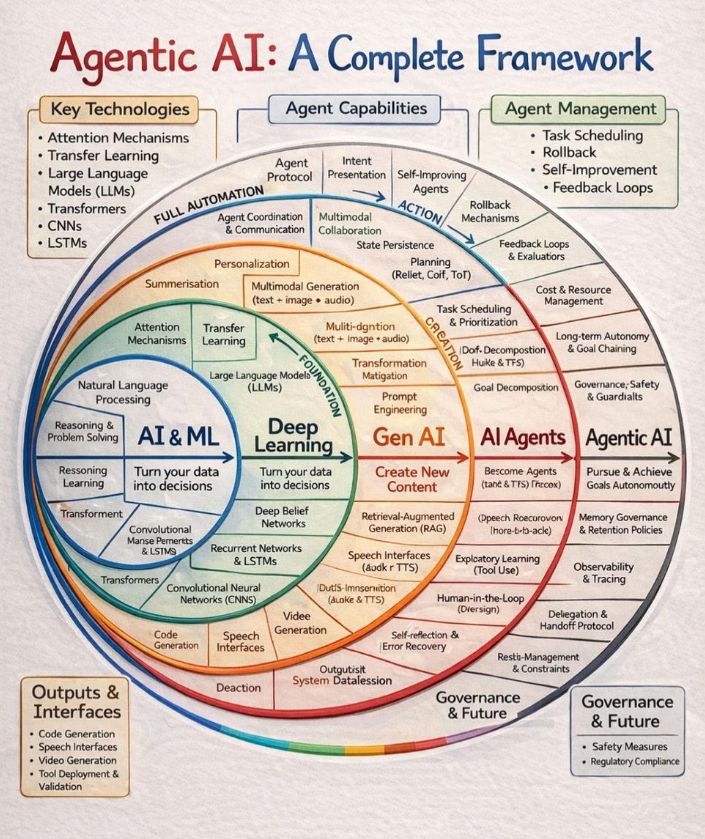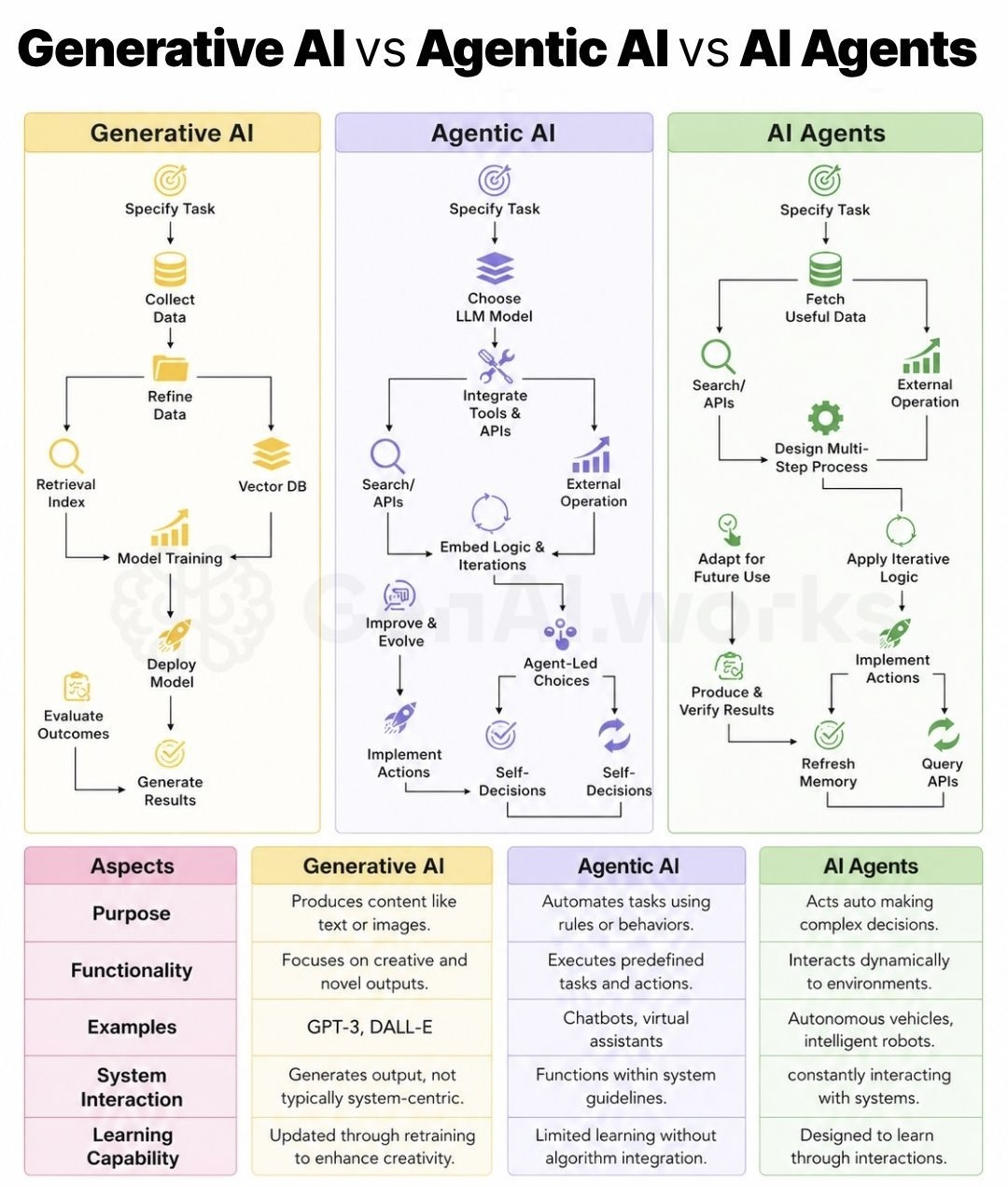

Generative AI, Agentic AI, and AI Agents are often used as if they mean the same thing.
They do not.
The difference becomes easier to understand when you look at what the system is actually allowed to do. Not what model it uses. Not what benchmark it scores on. What it is permitted to do inside a real workflow, with real data, in a real environment.
That distinction matters more than most technical comparisons, because it determines what you can actually build with each one.
The First Layer: Generative AI
At this level, the system is primarily built to create an output.
Text. Images. Code. Audio. Video. Summaries. Recommendations.
A user provides an instruction, the system uses a model and available context, then it produces a result. This is the foundation behind many AI features we use today.
A writing tool drafts content. An image model produces a visual. A coding assistant writes a function. A customer support tool suggests a reply.
The main value here is the quality of the generated output.
The system can produce something useful, but it is usually not responsible for managing the full process. It completes the request. It does not necessarily decide the next step.
Think of it as a highly capable craftsperson. You hand them a brief, they deliver a finished piece. But they do not go looking for the brief themselves. They do not decide whether the piece needs revisions. They do not ship it to the client. They produce, and then they wait.
This is not a limitation in the pejorative sense. It is a design boundary. And for a very large number of use cases, it is exactly the right boundary. You do not need your image generator to also manage your content calendar. You need it to produce an excellent image when asked.
The Second Layer: Agentic AI
Agentic AI begins when the system moves beyond simple generation.
Now it can select tools, call APIs, apply rules, run several steps, evaluate intermediate results, and adjust its path toward a goal. This is where AI starts to look less like a feature and more like an execution layer.
The system is not only responding. It is coordinating work.
For example: it can search for missing information. It can compare possible options. It can call an external system. It can apply business logic. It can retry after failure. It can decide what should happen next. It can return a completed outcome.
Generative AI produces the result. Agentic AI manages the steps that lead to the result.
It may still work inside strict limits, but it has more control over how the task is completed.
The practical difference shows up quickly. A generative system can write a market research summary if you give it the data. An agentic system can go find the data, decide which sources are relevant, pull the numbers, structure the analysis, and then write the summary. The output might look the same. The process behind it is fundamentally different.
This is also where most enterprise adoption is happening right now. Companies are not just asking AI to generate content. They are asking it to handle multi-step workflows: process an invoice, verify the details, flag anomalies, route approvals, and update the ledger. That sequence of decisions and actions is what makes it agentic.
The Third Layer: AI Agents
An AI agent becomes more interesting when it can operate inside a real environment over time.
It is not only producing content or following a fixed workflow. It can observe context, fetch the right data, make decisions, take actions, verify outcomes, update memory, and adapt based on what happens.
At this point, the system starts to behave more like a role inside a business process.
A sales agent can research accounts, prepare outreach, update CRM records, and schedule follow-ups. A support agent can read tickets, check order data, resolve common issues, and escalate complex cases. A research agent can monitor publications, extract findings, cross-reference with internal data, and surface insights without being asked.
The value is no longer just the generated answer. The value is the ability to work across tools, data, decisions, and actions.
What separates an AI agent from agentic AI is persistence and environmental awareness. An agentic system executes a workflow and finishes. An agent maintains state. It remembers what happened last time. It knows what changed since its last action. It can be interrupted, redirected, and resumed. It operates less like a script and more like a colleague who happens to be software.
Why the Distinction Matters in Practice
The reason this matters is not academic. It is architectural.
If you are building a product and you treat these three layers as interchangeable, you will either over-engineer a simple generation task or under-engineer a system that needs real agency. Both mistakes are expensive.
A chatbot that answers customer questions does not need to be an agent. It needs to be a well-tuned generative system with good retrieval. Adding agentic capabilities to it adds complexity, latency, and failure modes without adding proportional value.
Conversely, a system that manages procurement workflows across multiple vendors, currencies, and compliance regimes cannot be built as a simple generation layer. It needs to plan, execute, verify, and adapt. Trying to force that into a prompt-and-response pattern will break in ways that are difficult to debug and expensive to maintain.
The right question is not which layer is best. It is which layer matches the actual requirements of the task.
The Boundaries Are Moving
One more thing worth noting: these layers are not static. The boundary between generative AI and agentic AI is shifting as models become more capable of tool use and multi-step reasoning. The boundary between agentic AI and AI agents is shifting as memory systems, environment integrations, and feedback loops become more reliable.
What was an agent-level capability two years ago might be a standard agentic feature today. What requires a full agent framework now might be handled by a single model call in eighteen months.
But the conceptual distinction remains useful. Because even as the technology evolves, the question stays the same: what is this system allowed to do?
If it creates content, it is probably generative AI.
If it can plan and execute a sequence of steps, it is moving toward agentic AI.
If it can work across tools, memory, data, permissions, and actions over time, it starts to behave like an AI agent.
Understanding where your use case sits on that spectrum is the first real design decision. Everything else follows from it.