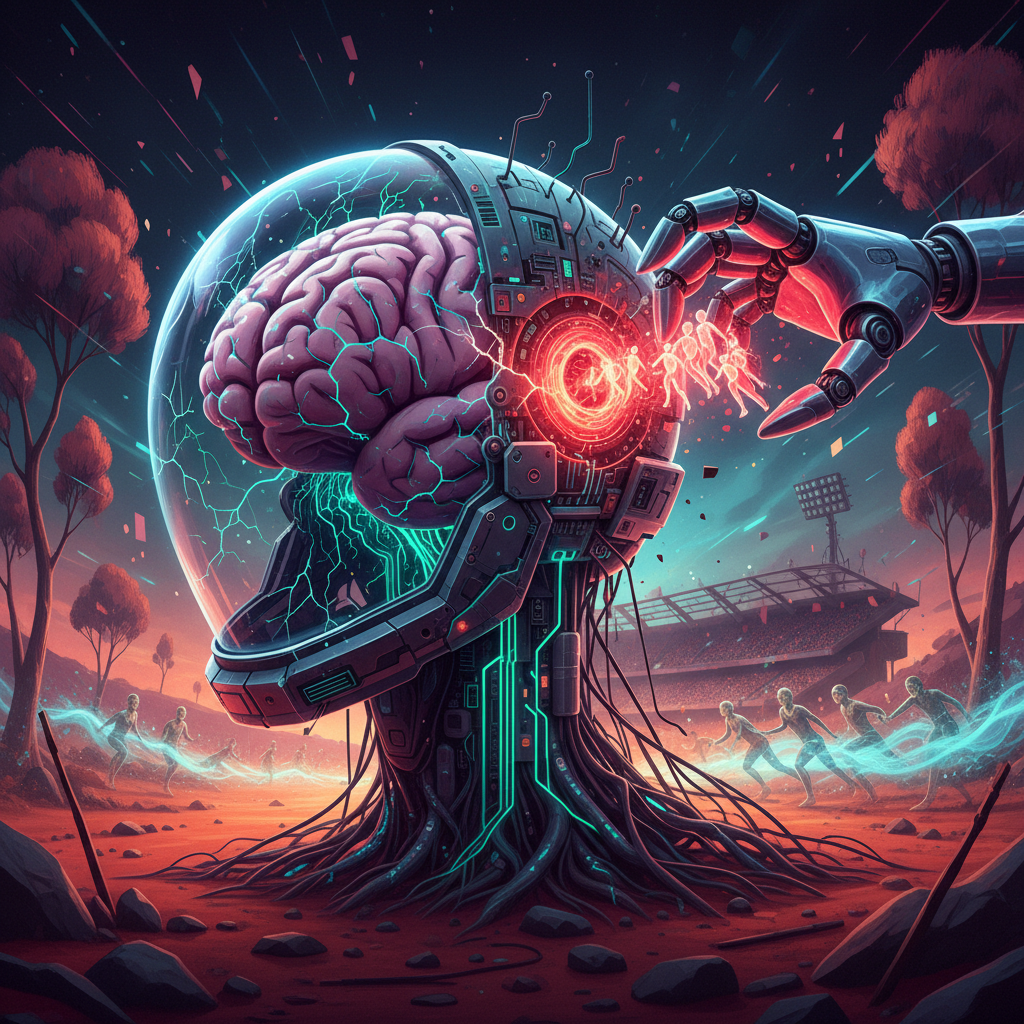

Picture this: you're a busy tradie in Perth, juggling quotes, invoices, and a mountain of administrative grunt work. You've heard the buzz about AI agents, those clever digital assistants that promise to handle the mundane, freeing you up to actually, you know, do your trade. You're imagining an AI that schedules your jobs, orders materials, and even chases up late payments, all while you're on the tools. It sounds like a bloody dream, doesn't it? A digital mate who just gets it.
Then, news drops that one of the big players in this space, Adept AI, which was once touted as a frontrunner in building these autonomous AI agents, has effectively packed up its agentic ambitions and been snapped up for its talent. Not for its groundbreaking product, mind you, but for the brains behind it. It's a bit like being promised a self-driving ute, only to find out the company decided to just sell their engineers to Toyota. You're left scratching your head, wondering what happened to the future you were promised, and more importantly, what this means for your own mental load.
This isn't just about one company's business decision, mate. This pivot, and the broader trend of consolidation in the AI space, has some fascinating, and frankly, a bit unsettling, psychological implications for us ordinary blokes and sheilas. We've been conditioned to expect AI to be this omnipotent problem-solver, a digital genie ready to grant our every efficiency wish. When a company like Adept, which had some serious smarts and funding, shifts gears so dramatically, it sends ripples through our collective perception of AI's capabilities and trustworthiness.
Research from institutions like the University of Sydney's Brain and Mind Centre has been exploring the cognitive effects of increasing AI interaction. Dr. Sarah Pearson, a cognitive psychologist specialising in human-computer interaction, recently remarked, "The constant promise of AI autonomy, followed by a retraction or a shift, can lead to what we call 'automation distrust' or 'algorithm aversion.' People start to question the fundamental reliability of these systems, which can ironically increase their cognitive load as they second-guess AI outputs." She further elaborated, "When we outsource complex tasks to AI, there's a delicate balance. Too much reliance can atrophy our own problem-solving skills, but too little, due to distrust, means we don't reap the benefits." It’s a bit like trying to trust a new apprentice who keeps changing their mind about how to do a job, you eventually just do it yourself, but with a sigh.
What Adept's talent acquisition by a larger entity, reportedly Microsoft, signals is a potential centralisation of AI development. Instead of a diverse ecosystem of specialised AI agents, we might see a future where a few tech behemoths control the underlying infrastructure and capabilities. This isn't necessarily a bad thing for innovation, but it certainly changes the psychological contract we have with AI. We're moving from a world where we might interact with a myriad of niche AI tools to one where our digital lives are increasingly mediated by a handful of powerful platforms. This can lead to a sense of reduced agency and control, a feeling that our choices are being subtly steered by algorithms we don't understand, operating within systems we can't influence.
Consider the concept of 'learned helplessness' in a digital context. If we're constantly being told AI will solve our problems, but then the specific, tailored solutions we were hoping for don't materialise, or are absorbed into larger, more generic platforms, we might become less proactive in seeking out or even conceptualising our own solutions. We might simply wait for the next big tech company to deliver the silver bullet, rather than innovating ourselves. Australia's tech scene is like a good flat white, better than you'd expect, but we thrive on that independent, problem-solving spirit. If we start relying too heavily on imported, consolidated AI, we risk losing some of that spark.
Professor David Danks, a philosopher and cognitive scientist at Carnegie Mellon University, who has extensively studied the ethics of AI, pointed out in a recent webinar, "The acquisition of Adept's talent, rather than its product, highlights a crucial shift. It's not just about what AI can do, but who controls the doing. This has profound implications for how individuals perceive their own capabilities in an AI-driven world. If the most advanced agentic AI is developed behind closed doors by a few giants, the public's understanding and trust in AI could become fragile." His point is well taken, if we don't see the sausage being made, we might be less inclined to eat it, or at least, we'll be asking a lot more questions about the ingredients.
The broader societal implications are significant. If AI agent development becomes concentrated, what happens to the smaller, more agile startups that were aiming to build highly specialised agents for specific industries, like our agricultural tech sector or mining operations? These are areas where Down Under, we do things differently, and often need bespoke solutions. If the talent and resources are all funnelled into a few mega-corporations, will our unique needs be adequately addressed, or will we be forced to adapt to more generic, one-size-fits-all AI solutions? This could stifle local innovation and exacerbate the digital divide between those who can leverage generic AI and those who need more tailored, context-specific applications.
So, what's a person to do in this shifting landscape? Firstly, cultivate a healthy scepticism. Don't fall for the hype, but don't dismiss the potential either. Understand that AI is a tool, not a magic wand. Secondly, actively engage with and question the AI systems you use. Understand their limitations, biases, and where their data comes from. Don't let yourself become a passive recipient of algorithmic outputs. Thirdly, support local innovation. Companies like DataGlobal Hub are trying to keep us informed, but also look to our own backyard. There are brilliant minds here in Australia working on AI solutions that are specifically designed for our context, and they deserve our attention and support.
Finally, and perhaps most importantly, keep your own critical thinking skills sharp. The more AI promises to think for us, the more crucial it becomes that we retain our ability to think critically about what it's telling us. Don't let the convenience of AI lull you into cognitive complacency. Mate, this AI thing is getting interesting, but we need to stay switched on. The future of our brains, and our ability to navigate this increasingly complex world, might just depend on it. For more on the intricacies of AI development and its societal impact, you might find articles on MIT Technology Review insightful, or even check out the latest discussions on Ars Technica for a more technical deep dive. It's not just about the tech itself, it's about how we, as humans, adapt to its relentless evolution.