
You know, sometimes I sit in my little office overlooking the Chao Phraya River, sipping my cha yen, and I think about the future. Not just any future, mind you, but the future where cars drive themselves. Specifically, Tesla's Full Self-Driving, or FSD, and how it's going to crash, literally and figuratively, into the beautiful, chaotic reality of Thailand.
Elon Musk, bless his ambitious heart, talks about robotaxis like they're just around the corner, a fleet of silent, electric chariots ready to whisk us away. But here in Bangkok, where a simple trip to the market can feel like an extreme sport, the idea of a car navigating without a human hand on the wheel feels less like innovation and more like a particularly spicy tom yum challenge. Yet, the currents of technology are strong, and even the most stubborn traffic jam eventually gives way. So, let's fast forward, say, five to ten years. What does our Land of Smiles look like when the cars start smiling back, or at least, driving themselves?
A Future Vision: The Autonomous 'Soi' Surfers of 2031
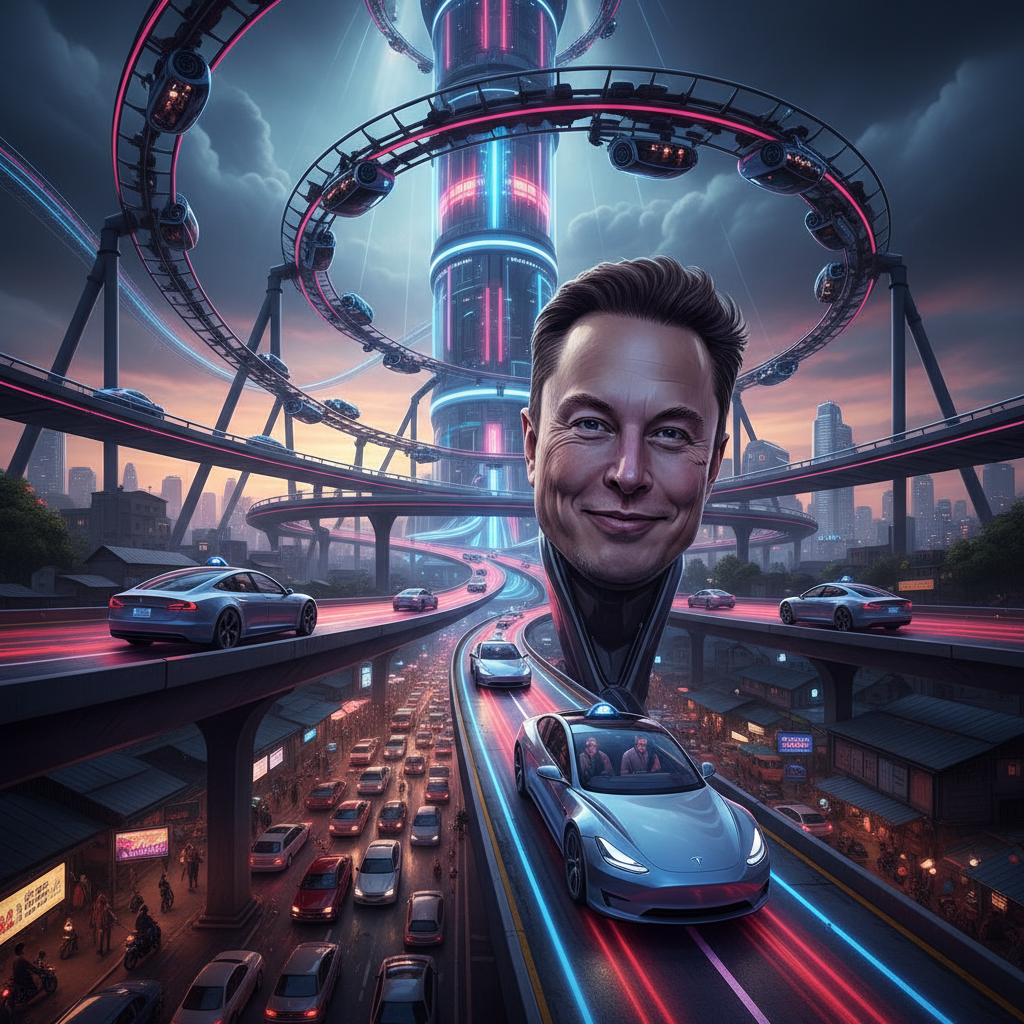
Imagine this: it's 2031. The morning rush hour is still a thing, because, well, some things never change. But instead of a symphony of honking horns and sputtering engines, there's a quieter hum. Sleek, electric autonomous vehicles, many of them Teslas, glide through the streets. They're not just on the main arteries, oh no. They've learned the intricate dance of the soi, those narrow, winding alleys where street vendors, motorbikes, and stray dogs perform a daily ballet. These aren't just cars, they're intelligent navigators, programmed with a 'Thai-style innovation' that understands the unspoken rules of our roads: the subtle nod that means 'you go first,' the flash of headlights that signals 'I'm coming through,' and the uncanny ability to squeeze through gaps that would make a Western driver faint.
Tourists, fresh off their long flights, no longer fumble with taxi apps or haggle over fares. They simply summon a 'robotuk-tuk', a small, open-sided autonomous vehicle, perhaps a modified Tesla Cybertruck chassis, designed to mimic our iconic three-wheelers, but with air conditioning and a built-in translator. It whisks them directly from Suvarnabhumi Airport to their boutique hotel in Thonglor, expertly avoiding the usual tourist traps and even suggesting the best pad thai stall nearby. The tourism industry, already a cornerstone of our economy, has been utterly transformed. Hotels now offer autonomous shuttle services, tour operators design routes optimized for FSD vehicles, and even remote provinces, once difficult to access, are now within easy reach, opening up new opportunities for local communities.
Delivery services are lightning fast. Your som tum arrives via a small, self-driving electric van, navigating the tight corners and pedestrian zones with uncanny precision. Logistics companies, like Flash Express and Kerry Express, have fully integrated autonomous fleets, drastically cutting down on labor costs and delivery times. This isn't just about convenience, it's about reshaping urban planning, reducing pollution, and potentially, freeing up vast swathes of parking space for green areas or community hubs. Only in Bangkok, where every square meter is precious, would such a transformation be so keenly felt.
How We Get There From Today: The Regulatory Gauntlet
Getting to this future isn't going to be a smooth ride, of course. It's more like trying to cross a busy street during Songkran, exhilarating, a little chaotic, and you're definitely going to get wet. The biggest hurdle, globally and especially here, is regulation. Tesla's FSD, despite its impressive advancements, still faces significant scrutiny over safety and liability. The regulatory battle is fierce, a global chess match between innovation and caution.
In the US, the National Highway Traffic Safety Administration, or Nhtsa, has been closely monitoring FSD's performance, investigating crashes and demanding data. In Europe, countries like Germany have taken a more cautious approach, implementing strict rules for autonomous driving levels. Here in Thailand, our Department of Land Transport, or DLT, has been studying global precedents, but adapting them to our unique road conditions is a monumental task. Our traffic laws, while comprehensive on paper, often rely on human interpretation and the unwritten rules of the road. How do you program an AI to understand the subtle art of the 'near miss' that defines so much of our daily commute?