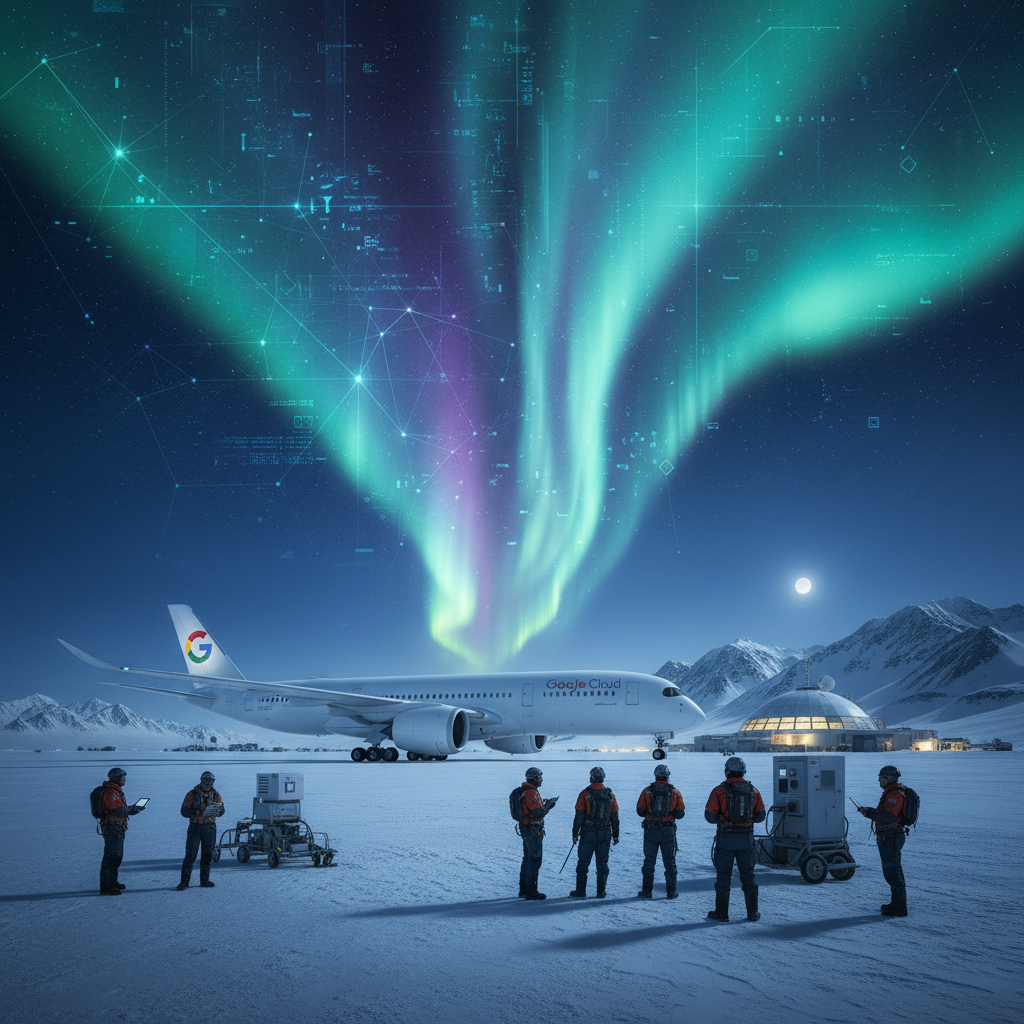

Last night, the aurora lit up our research station with hues of green and violet, a silent ballet against the endless white. It is moments like these, under the vast, indifferent sky, that you truly appreciate the marvel of human ingenuity, especially when it comes to something as fundamental as flight. Here, a safe landing is not just a convenience, it is a lifeline. And increasingly, that lifeline is being woven with threads of artificial intelligence.
We are talking about AI in aviation: flight optimization, predictive maintenance, and air traffic control. It sounds technical, perhaps a bit dry, but trust me, it is anything but. This is what AI looks like at the end of the world, and it is reshaping how every single one of us travels, whether you are flying to Stockholm for a fika or bringing supplies to a remote Antarctic outpost.
The Quiet Revolution Above Our Heads
The skies above us are becoming smarter, more connected, and more efficient, thanks to AI. Imagine a world where every flight path is not just a line on a map, but a dynamic, living entity, constantly adjusting for weather, air traffic, and even fuel efficiency in real time. This is not science fiction, it is the present. Companies like Google, with its powerful optimization algorithms, and aviation giants like Airbus, are pouring resources into making this a reality. They are not just tweaking existing systems; they are fundamentally rethinking how we get from point A to point B.
For those of us living in places like the Antarctic, where every flight is a monumental logistical undertaking, this shift is profoundly impactful. Our small planes, often carrying vital scientific equipment or personnel, operate in some of the most challenging conditions on Earth. Precise weather forecasting, dynamic route adjustments to avoid katabatic winds, and ensuring every component is in perfect working order are not luxuries; they are necessities for survival. AI is stepping in to provide that extra layer of certainty and safety.
Why Most People Are Ignoring It
Perhaps it is the sheer complexity of it all, or maybe it is the fact that much of this innovation happens behind the scenes, far from the public eye. When you board a plane, you are probably thinking about your destination, your book, or perhaps the quality of the in-flight coffee. You are not usually pondering the intricate algorithms that just shaved 15 minutes off your flight time or predicted a minor engine fault weeks before it became a major issue. This quiet revolution lacks the flashy headlines of generative AI art or self-driving cars, but its impact is arguably more pervasive and critical to our global infrastructure.
Many of these advancements are happening in specialized labs and air traffic control centers, far from the daily news cycle. The technology is often integrated seamlessly into existing systems, making its presence almost invisible to the average passenger. It is not a new gadget you can hold in your hand, but an invisible hand guiding the very fabric of air travel, making it smoother, safer, and more sustainable. This makes it easy to overlook, even as it touches millions of lives every day.
How It Affects YOU
So, how does this invisible hand reach into your life? Let us count the ways. Firstly, think about your wallet. Optimized flight paths mean less fuel consumption, which can translate to lower operating costs for airlines and potentially, more stable ticket prices for you. Less fuel also means a smaller carbon footprint, a critical consideration for our planet, especially in fragile environments like the Antarctic. Every kilogram of CO2 saved matters.
Secondly, safety. Predictive maintenance, powered by AI, means that aircraft components are being monitored constantly. Sensors collect vast amounts of data, which AI models analyze to detect subtle anomalies that might indicate a part is nearing the end of its life. This allows for proactive repairs or replacements, long before a failure could occur. It is like having a doctor who can predict your illness before you even feel a symptom. This is a game changer for reducing mechanical failures and enhancing the overall safety of air travel. According to Reuters, the aviation industry is seeing significant improvements in maintenance schedules and cost savings due to these AI applications.
Finally, efficiency. AI in air traffic control can optimize routes, manage congestion, and even predict potential delays before they happen, allowing controllers to make more informed decisions. This means fewer circling planes, shorter taxi times, and more punctual arrivals. For anyone who has ever been stuck on a tarmac, knowing that AI is working to get you to your destination faster is certainly a welcome thought.
The Bigger Picture: A Global Tapestry of Flight
Beyond individual journeys, AI in aviation is weaving a global tapestry of interconnectedness. For a nation like Sweden, with its vast northern territories and reliance on air travel for both commerce and connectivity, these advancements are crucial. Regional airports, often serving remote communities, benefit immensely from enhanced safety protocols and more reliable schedules. The same holds true for the scientific missions here in Antarctica, where timely delivery of supplies and safe transport of researchers are non-negotiable.
Economically, the stakes are enormous. The global aviation industry contributes trillions to the world economy and supports millions of jobs. Any technology that can enhance its efficiency and safety has ripple effects across supply chains, tourism, and international business. Environmentally, the push for greener aviation is paramount. AI's ability to optimize fuel burn, for example, is a direct contribution to global climate goals, helping to protect the very ecosystems we study here at the South Pole.
What Experts Are Saying
Industry leaders are vocal about the transformative power of AI. "AI is not just an incremental improvement for aviation, it is a paradigm shift," stated Guillaume Faury, CEO of Airbus, in a recent industry conference. "From design to operations, it is enabling levels of safety, efficiency, and sustainability we could only dream of a decade ago." His vision is one where AI becomes an indispensable co-pilot, not just for the human pilot, but for the entire aviation ecosystem.
Similarly, Dr. Fei-Fei Li, a leading AI researcher and co-director of Stanford's Human-Centered AI Institute, emphasized the human element. "The goal of AI in aviation is not to replace human expertise, but to augment it," she noted in an interview with MIT Technology Review. "It provides pilots and air traffic controllers with better information, predictive insights, and decision support, making their incredibly complex jobs safer and more manageable." This human-AI collaboration is key.
From the regulatory side, Kelvin Coleman, former Administrator of the Federal Aviation Administration (FAA), highlighted the challenges and opportunities. "Integrating AI into highly regulated sectors like aviation requires rigorous testing and robust certification processes," Coleman explained. "The potential benefits are immense, but safety must always remain the absolute priority. We are seeing incredible progress, but it demands careful, collaborative development between innovators and regulators." This balance between innovation and safety is a constant dance.
What You Can Do About It
For the average person, engaging with this topic might seem distant, but your awareness matters. Support airlines and manufacturers that invest in these advanced safety and efficiency technologies. Advocate for policies that encourage responsible AI development and deployment in critical infrastructure. If you are in a field related to data science, engineering, or aviation, consider how your skills could contribute to this evolving landscape. For students, this is a burgeoning field ripe with opportunity, offering a chance to shape the future of global travel.
On a more personal note, simply appreciating the invisible work that goes into making your flight safe and smooth can foster a sense of gratitude for the incredible minds working behind the scenes. And perhaps, the next time you are delayed, you will understand that the systems are working to ensure your safety, even if it means a little extra waiting.
The Bottom Line: Safer Skies, Closer Worlds
In the silence of Antarctica, you hear things differently. You hear the hum of the generators, the creak of the ice, and sometimes, the distant drone of a plane bringing new faces or vital supplies. These flights, once perilous journeys into the unknown, are becoming increasingly predictable and safe, thanks to AI. In five years, the integration of AI into aviation will be even more profound. We will see more autonomous systems assisting pilots, hyper-personalized flight paths, and maintenance schedules so precise they will border on prescience. The skies will be safer, more efficient, and more connected than ever before. This will not just be a technological achievement; it will be a human one, bringing our vast world a little closer together, one optimized flight at a time. It is a future where the wonder of flight is matched by the intelligence that guides it, a testament to our ongoing quest for connection and exploration, even from this remote corner of the globe. For more on how AI is transforming industries, you can visit TechCrunch.