
The news hit the wires like a Lagos bus hitting a pothole: Adept AI, once a darling of the AI agent space, reportedly shifting gears, its highly sought-after talent now the main attraction for larger tech entities. On the surface, it looks like a win. Brilliant minds get absorbed into bigger projects, shareholders get their returns, and the AI industry continues its relentless march forward. But let's talk about what nobody wants to discuss: the underlying currents of this trend, and what it truly signifies for the future of innovation, particularly from my vantage point here in Nigeria.
Unpopular opinion perhaps, but I see this less as a natural evolution and more as a sophisticated form of brain drain, a digital colonialism dressed in venture capital. When a startup with a clear, ambitious vision for autonomous AI agents, backed by significant funding, ends up essentially dissolving its product focus to become a talent acquisition target, it paints a rather grim picture. It suggests that the true value isn't in the groundbreaking technology they were building, but in the human capital. And who benefits most from this talent consolidation? The established giants, of course.
Historically, the tech world has always seen acquisitions. It's the natural order of things, some might argue. Small fish get eaten by big fish. But the scale and nature of these recent 'acqui-hires' in the AI space feel different. It's not just about market share or intellectual property anymore; it's about cornering the market on human intelligence, on the very minds capable of pushing the boundaries of artificial intelligence. Remember the dot-com bubble? Companies were valued on eyeballs and potential. Now, in AI, the currency seems to be PhDs and deep learning expertise. This isn't just a trend; it's a strategic maneuver by Big Tech to maintain its chokehold on innovation.
Consider Adept AI. They were founded by brilliant minds from Google and OpenAI, aiming to build AI agents that could perform complex tasks across various applications. They raised substantial capital, reportedly over $400 million, from major investors. Their initial vision was grand, promising a new paradigm in human-computer interaction. Yet, here we are, seeing reports of their talent being eyed by the very companies their founders once worked for, or their direct competitors. This isn't a failure of vision; it's a failure of the ecosystem to allow truly independent, disruptive innovation to flourish outside the gravitational pull of a few dominant players.
This isn't an isolated incident. We've seen similar patterns. Smaller, innovative AI labs struggle to compete with the compute power, data access, and talent war chests of companies like Microsoft, Google, and Meta. It's a vicious cycle. Startups need talent, but the best talent is drawn to the resources and prestige of the giants. When a startup can't scale its product fast enough, or finds itself in a tight funding environment, the 'talent acquisition' becomes a lucrative exit strategy. It's a golden parachute for the founders, but what about the broader dream of decentralized AI innovation?
"The AI talent market is incredibly competitive, and the best minds are always in demand," noted Dr. Timnit Gebru, a prominent AI researcher and advocate for ethical AI, in a recent interview. "But when promising startups are consistently absorbed for their personnel rather than their products, it raises questions about whether true independent research and development can thrive outside of a few mega-corporations." Her point resonates deeply. If the only viable path for a groundbreaking AI startup is to eventually become a feeder for a tech giant, then the diversity of thought and approach in AI development will inevitably suffer.
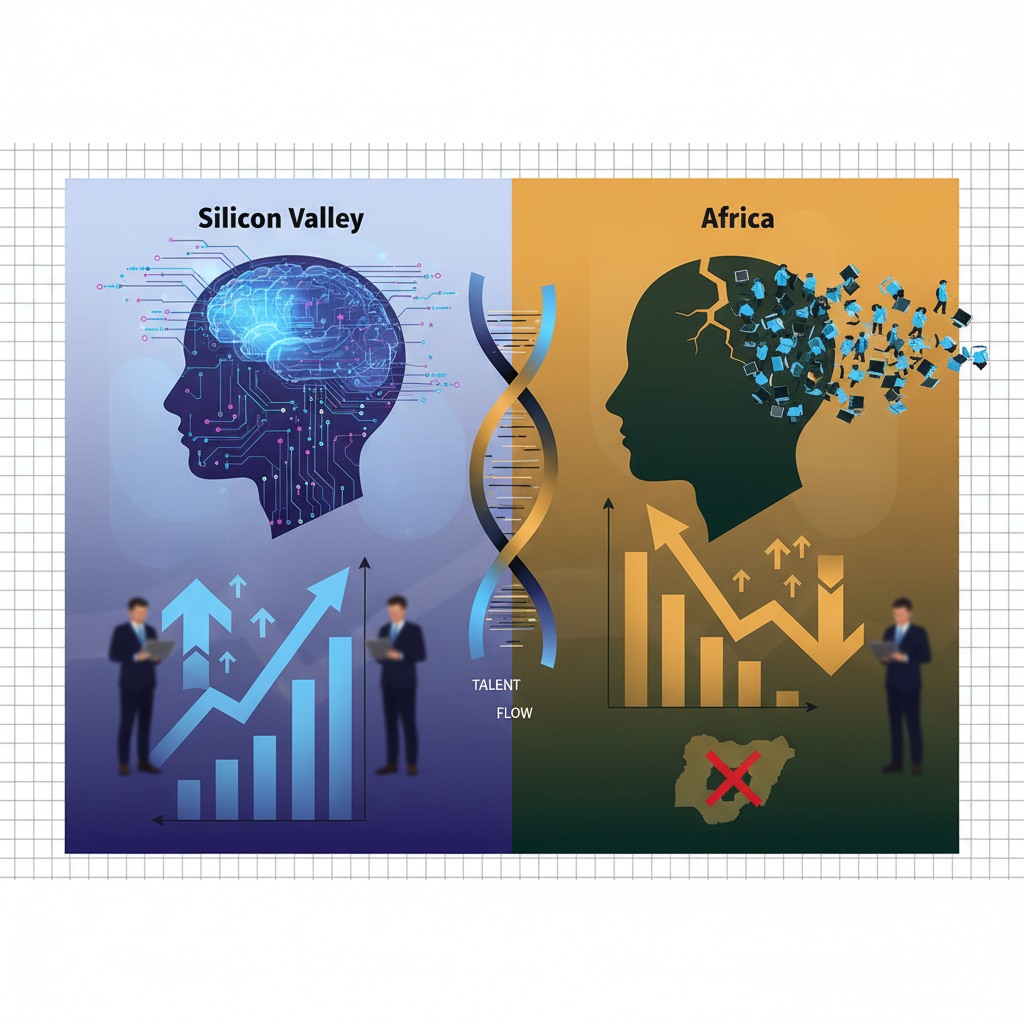
From an African perspective, this trend is particularly concerning. We are already battling to retain our brightest minds, many of whom are lured by opportunities in Silicon Valley or Europe. When even well-funded AI startups in the West can't maintain their independence, what hope is there for emerging AI ecosystems in Lagos, Nairobi, or Accra? We are trying to build our own technological sovereignty, to create solutions tailored to our unique challenges. But if the global talent market is effectively being centralized, it makes our task exponentially harder.
"We need to cultivate environments where African AI talent can not only emerge but also thrive and build locally, without feeling the constant pressure to emigrate or be acquired," stated Dr. Olubayo Adekanmbi, the founder of Data Science Nigeria, a leading non-profit focused on AI education and development. "The current global dynamics risk turning developing regions into mere producers of raw talent, rather than centers of independent innovation." His words echo a sentiment felt across the continent. We don't want to just be a source of data or a market for foreign AI products; we want to be creators and owners.
This is not to say that every acquisition is inherently bad. Sometimes, the synergy can lead to incredible advancements. But the consistent pattern of talent absorption, especially for companies like Adept AI that were at the forefront of a specific, complex AI domain like agents, suggests a deeper issue. It hints at an ecosystem where only those with near-infinite resources can truly play the long game of foundational AI development. The barrier to entry for building truly disruptive AI is becoming impossibly high, not just in terms of compute, but in terms of human capital.
What does this mean for the future? It means less diversity in AI products, fewer truly novel approaches, and an increased risk of algorithmic bias being baked into systems that are developed by a homogeneous group of engineers within a few corporate cultures. If the same few companies control the vast majority of AI talent, they will inevitably shape the future of AI in their own image, with their own priorities, which may not always align with the global good.
So, is Adept AI's pivot a fad or the new normal? I fear it's the latter. It's a symptom of an AI industry consolidating power at an alarming rate. It's a stark reminder that in the race for artificial general intelligence, the most valuable asset remains human intelligence, and those with the deepest pockets are aggressively cornering that market. For us in Nigeria, and across Africa, it's a wake-up call. We must double down on fostering local talent, creating robust ecosystems, and building our own AI champions, lest we become mere spectators in a game where the rules are set far away from our shores.
The implications extend beyond just talent. It speaks to data ownership, to the very models of innovation that will define the next century. If the giants are buying up all the brains, who will build the AI that truly serves the diverse needs of humanity, rather than just the commercial interests of a few? This is a question that keeps me up at night, and it should keep you up too. The future of AI, and indeed our digital sovereignty, might just depend on the answers we find.
For more on the challenges faced by emerging tech ecosystems, you can read about how Mistral AI's open models might impact African tech hubs [blocked]. The struggle for independent innovation is real, and it's global. We must remain vigilant and question the narratives presented to us, especially when everyone's celebrating, but I have questions about who truly benefits. For further insights into the global AI landscape, consider reports from TechCrunch or MIT Technology Review. The stories they tell, often between the lines, are crucial for understanding this evolving terrain.