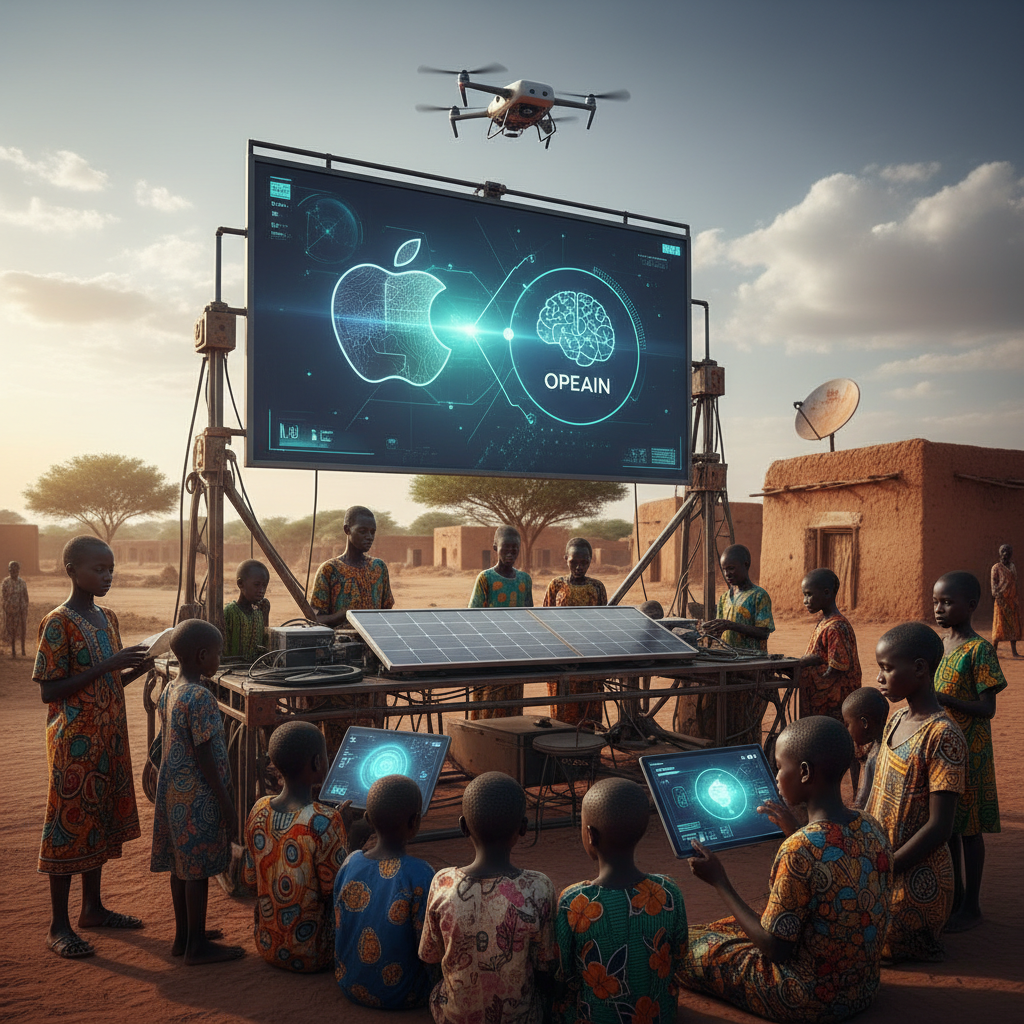
The news arrived like a Sahelian dust storm, swirling across the digital landscape: Apple, the titan of Cupertino, is officially partnering with OpenAI, the architect of ChatGPT, to weave advanced AI directly into the fabric of iPhones and Macs. Analysts in New York and London are already dissecting market shares, forecasting new revenue streams, and predicting a fresh wave of consumer upgrades. But here, under the persistent sun of Burkina Faso, the conversation takes a different turn. We hear the hype, we understand the ambition, yet our perspective is shaped by a daily reality where connectivity is a luxury, not a given, and where a mobile phone is often a family’s primary link to the world, not a personal accessory.
For many in the global North, this partnership means a smarter Siri, more intuitive photo editing, or perhaps an AI assistant that drafts emails with uncanny precision. For us, the question is more fundamental: does this move, this grand alliance of tech giants, bring us any closer to solving the pressing challenges of food security, climate resilience, or access to education? Or is it simply another layer of sophistication for those who already have everything?
Sam Altman, OpenAI’s CEO, has spoken extensively about the democratization of AI, about making powerful tools accessible to everyone. In a recent interview, he stated, “Our goal has always been to build artificial general intelligence that benefits all of humanity, and partnerships like this are crucial for broad distribution and impact.” This sentiment is noble, but the path from a Silicon Valley boardroom to a remote Burkinabè village is long and fraught with obstacles. The reality on the ground is that even the most advanced AI models are useless without reliable internet access, affordable devices, and the digital literacy to navigate them. In Burkina Faso, mobile penetration stands at around 90 percent, but smartphone ownership is significantly lower, and data costs remain a barrier for many. The average monthly income often means choosing between internet bundles and essential food items.
Tim Cook, Apple’s CEO, has highlighted the privacy-centric approach of their AI integration, emphasizing on-device processing where possible. “We believe in powerful intelligence that respects your privacy,” Cook reportedly said during a recent product announcement, “and this collaboration with OpenAI allows us to deliver that at an unprecedented scale.” Privacy is important, certainly, but for someone struggling to irrigate a millet field in a drought-stricken region, the immediate concern isn't whether their data is being processed on a server or on their phone, but whether they can access timely weather forecasts or market prices without draining their limited data plan.
Consider the implications for agriculture, a sector vital to our survival here. AI has immense potential in precision farming, disease detection, and optimizing irrigation. We have seen early, promising initiatives. For instance, local startups are exploring how basic AI models can analyze satellite imagery to predict crop yields or identify areas affected by pests. But these often rely on centralized processing and require data collection through specialized drones or sensors, which are expensive and scarce. If Apple and OpenAI’s collaboration means that even basic, localized AI capabilities become more readily available on standard, albeit still costly, devices, that could be a game-changer. Imagine a simple iPhone app, powered by OpenAI’s models, that can identify plant diseases from a photo taken by a farmer, or provide real-time advice on optimal planting times based on local microclimates. This is where the rubber meets the road, where the abstract promise of AI translates into tangible benefits.
However, the integration of such advanced AI into high-end devices like iPhones and Macs also risks widening the digital divide. If these powerful new capabilities are locked behind expensive hardware and data plans, they will remain out of reach for the vast majority of people in countries like ours. It becomes a tool for the privileged, further exacerbating inequalities rather than bridging them. We need solutions that are designed with resource constraints in mind, not just optimized for the affluent markets of the West.
Dr. Oumarou Sawadogo, a telecommunications policy expert at the Université Joseph Ki-Zerbo in Ouagadougou, voiced a common concern. “The global tech narrative often overlooks the fundamental infrastructure gaps in places like Burkina Faso. A sophisticated AI on a premium device is a marvel, yes, but it’s a marvel that very few can afford or even reliably use when electricity is intermittent and data is expensive. We need foundational investments in connectivity and digital literacy first, otherwise, these advancements will only serve to deepen existing disparities.” His words echo the sentiments of many who watch these global developments with a mix of hope and skepticism.
There is also the question of relevance. While a sophisticated AI might help a Western user manage their complex calendar or compose a nuanced business proposal, the needs here are often more basic, more immediate. Can this AI help track livestock movements to prevent disease spread? Can it translate local dialects into French or English for educational purposes? Can it provide early warnings for flash floods or assist in locating clean water sources? These are the applications that truly matter, the ones that could genuinely transform lives. Forget the hype, this is what matters.
We have seen some positive movements. Organizations like the African Development Bank are investing in digital infrastructure projects, aiming to expand internet access across the continent. Initiatives to provide affordable smartphones and digital literacy training are also gaining traction. But the pace is slow, and the scale of the challenge is immense. The average cost of a new iPhone remains prohibitively high, often equivalent to several months, if not a year, of income for many Burkinabè families. Even if an older, more affordable model could access some of these AI features, the data costs would still be a significant hurdle.
This partnership between Apple and OpenAI is undoubtedly a significant milestone in the evolution of AI. It signals a future where AI is not just an external service but an intrinsic part of our personal devices. Yet, from our vantage point in Burkina Faso, it serves as a stark reminder that technological progress, however groundbreaking, must be viewed through the lens of equitable access and real-world impact. Until these powerful tools can genuinely serve the needs of everyone, not just a select few, their full potential remains untapped. The true measure of this innovation will not be in the number of iPhones sold, but in how it ultimately touches the lives of the most vulnerable, the ones for whom a small improvement can mean the difference between hardship and hope. It is a long road from the gleaming Apple Park to the dusty paths of Ouagadougou, and we are watching closely to see if this new AI can truly make the journey. The world is changing rapidly, and we must ensure that these changes uplift everyone, not just those already at the top of the digital ladder. For more on the broader implications of AI in developing nations, consider reading about OpenAI's Enterprise Gambit: Will ChatGPT Truly Elevate Mexico's Workforce or Just Deepen the Digital Divide? [blocked]. For further analysis on AI's global impact, Reuters Technology often provides valuable insights.