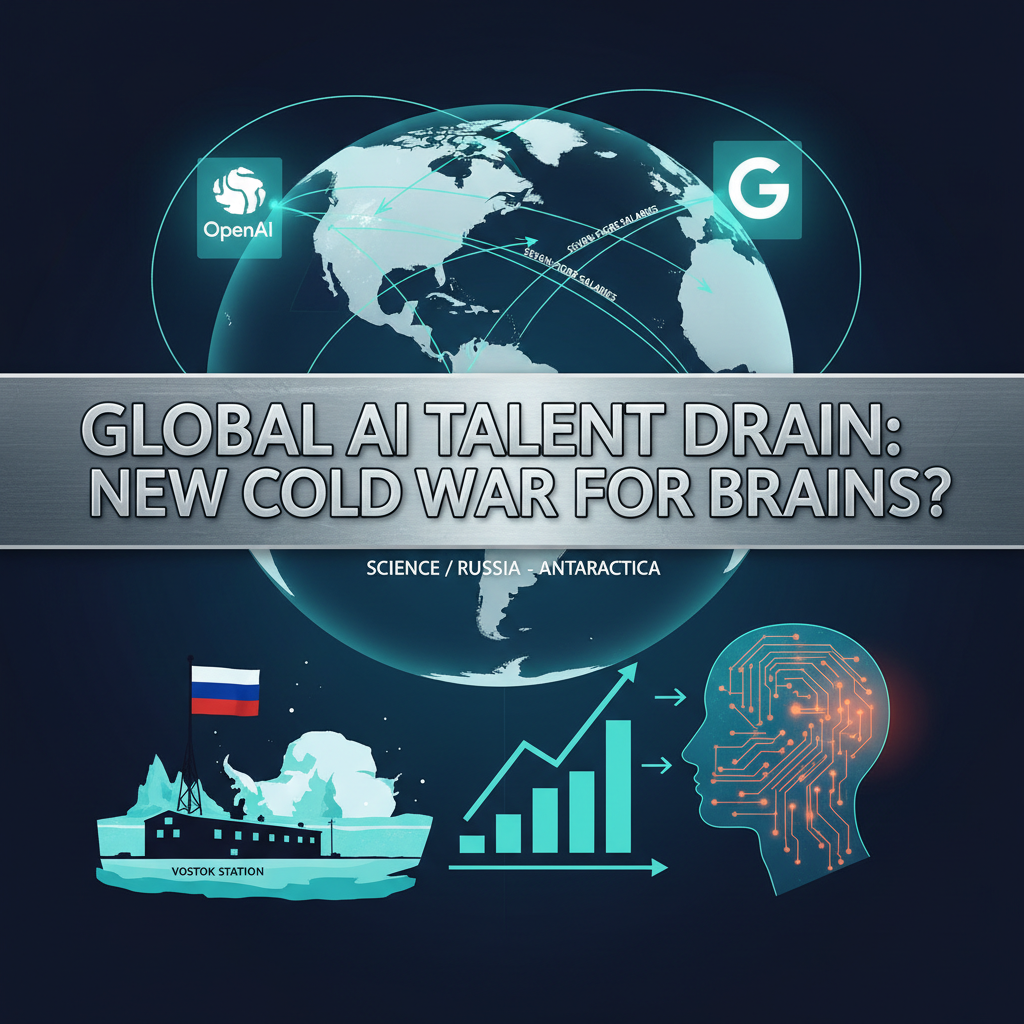

Is the pursuit of artificial intelligence talent becoming a new form of geopolitical competition, a silent cold war fought not with missiles, but with multi-million dollar compensation packages and promises of unparalleled research environments? The question looms large as the global tech industry, spearheaded by titans like OpenAI, Google, and Microsoft, engages in an unprecedented bidding frenzy for the brightest minds in AI. This phenomenon, marked by seven-figure salaries and aggressive recruitment, is not merely reshaping Silicon Valley, it is fundamentally altering the global distribution of scientific expertise, with profound implications for nations and research institutions worldwide.
To understand the current maelstrom, one must first consider the historical precedents. The concept of a 'brain drain' is not novel. Post-World War II, the United States benefited significantly from European scientific migration. During the Cold War, the Soviet Union faced its own challenges in retaining top scientific and engineering talent, particularly as global opportunities expanded. However, these historical movements, while impactful, rarely involved the sheer scale of financial incentives now commonplace in the AI sector. The current situation is less a gradual migration and more an instantaneous teleportation of expertise, driven by market forces that prioritize immediate AI breakthroughs above all else. In the early 2010s, as deep learning began its ascent, a handful of universities and corporate labs cultivated this nascent field. The talent pool was small, and competition, while present, was manageable. Researchers were drawn by intellectual curiosity and the promise of groundbreaking discoveries, often within academic settings or well-funded corporate research divisions like Google DeepMind.
The current state of affairs, however, defies historical comparison. Data from various recruitment agencies and industry reports paint a stark picture. Senior AI researchers, particularly those with expertise in large language models, reinforcement learning, or advanced robotics, can command base salaries exceeding $500,000, often supplemented by stock options and bonuses that push total compensation well into the seven-figure range. For instance, a lead researcher at a prominent AI lab, with a proven track record of publications in top-tier conferences like NeurIPS or Icml, might receive an offer package valued at $2 million to $5 million annually. This is not an outlier, but an increasingly common occurrence for those at the pinnacle of the field. Reuters has reported extensively on this escalating compensation, noting its disruptive effect on traditional tech salary structures.
This intense competition is fueled by a clear strategic imperative: the race for artificial general intelligence, or AGI, and the immediate commercialization of generative AI technologies. Companies like OpenAI, with its GPT series, and Google, with Gemini, are not just building products, they are building foundational technologies that promise to redefine industries. The return on investment for securing a top AI scientist, who might accelerate a critical breakthrough or optimize a core algorithm, is perceived as astronomically high. Jensen Huang, CEO of NVIDIA, a company central to the AI infrastructure boom, has repeatedly emphasized the scarcity of truly exceptional AI engineers, stating, "The demand for AI talent is insatiable. It's the new gold rush, and the gold is intellect." This sentiment is echoed by Sam Altman of OpenAI, who has publicly acknowledged the intense competition for talent, suggesting that the drive to attract the best is paramount for achieving their ambitious goals.
From our vantage point at Vostok Station, where the extreme environment demands precision and resilience from every piece of technology, the implications of this global brain drain are particularly acute. At -40°C, technology behaves differently, and so too does the scientific ecosystem. The data from our Antarctic station reveals a subtle but concerning trend: a slow but steady decrease in the number of Russian researchers pursuing advanced degrees specifically in core AI algorithms and foundational models, compared to applied AI. While applied AI, particularly in areas like climate modeling and satellite data analysis, remains robust due to its immediate relevance to our work, the foundational research talent is increasingly drawn to the higher echelons of global tech.
Professor Elena Petrova, Head of the Artificial Intelligence Department at the Moscow Institute of Physics and Technology, recently articulated this challenge. "Our graduates are highly sought after globally. While it is a testament to the quality of our education, it also presents a significant challenge for retaining the very best minds for domestic research and development," she noted in a recent interview with a local Moscow publication. "We simply cannot compete with the compensation packages offered by Silicon Valley giants, or even by well-funded startups in London or Beijing." This sentiment is not unique to Russia. Nations across Europe and Asia are grappling with similar issues, facing the prospect of their brightest minds being siphoned off by companies with virtually limitless resources.
Some argue that this talent migration is a natural evolution of a globalized economy, where talent flows to where it is most valued and where resources for advanced research are most abundant. Dario Amodei, CEO of Anthropic, has often spoken about the need for focused, well-resourced teams to tackle the complex challenges of AI safety and development. He might contend that concentrating talent, even if globally sourced, accelerates progress for all. However, critics, myself included, question the long-term impact on national innovation ecosystems and the equitable distribution of AI's benefits. If foundational AI research becomes increasingly concentrated in a few corporate labs, what does this mean for scientific diversity, independent research, and the ability of smaller nations to participate meaningfully in the AI revolution?
The analogy of a scientific 'resource extraction' comes to mind. Just as nations might export raw materials for processing elsewhere, are we seeing an export of raw intellectual capital, processed and refined by a select few global corporations? The implications extend beyond economics. It touches upon national security, technological sovereignty, and the very future of scientific inquiry. If all the brightest minds are working on the next generative model for a private entity, who will be left to address critical public sector challenges, such as optimizing energy grids, developing new medical diagnostics, or, indeed, refining climate models from remote outposts like ours?
My verdict, informed by the rigorous data analysis we conduct even here at the bottom of the world, is that this AI talent war is far from a transient fad. It is the new normal. The strategic importance of AI, coupled with the immense capital flowing into the sector, has created a permanent shift in the value proposition for top-tier researchers. The salaries are not merely inflated; they reflect the perceived value of intellectual property in a domain that promises to redefine human civilization. However, this new normal carries significant risks. It risks creating a two-tiered system: a privileged few nations and corporations that can afford the best, and the rest who struggle to keep pace. For countries like Russia, and for scientific endeavors like our Antarctic research, the challenge is clear: how do we cultivate and retain world-class AI talent when the gravitational pull of global tech giants is so overwhelmingly strong? The answer likely lies in fostering unique research environments, focusing on niche but critical applications, and investing heavily in domestic education and infrastructure, even if the financial incentives cannot match those of the global behemoths. The battle for brains is real, and its consequences will shape the geopolitical and scientific landscape for decades to come. For more insights into the broader technological shifts, one might consult MIT Technology Review. The future of scientific leadership depends on how effectively nations adapt to this new reality.