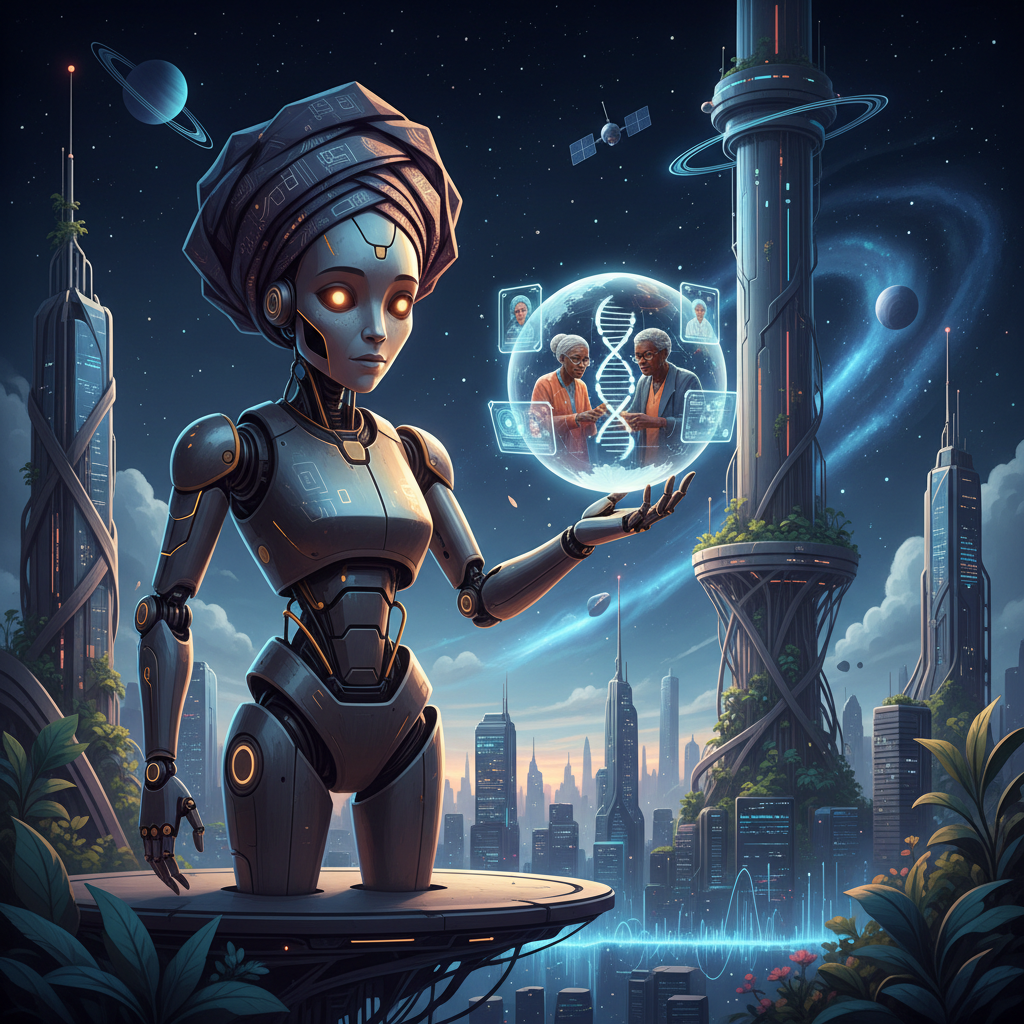

The year is 2031. My grandmama, God bless her soul, is 98 years young. She lives in her ancestral home in Anambra, surrounded by her great-grandchildren and, surprisingly, a small fleet of autonomous companions. There’s Ada, a sleek, humanoid robot from a Lagos-based startup called ‘Nne Care’, who reminds her to take her medications, monitors her vitals with uncanny precision, and even engages her in lively Igbo conversations. Then there’s Emeka, a smaller, drone-like device that fetches her a glass of water, adjusts the ambient temperature, and alerts the family if there’s any anomaly. This isn't science fiction, my friends; this is the future Nigeria is building, a future where aging is not a decline but a prolonged, dignified, and technologically augmented chapter of life.
For too long, the narrative around aging populations has been dominated by the West, focusing on their 'silver tsunami' and the impending economic doom. But here in Africa, particularly in Nigeria, we see a different kind of wave forming, one powered by ingenuity, necessity, and a deep cultural reverence for our elders. We are not just reacting to an aging demographic; we are proactively shaping a longevity revolution, and mark my words, Nigeria will lead this revolution.
How do we get there from today, you ask? It's a journey paved with audacious startups, strategic investments, and a cultural shift that embraces technology as an extension of community. Right now, in April 2026, the global conversation is still largely about AI's impact on productivity and creative industries. But the real, transformative power, especially for nations like ours, lies in its application to human well-being, particularly for our aging population. We have a rapidly growing young population, yes, but also an increasing number of elders who deserve the best care, often in contexts where traditional care models are strained.
Our journey began subtly. The first wave was healthcare AI diagnostics. Companies like ‘MedScan Africa’ started deploying AI models, trained on diverse African datasets, to detect early signs of age-related diseases like glaucoma, diabetes, and hypertension in rural clinics. This dramatically reduced diagnostic times and improved outcomes. "We realized that the data scarcity often cited in global AI was actually an opportunity for us to build bespoke solutions," explains Dr. Ngozi Okoro, CEO of MedScan Africa. "Our algorithms are now more attuned to the nuances of African physiology and disease patterns than many Western counterparts." This foundational work laid the groundwork for more complex interventions.
The next phase, which we are seeing accelerate now, is the rise of eldercare robotics. These aren't just glorified alarm systems; they are sophisticated AI-powered companions. Think less R2-D2 and more a proactive, empathetic assistant. They are designed to understand local languages, cultural norms, and even individual preferences. The goal is not to replace human interaction, but to augment it, providing constant, unobtrusive support. Imagine a robot that can gently remind an elder to take their herbal remedies, adapted for their specific needs, or one that can engage them in a game of Ayo, learning their play style over time. This is where companies like ‘Nne Care’ are making breakthroughs, leveraging advancements in natural language processing and empathetic AI to create truly intuitive interfaces. According to a recent report on AI advancements, the global market for eldercare robots is projected to exceed $30 billion by 2030, and a significant portion of that innovation, I predict, will be coming from our shores. You can read more about these trends on TechCrunch.
Key milestones on this path are already visible. By 2027, I expect to see widespread adoption of AI-powered remote monitoring systems in urban centers, moving beyond just wearables to integrated home sensors that predict falls or distress before they happen. By 2029, personalized longevity research, fueled by localized genomic data and AI analysis, will start to yield tailored dietary and lifestyle recommendations, pushing the boundaries of healthy aging. We’re talking about AI-driven nutrition plans that consider traditional African diets and genetic predispositions, not just generic Western advice. And by 2031, my imagined scenario of Ada and Emeka will be commonplace, with affordable, locally manufactured eldercare robots becoming a staple in many Nigerian homes, particularly those with family members living abroad who want to ensure their parents are well cared for.
Who wins in this future? Our elders, first and foremost, gaining unprecedented levels of autonomy and dignity. Their families win, experiencing peace of mind and reduced caregiving burdens. The Nigerian economy wins, with a booming new sector creating jobs in robotics engineering, AI development, data science, and specialized eldercare services. And the world wins, as Nigeria demonstrates a scalable, culturally relevant model for addressing global aging challenges. This is not just about technology; it's about building a more compassionate society, one byte at a time.
However, there are challenges. We must address the digital divide, ensuring equitable access to these technologies. Data privacy and ethical AI development are paramount. We cannot allow these powerful tools to become instruments of surveillance or exploitation. "The ethical framework for AI in eldercare must be built on trust, transparency, and respect for autonomy," states Professor Adeola Johnson, a leading AI ethicist at the University of Ibadan. "Without that, even the most advanced technology will fail to serve its true purpose." This is a conversation we must have now, not later.
Who loses? Perhaps those who cling to outdated models of care, or those who fail to invest in the education and infrastructure needed to support this technological leap. Companies that don't adapt, that don't see the unique opportunities in emerging markets, will be left behind. The future is already here because it's just not evenly distributed, and those who recognize its presence in places like Lagos will be the ones to capitalize on it.
What should readers do now? If you're an investor, look to Lagos, look to the startups building these solutions. If you're a technologist, consider how your skills can be applied to the profound challenges and opportunities of longevity. If you're a policymaker, create the regulatory sandboxes and incentives that foster this innovation responsibly. We are not just talking about extending life; we are talking about enhancing it, about ensuring that every year lived is a year lived with purpose and comfort. The potential for healthcare AI in Africa is immense, and it extends far beyond eldercare, touching everything from diagnostics to drug discovery, as explored in articles like The AI Pill Paradox: Will Breakthroughs Reach Eswatini or Just Deepen the Divide? [blocked].
This isn't just about robots and algorithms; it's about reimagining our relationship with age, with family, and with technology itself. It's about leveraging our collective intelligence to build a future where the wisdom of our elders is cherished and supported by the best of human and artificial ingenuity. The drumbeat of innovation is loud in Nigeria, and it’s playing a tune for a longer, healthier, and more connected future for us all. For more insights into the broader implications of AI on society, I recommend keeping an eye on publications like Wired. The revolution is not coming; it is already unfolding right before our eyes.