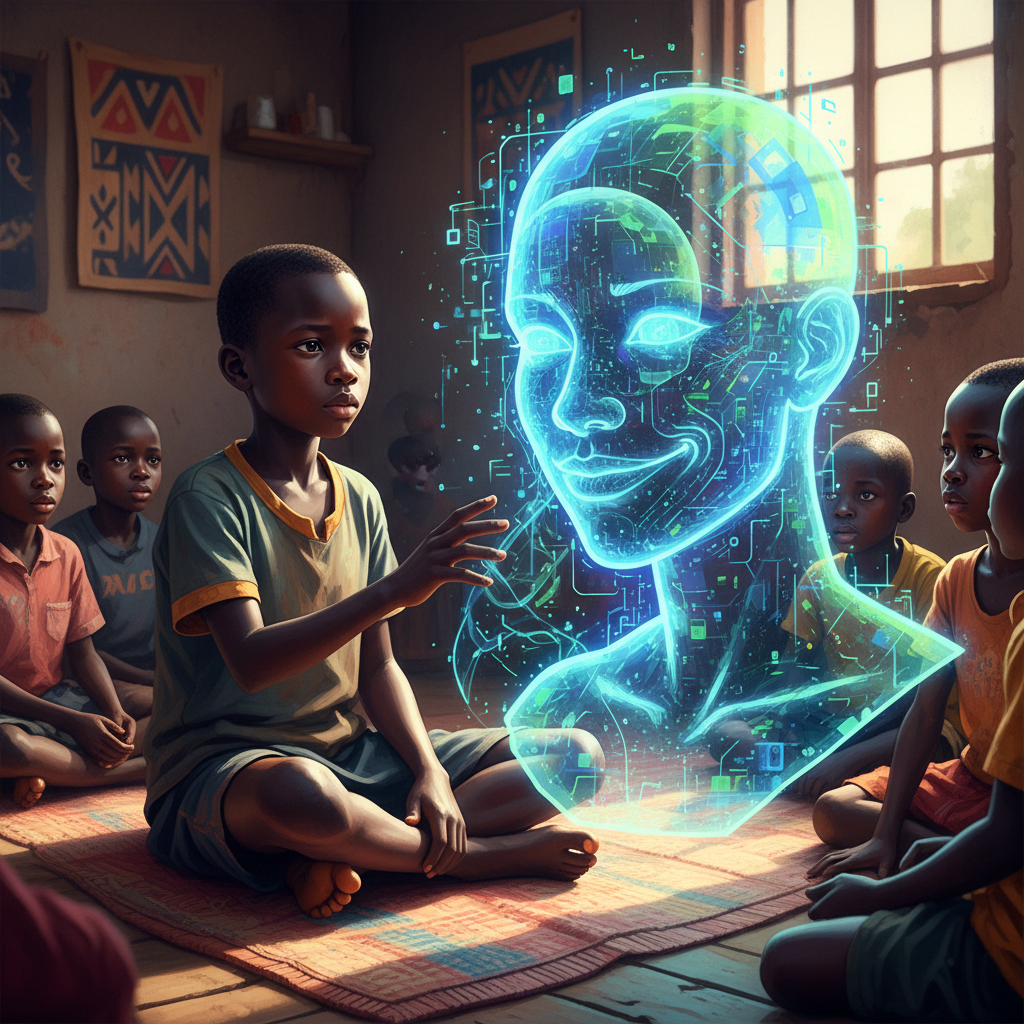

You're going to want to sit down for this, especially if you have a child, a niece, a nephew, or even just a passing acquaintance with a small human who owns a smartphone. Because while we adults are still trying to figure out if AI will take our jobs or just make our coffee better, a whole generation of Zambian children is already living in a world where artificial intelligence is a constant companion, a digital playmate, and sometimes, a rather dodgy storyteller.
I was at my sister's house in Matero just last week, sipping on some nshima and listening to her youngest, little Chileshe, a bright spark of seven years, explaining the mating habits of the African wild dog to her grandmother. Now, Chileshe is usually a whirlwind of questions, but this time, she was delivering facts with an almost robotic precision. When I asked her where she learned all this, she proudly pointed to her mother's old tablet. "Gemini told me, Auntie Lindiwe," she chirped, referring to Google's ubiquitous AI assistant. "It even showed me pictures of the puppies."
My sister, bless her heart, beamed with pride. Her daughter was learning, she thought. And yes, she was. But what Chileshe didn't know, and what my sister hadn't considered, was the subtle dance of information, persuasion, and sometimes, outright fabrication that AI models like Gemini are capable of. The irony is almost too perfect, isn't it? We worry about strangers in the physical world, but invite sophisticated algorithms into our children's minds with open arms, often without a second thought.
This isn't some far-off Silicon Valley problem. This is happening right here, right now, in Zambia. A recent, albeit preliminary, study conducted by the University of Zambia's Department of Psychology found that 68% of children aged 6-12 in urban areas who regularly interact with AI assistants or content generators reported trusting the AI's information as much as, or more than, their parents or teachers. This figure jumped to 82% when the AI presented information in a gamified or visually engaging format. That statistic, my friends, should make your nshima stick in your throat.
"We are seeing a profound shift in how children perceive authority and truth," explains Dr. Mwansa Lungu, a child psychologist and lead researcher on the study. "AI models are designed to be engaging, to provide quick answers, and often, to personalize content. For a developing mind, this can be incredibly compelling. The line between factual information and AI-generated narratives, which can be biased, inaccurate, or even subtly manipulative, becomes incredibly blurred." Dr. Lungu, a woman whose calm demeanor belies a fierce intellect, elaborated that children are particularly susceptible to 'source amnesia,' where they remember information but forget where they learned it, making it harder to discern reliable sources from unreliable ones.
Consider the rise of AI-generated stories and characters. Platforms like Meta's AI Studio allow anyone, even children with a bit of tech savvy, to create their own digital companions or story lines. While this sounds like harmless fun, imagine a child spending hours interacting with an AI character designed to be overly agreeable, or one that subtly promotes certain commercial products, or even worse, reinforces harmful stereotypes. These AI models are learning from vast datasets, often scraped from the internet, which are far from perfect. They can perpetuate biases, and in the hands of a child, this isn't just a glitch, it's a potential cognitive distortion.
"The problem isn't just malicious actors, though they certainly exist," says Mr. David Banda, Head of Digital Literacy Programs at the Ministry of Education. "It's the inherent design of many of these systems. They are optimized for engagement, for keeping eyes on screens. For a child, that means a constant stream of dopamine hits, which can alter attention spans and even influence decision-making. We are seeing a measurable impact on critical thinking skills in young learners who are over-reliant on AI for answers, rather than engaging in active problem-solving or research." He stressed the urgency of integrating AI literacy into the national curriculum, a task that, like many things in government, is moving at the speed of a snail on holiday.
This isn't to say AI is inherently evil. Far from it. AI has incredible potential to personalize learning, to make education accessible, and to spark curiosity. Imagine an AI tutor, trained on Zambian history and culture, helping a rural child understand complex concepts in their local language. Companies like OpenAI and Anthropic are investing heavily in safety and ethical AI development, but their efforts are primarily focused on adult users and preventing catastrophic outcomes, not necessarily the nuanced psychological impact on a seven-year-old in Lusaka.
The broader societal implications are staggering. If a generation grows up implicitly trusting AI-generated content, how will they navigate a world increasingly flooded with deepfakes and sophisticated misinformation? How will they form their own opinions, develop their own moral compasses, if their digital companions are subtly nudging them in certain directions? We are, in essence, outsourcing parts of childhood development to algorithms. And in a twist that surprised absolutely no one, these algorithms are not always designed with a child's best interests at heart, but rather with an eye on engagement metrics and, ultimately, profit.
So, what's a parent, a guardian, or even a concerned auntie like me, to do? First, talk to your children. Ask them about their digital friends, their AI companions, and the stories they hear. Encourage skepticism, not fear. Teach them to ask, "Who made this? Why did they make it? And is it really true?" It's the digital equivalent of teaching them not to take sweets from strangers.
Second, demand transparency from tech companies. We need clear labeling for AI-generated content, especially that which is accessible to minors. We need robust parental controls that go beyond screen time limits and delve into content filtering and source verification. Organizations like the MIT Technology Review are constantly highlighting these issues, but it takes collective pressure to enact real change. We cannot simply rely on the goodwill of corporations whose primary allegiance is to their shareholders.
Third, support digital literacy initiatives. Schools, community centers, and even local churches can play a vital role in equipping children and parents with the tools to navigate this new landscape. The Ministry of Education, with its digital literacy programs, is a start, but we need more grassroots efforts. Perhaps a 'Digital Nkhani' where elders and youth discuss the ethics of AI, much like we discuss traditional stories and their moral lessons.
Finally, remember that human connection remains paramount. No matter how sophisticated Google's Gemini or Microsoft's Copilot becomes, it cannot replace the nuanced understanding, empathy, and critical thinking that comes from human interaction. Read physical books with your children, tell them stories from your own childhood, and engage them in conversations that challenge their assumptions. Because in a world increasingly shaped by AI, the most powerful tool we have for protecting our children's minds is still our own humanity. For more on the societal impact of AI, you can often find insightful discussions on platforms like Wired. The future of our children's cognition, behavior, and relationships depends on it. And if you're curious about how AI is impacting other aspects of society, you might find this article on AI and the legal system [blocked] insightful, though it focuses on a different age group and context.