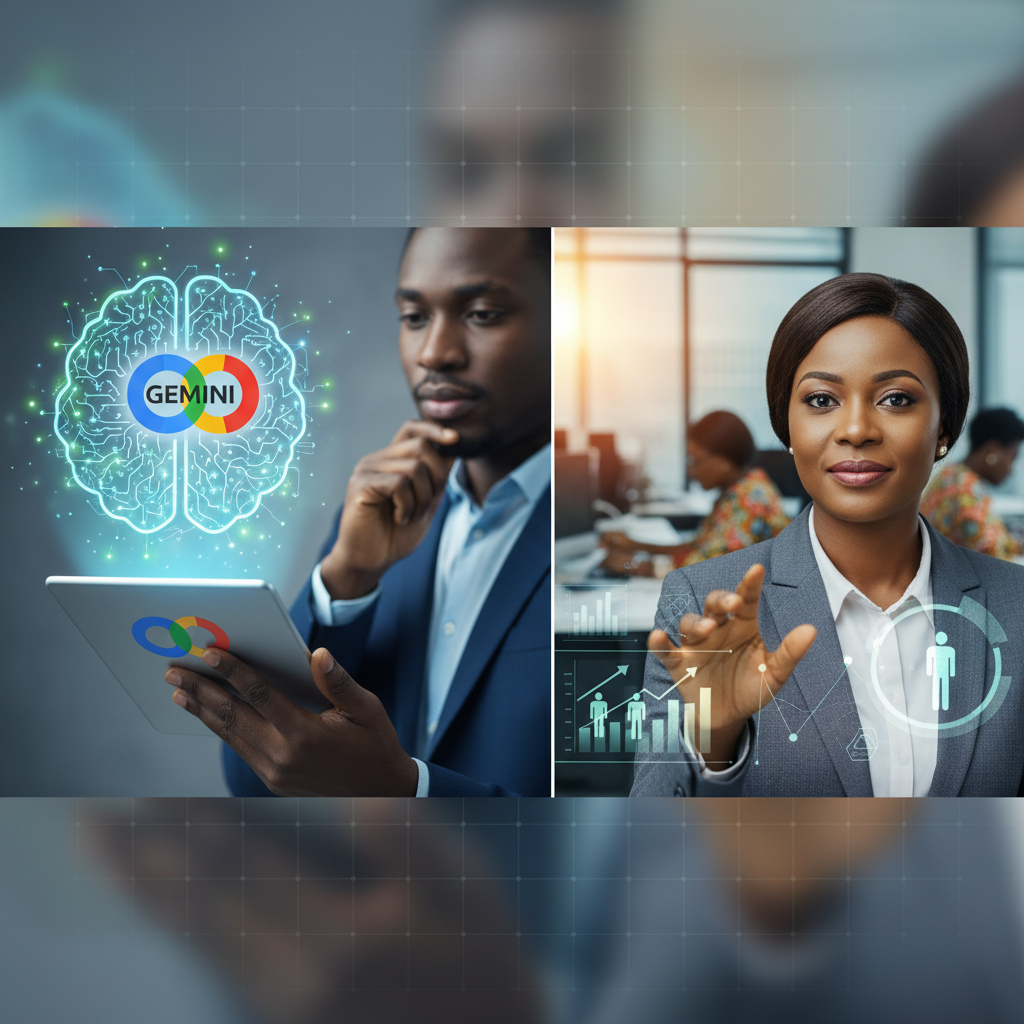
The fluorescent lights of the Lagos office hummed, a familiar soundtrack to Chidi's mounting anxiety. He stared at his laptop, the cursor blinking mockingly on a spreadsheet that refused to balance. His head throbbed. Usually, he would call his friend, maybe step out for a quick suya. But today, his company, a fast-growing fintech called 'NaijaPay', had a new directive: for stress, for burnout, for anything that felt too heavy, there was 'MindMender AI', an in-house digital wellness platform powered by a custom-tuned version of Google's Gemini. Chidi sighed, clicked the icon, and watched as a friendly, animated avatar materialized on his screen, asking in a soothing, synthesized voice, 'Hello Chidi. How are you feeling today?'
This isn't a scene from a science fiction novel, my friends. This is April 2026, and the future is already here because it's just not evenly distributed. In Nigeria, a nation known for its resilience and entrepreneurial spirit, the integration of AI into mental health support for workers is no longer an experiment, it's a burgeoning reality. I've seen it firsthand, from the bustling tech hubs of Yaba to the corporate towers of Victoria Island. Companies, desperate to retain talent and boost productivity amidst rising stress levels, are turning to AI chatbots, addiction algorithms, and digital wellness apps with an enthusiasm that borders on the evangelical.
Let's talk numbers, because that's what gets the attention of the boardrooms. A recent report by DataGlobal Hub's West Africa desk revealed a staggering 180% increase in corporate adoption of AI-driven mental wellness platforms across Nigeria in the last 18 months alone. For companies with over 500 employees, the adoption rate stands at an impressive 65%. The projected Return on Investment, according to a study by the Nigerian Institute of Management, averages 3.5x within two years, primarily due to reduced absenteeism and improved employee engagement. The promise is clear: a healthier workforce means a wealthier company.
Take 'NaijaPay', for instance. Their HR director, Funke Adebayo, told me, 'Before MindMender AI, our employee assistance program saw less than 10% utilization. People were shy, they feared stigma. Now, with the anonymity of an AI, that number has jumped to nearly 45% for initial consultations.' She credits the AI with a 15% drop in reported stress-related sick days. This is powerful stuff, particularly in a society where mental health discussions are often shrouded in silence and cultural taboos.
However, not everyone is singing praises. For every NaijaPay, there's a company like 'AfroConnect Telecoms' that stumbled. They implemented an 'addiction algorithm' designed to detect and intervene in potential substance abuse based on communication patterns and work hours. It was a disaster. Employees felt spied upon, and the algorithm, trained on Western datasets, often flagged perfectly normal Nigerian communication styles as 'erratic'. Productivity plummeted, and a significant portion of their top engineering talent left for competitors. Mark my words, context matters, and a one-size-fits-all AI solution rarely works in our diverse landscape.
Worker perspectives are as varied as the colours of a Lagos market. Chidi, after his initial hesitation, found MindMender AI surprisingly helpful. 'It's not like talking to a person, no. But it asks the right questions, helps me organize my thoughts, and gives me breathing exercises. Sometimes, that's all you need to clear your head,' he confessed. Yet, others remain deeply skeptical. 'It's a machine, abeg,' scoffed Emeka, a software developer at a rival firm. 'It doesn't understand my mother's pressure, or the traffic on Third Mainland Bridge. It's just keywords and algorithms. Where is the empathy?' This sentiment is echoed by many who feel that while AI can offer tools, it cannot replace the nuanced understanding and human connection essential for true mental well-being.
Dr. Ngozi Okoro, a leading psychiatrist and founder of the 'Mindful Nigeria Initiative', offers a balanced perspective. 'AI tools like therapy chatbots and digital wellness apps have immense potential to democratize access to mental health support, especially in a country with a severe shortage of trained professionals,' she explained during a recent panel discussion. 'However, we must be vigilant. These are assistive technologies, not replacements for human therapists. The risk of misdiagnosis, over-reliance, and privacy breaches is significant if not managed ethically.' She emphasized the need for culturally competent AI models and robust data protection frameworks. According to MIT Technology Review, the development of culturally sensitive AI remains a global challenge, but one that is particularly acute in diverse nations like Nigeria.
Indeed, the ethical considerations are paramount. Who owns the data generated by these wellness apps? How is it secured? Can an algorithm truly understand the intricacies of Nigerian social dynamics, family pressures, and spiritual beliefs that often underpin mental distress? These are not simple questions, and the answers will shape the future of work and wellness in our nation. Companies like 'TechCure Africa', a Nigerian startup, are attempting to address this by building localized AI models, incorporating local languages, proverbs, and cultural narratives into their therapy chatbots. Their founder, Aisha Bello, believes that 'Nigeria will lead this revolution in culturally intelligent AI, because we understand the nuances of our own people better than any foreign tech giant.'
What's coming next? I predict a decade of intense innovation and consolidation in this space. We will see more sophisticated AI models, perhaps even those powered by advanced multimodal AI like Google's Gemini, capable of interpreting vocal inflections and facial micro-expressions to better gauge emotional states. The line between a digital assistant and a digital confidante will blur further. We will also witness a push for hybrid models, where AI acts as a first line of defense, triaging and providing initial support, before seamlessly escalating to human therapists for complex cases. This blend of technology and humanity, if executed thoughtfully, could be the sweet spot. The challenge, as always, will be to ensure that the pursuit of efficiency does not come at the expense of genuine care and human dignity. The conversation around AI and mental health is just beginning here, and it promises to be as vibrant and complex as Nigeria itself. For more insights into how AI is reshaping industries, you can explore articles on TechCrunch. The landscape is changing fast, and we must be ready to adapt, to innovate, and to protect our people's well-being in this new digital era.