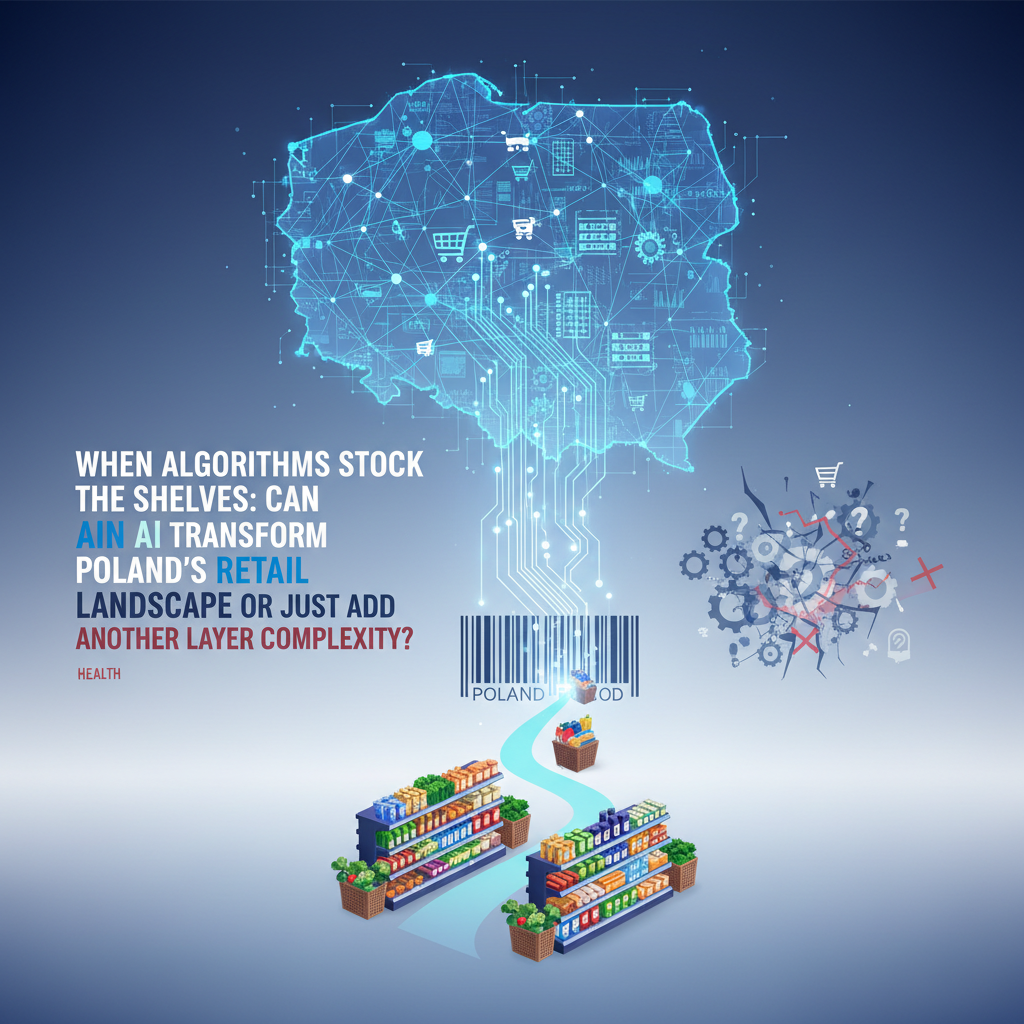

The bustling aisles of a modern supermarket, or the meticulously curated digital storefront of an e-commerce giant, might seem like a straightforward affair to the casual observer. Yet, beneath this veneer of simplicity lies a logistical ballet of immense complexity. Every item on every shelf, physical or virtual, represents a decision, a prediction, and a calculated risk. For decades, this intricate dance has been choreographed by human intuition, historical data, and often, a significant degree of guesswork. Today, however, a new conductor has entered the orchestra pit: Artificial Intelligence.
Is this algorithmic maestro merely a passing novelty, a fleeting moda in the ever-changing world of commerce, or is it fundamentally altering the very fabric of retail operations, becoming the new normal? From my vantage point in Poland, a country with a vibrant and rapidly evolving retail sector, the evidence suggests the latter. AI is not just optimizing; it is redefining how goods move from producer to consumer, how shelves are stocked, and how individual preferences are understood.
Historically, demand forecasting in retail was a blunt instrument. Retailers relied on seasonal trends, holiday spikes, and perhaps some basic regression analysis. The result was often either overstocking, leading to costly waste and markdowns, or understocking, resulting in lost sales and frustrated customers. Consider the challenge of a Polish grocer preparing for Wigilia, Christmas Eve. Predicting the exact quantity of carp, barszcz, and makowiec required a blend of experience and prayer. A slight miscalculation could mean significant financial loss or a disappointed community.
Then came the era of big data, providing an unprecedented volume of transactional information. But data alone is inert; it requires sophisticated processing. This is where AI, particularly machine learning models, has proven transformative. The algorithm works like this: instead of merely looking at past sales, AI models ingest a multitude of variables. These include local weather patterns, public holidays, school calendars, social media sentiment, competitor pricing, local events, and even macroeconomic indicators. For instance, a sudden cold snap in April might trigger an AI system to increase orders for tea and soup in specific regions, while a heatwave might boost demand for ice cream and bottled water.
Major players like Amazon and Walmart have been at the forefront of this revolution for years, leveraging their immense data reservoirs. Amazon, for example, reportedly uses AI to predict product demand with remarkable accuracy, sometimes even before a customer places an order, allowing for pre-shipping to distribution centers closer to anticipated buyers. This proactive approach significantly reduces delivery times and logistics costs. Similarly, Walmart has invested heavily in AI for inventory management, aiming to reduce stockouts and optimize shelf space across its vast network of stores.
In Europe, the adoption is equally compelling. According to a recent report, the global AI in retail market is projected to grow significantly, with a compound annual growth rate exceeding 25% over the next five years. This growth is driven by the demonstrable return on investment. Retailers employing AI for demand forecasting have reported reductions in inventory holding costs by 10-30% and an increase in sales due to improved product availability by 5-15%. These are not marginal gains; they represent fundamental shifts in profitability.
From a systems perspective, inventory optimization is a direct beneficiary of accurate demand forecasting. Once demand is predicted, AI systems can then determine optimal stock levels, reorder points, and even warehouse placement. This minimizes the 'bullwhip effect' in the supply chain, where small fluctuations in retail demand lead to increasingly larger fluctuations in orders upstream. For a country like Poland, which relies heavily on efficient logistics within the European Union, streamlining this process is paramount. Poland's engineering talent explains why many local startups are now emerging to offer specialized AI solutions for supply chain challenges, often tailored to the nuances of the European market.
Beyond the cold logic of logistics, AI is also profoundly reshaping the customer experience through personalization. The days of generic marketing campaigns are rapidly fading. AI-powered recommendation engines, familiar from Netflix and Spotify, are now standard in retail. These systems analyze individual browsing history, purchase patterns, demographic data, and even real-time behavior to suggest products, promotions, and content that are highly relevant to each customer. This is not merely about showing a customer a product they might like; it is about creating a bespoke shopping journey.
Consider the online Polish fashion retailer, Answear.com, or the grocery giant, Żabka. Both are increasingly using AI to understand customer preferences. Żabka, with its vast network of convenience stores, leverages data from its loyalty program to offer personalized discounts and product suggestions through its mobile application. This level of granular personalization was unimaginable a decade ago. It transforms the shopping experience from a hunt for necessities into a curated discovery.
However, this technological advancement is not without its challenges. Data privacy is a significant concern, particularly in Europe with the stringent General Data Protection Regulation, GDPR. Retailers must navigate the fine line between leveraging customer data for personalization and respecting individual privacy rights. Transparency in how data is collected and used is crucial for maintaining consumer trust. Moreover, the implementation of these complex AI systems requires significant investment in infrastructure, talent, and ongoing maintenance. Small and medium-sized enterprises, particularly in regions with less developed tech ecosystems, may struggle to keep pace.
Expert opinions on this trend are largely aligned regarding its inevitability, though concerns about implementation remain. Dr. Anna Wróblewska, a leading AI ethics researcher at the University of Warsaw, recently stated, "The power of AI in retail is undeniable, but we must ensure its deployment is ethical and transparent. The algorithms must serve the customer, not exploit them, and data privacy cannot be an afterthought." Her words resonate deeply with the European emphasis on consumer protection.
Similarly, Mr. Piotr Konieczny, CEO of a prominent Polish logistics tech firm, emphasized the practical benefits. "We have seen our clients achieve remarkable efficiencies. A 15% reduction in spoilage for fresh produce, for example, is not just a financial gain; it is a step towards greater sustainability. AI provides the precision that human oversight alone cannot match," he told Reuters in a recent interview.
Even Mr. Satya Nadella, CEO of Microsoft, whose company offers numerous AI solutions for enterprise, has highlighted the broader implications. He noted in a recent earnings call, "AI is transforming every industry, and retail is at the forefront. It is about empowering businesses to do more with less, to understand their customers better, and to innovate at a pace previously impossible." This sentiment underscores the strategic importance of AI not just as a tool, but as a competitive imperative.
My verdict is clear: AI in retail, encompassing demand forecasting, inventory optimization, and personalized shopping, is far from a fad. It is the new normal. The efficiencies gained, the waste reduced, and the enhanced customer experiences are too significant to ignore. While the initial investment and the ethical considerations present hurdles, the trajectory is undeniable. Companies that embrace these technologies will thrive, while those that cling to outdated methods risk being left behind, much like a traditional sklep trying to compete with a modern hypermarket without a proper supply chain. The future of retail, from the bustling bazar to the global e-commerce platform, will be increasingly intelligent, increasingly personalized, and undeniably algorithmic. The challenge now is to ensure this intelligence is wielded responsibly, for the benefit of both businesses and consumers across Poland and beyond.