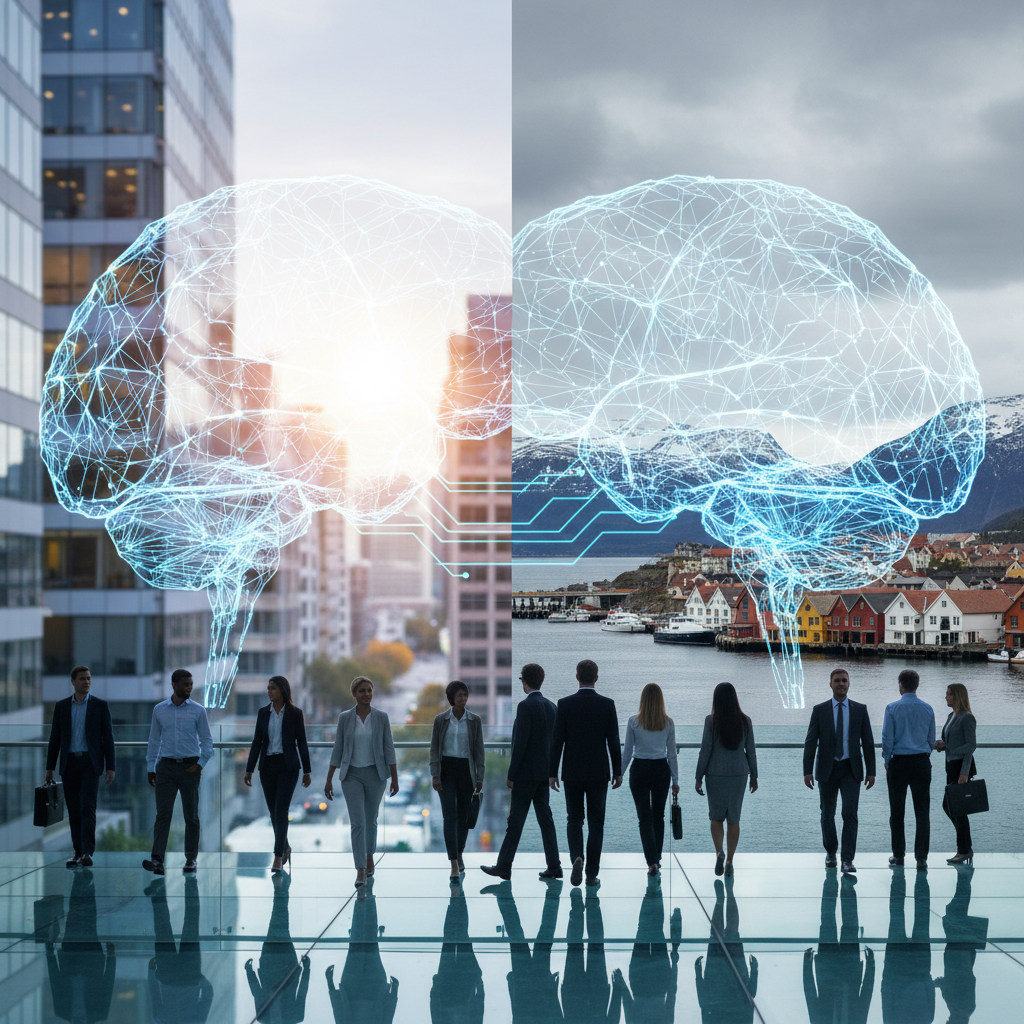

The fjords of Norway, carved by millennia of ice and water, stand as enduring symbols of precision and natural order. Yet, in the digital realm, the currents of artificial intelligence often flow with less predictable, and sometimes less equitable, force. Today, the global conversation around AI bias in hiring has reached a critical juncture, particularly here in Europe, where robust regulatory frameworks are beginning to crystallize. The question is no longer if algorithms discriminate, but how we, as a society, will engineer their fairness.
The European Union's Artificial Intelligence Act, a landmark piece of legislation, is now in its implementation phase, sending ripples across the continent and beyond. This comprehensive law classifies AI systems based on their risk level, with those used in employment and worker management falling squarely into the 'high-risk' category. This designation is not merely bureaucratic; it mandates stringent requirements for data governance, human oversight, transparency, and accuracy. For companies utilizing AI in their hiring processes, from initial candidate screening to performance evaluations, the landscape has fundamentally shifted.
Norway, though not a full EU member, often aligns closely with European regulations through its participation in the European Economic Area, or EEA. This means the implications of the AI Act are very much a reality for Norwegian businesses and public institutions. "Norway's approach to AI is rooted in trust, and that trust is built on transparency and accountability," explains Dr. Kristin Skogen Lund, CEO of Schibsted, one of Norway's largest media and technology groups. "The AI Act provides a much-needed framework to ensure that the tools we deploy uphold these fundamental values, especially when they impact people's livelihoods."
The urgency for such regulation is underscored by a growing body of evidence and a surge in legal challenges. Consider the case of Amazon, which famously abandoned an AI recruiting tool in 2018 after discovering it discriminated against women. The system, trained on a decade of resumes predominantly from male applicants in technical roles, learned to penalize resumes containing words like 'women's' or graduates of women's colleges. This was a stark early warning, a digital canary in the coal mine, illustrating how historical biases can be inadvertently codified into future decision-making systems.
More recently, reports from the United States have highlighted ongoing issues. A 2023 study by the National Bureau of Economic Research found that AI job application screening tools could exacerbate existing biases, particularly against older workers and certain minority groups. While American legal frameworks, such as the New York City law requiring bias audits for automated employment decision tools, offer some protections, the EU AI Act's scope is broader and more prescriptive.
Let me explain the engineering behind this challenge. AI hiring tools often operate on principles of pattern recognition. They analyze vast datasets of past successful hires and job performance to predict future success. The problem arises when these historical datasets reflect societal biases. If a company historically hired fewer women for engineering roles, the AI might learn that 'female' is a negative predictor for 'successful engineer,' not because of actual capability, but because of the data's inherent skew. It is like training a compass using a magnetic field that has always been subtly off true north; the compass will consistently point to a skewed destination.
The regulatory response in Europe demands a proactive approach. Companies must now conduct thorough impact assessments, implement human oversight mechanisms, and ensure that their AI systems are regularly audited for bias. This is not a trivial undertaking. It requires significant investment in data scientists, ethicists, and legal experts. For many Norwegian companies, particularly smaller enterprises, navigating these new requirements represents a substantial challenge, albeit a necessary one.
Indeed, the Nordic model extends to technology, emphasizing social welfare and equitable access. This ethos naturally translates into a demand for AI systems that do not perpetuate or amplify existing inequalities. The Norwegian Data Protection Authority, Datatilsynet, has been actively engaging with businesses to prepare for the AI Act's full enforcement. "Our role is not just to enforce, but to guide," states Bjørn Erik Thon, Director General of Datatilsynet. "We are seeing genuine efforts from companies to understand and implement these new standards, recognizing that trust in AI is paramount for its societal acceptance and economic benefit."
Beyond the regulatory stick, there is also a growing understanding of the business case for fair AI. Diverse teams are proven to be more innovative and financially successful. Companies that can demonstrate unbiased hiring practices are likely to attract top talent, particularly younger generations who prioritize ethical considerations. This is not merely about avoiding lawsuits; it is about building a more robust and resilient workforce.
Consider the practical implications. An AI system designed to screen thousands of applications for a software developer role might flag candidates with non-traditional educational backgrounds or those who took career breaks for family reasons as less suitable, simply because the training data did not include many such 'successful' profiles. The AI Act compels companies to identify these potential biases and mitigate them, perhaps by ensuring diverse training data, or by implementing explicit fairness metrics during model development and deployment. This could involve using techniques like 'adversarial debiasing' or 'fairness-aware learning' to actively reduce discriminatory outcomes.
Globally, the conversation is intensifying. OpenAI, for instance, has publicly committed to developing AI systems that are fair and unbiased, acknowledging the profound societal impact of their technologies. Similarly, Google's DeepMind continues to research methods for identifying and mitigating bias in large language models and other AI applications. The pressure is mounting from all sides: regulators, civil society organizations, and increasingly, from the public itself.
The path ahead is not without its complexities. Defining 'fairness' in an algorithmic context can be challenging, as different definitions can lead to different outcomes. Is it about equal opportunity, equal outcome, or something else entirely? These are philosophical questions that engineers and policymakers must grapple with collectively. However, the direction is clear: the era of unchecked algorithmic deployment in sensitive areas like employment is drawing to a close, at least in Europe.
The shift we are witnessing is profound. It is a move from simply optimizing for efficiency to optimizing for equity. From a Norwegian perspective, where societal cohesion and fairness are deeply ingrained values, this evolution in AI governance is not just welcome; it is essential. The global race for AI supremacy must not come at the cost of human dignity and equal opportunity. As the digital tides continue to rise, Europe, with Norway as an active participant, is striving to build digital dikes that protect against algorithmic injustice, ensuring that the promise of AI is a promise for all. For further insights into the global regulatory landscape, one might consult MIT Technology Review or Reuters Technology. The future of work, shaped by AI, depends on it.