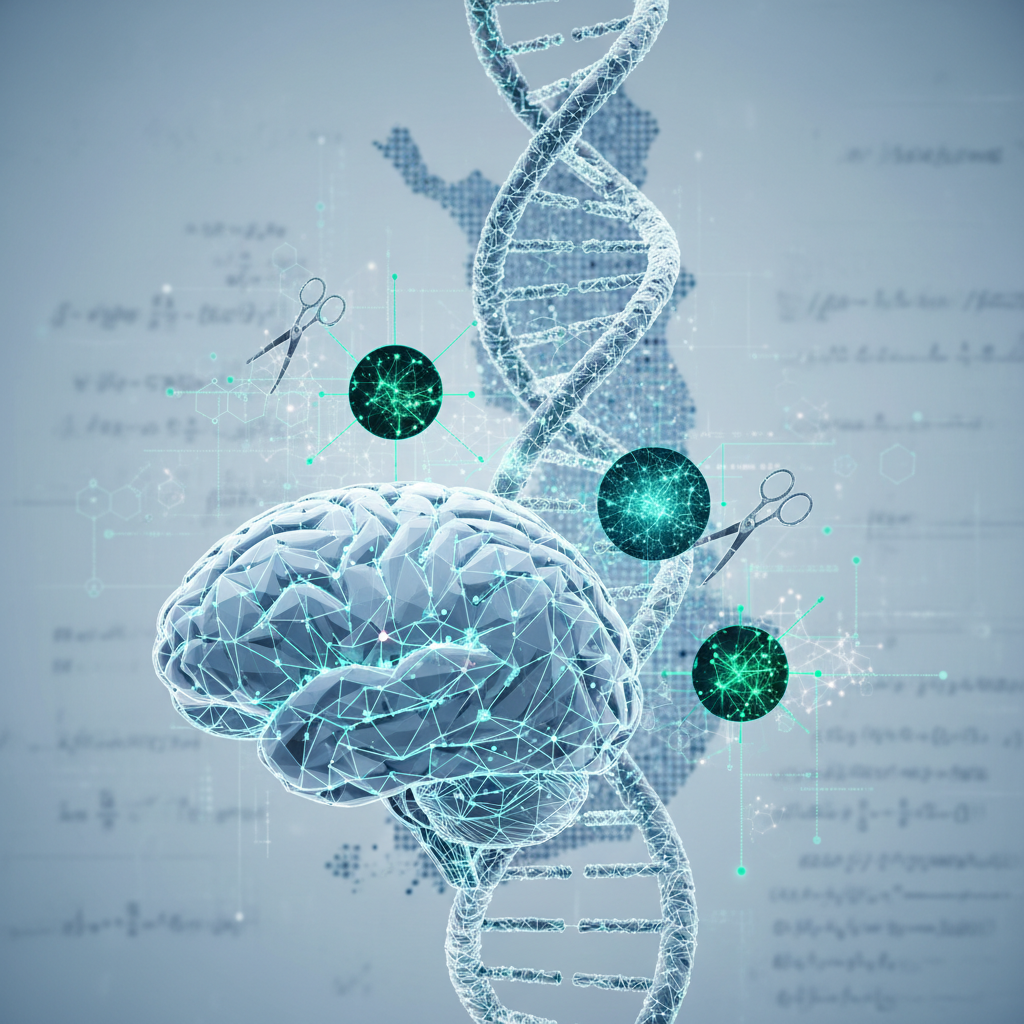

The world of artificial intelligence often feels like a constant barrage of pronouncements, each grander than the last. From generative models crafting prose to autonomous vehicles navigating complex cityscapes, the sheer volume of claims can overwhelm. Yet, beneath the surface of this digital cacophony, truly transformative work continues, often in fields far removed from the immediate public gaze. One such area, where meticulous research is now yielding tangible breakthroughs, is the intersection of AI and gene editing, particularly with Crispr technology. This is not about speculative futures, but about refining tools that are already reshaping medicine.
For years, Crispr Cas9 has been hailed as a revolutionary tool for its ability to precisely edit DNA. It has offered unprecedented control over the genetic code, promising cures for inherited diseases and new avenues for treating complex conditions like cancer. However, the initial enthusiasm, while justified, also highlighted inherent challenges. Off target edits, where the Crispr system cuts DNA at unintended locations, remain a significant concern. Predicting the efficiency and specificity of guide RNAs, the molecular GPS for Crispr, has also been an art more than a science. This is where machine learning, with its capacity for pattern recognition and predictive modeling, enters the picture, offering a path to unprecedented precision.
Recent research from institutions like the Broad Institute of MIT and Harvard, alongside groups at Stanford University, has demonstrated how AI can significantly enhance CRISPR's capabilities. One notable development involves the use of deep learning models to predict the efficacy and specificity of guide RNAs. Researchers, for example, have trained neural networks on vast datasets of experimental Crispr outcomes. These datasets include information on guide RNA sequences, target DNA sequences, and the resulting editing efficiencies and off target rates. By learning from these patterns, AI models can then predict with remarkable accuracy how a novel guide RNA will perform before it is even synthesized in a laboratory.
This predictive power is not merely an incremental improvement; it represents a fundamental shift. Imagine a scenario where a clinician or researcher needs to target a specific gene mutation responsible for a rare disease. Instead of laboriously designing and testing dozens of guide RNAs in the lab, an AI model can rapidly identify the most effective and least off target prone sequences. This dramatically accelerates the research process, reduces experimental costs, and, crucially, enhances the safety profile of potential gene therapies. As Dr. Feng Zhang, one of the pioneers of Crispr technology at the Broad Institute, has often emphasized, "Precision is paramount in gene editing. Any improvement in specificity and efficiency brings us closer to safe and effective clinical applications." His work, and that of his colleagues, consistently drives the field forward, often integrating computational approaches to refine biological tools.
The Technical Underpinnings: From Data to Design
The technical details, while complex, boil down to intelligent pattern recognition. Machine learning algorithms, particularly convolutional neural networks and recurrent neural networks, are adept at identifying subtle relationships within sequence data. For Crispr, this means analyzing the sequence of the guide RNA, the target DNA, and even epigenetic factors that might influence accessibility. These models learn to weigh different features, such as GC content, the presence of specific motifs, and the potential for secondary structures, to predict how well a guide RNA will bind and cut.
One approach, exemplified by tools developed at the Broad Institute, involves training models on large-scale functional genomics screens. These screens generate millions of data points on Crispr activity across various cell types and genomic loci. The AI then distills this information into predictive algorithms. For instance, a model might predict that a guide RNA with a certain nucleotide at position 18 and a specific flanking sequence is 90 percent likely to achieve high on target editing with less than 1 percent off target activity. This level of data driven optimization was simply unattainable a decade ago.
The implications for drug discovery are profound. Pharmaceutical companies, including giants like Novartis and Vertex Pharmaceuticals, are heavily investing in gene therapy platforms. The ability to design highly specific Crispr tools reduces the time and expense associated with preclinical development. It also increases the likelihood of successful clinical trials, as off target effects have been a significant hurdle in previous gene therapy attempts. This convergence of AI and biotechnology is creating a new paradigm for precision medicine, moving beyond broad stroke treatments to highly individualized interventions.
Finland's Role in a Data Driven Future
For a nation like Finland, with its strong emphasis on education, robust digital infrastructure, and a pragmatic approach to technological development, these advancements resonate deeply. Our healthcare system, known for its comprehensive electronic health records and a willingness to embrace innovation, provides a fertile ground for integrating such technologies. The concept of personalized medicine, tailored to an individual's genetic makeup, aligns perfectly with our long standing commitment to public health and equitable access to advanced care.
Finland's approach is quietly revolutionary. We understand that true innovation often comes not from flashy pronouncements, but from meticulous, data driven work. Our universities, such as the University of Helsinki and Aalto University, are actively engaged in bioinformatics and computational biology research, training the next generation of scientists who can bridge the gap between AI and genomics. The Finnish Biobank Act, for example, facilitates the ethical and responsible use of human biological samples and associated health data for research, providing a crucial resource for training sophisticated AI models in a real world context.
Furthermore, the legacy of companies like Nokia taught us something about reinvention and the importance of foundational research. While the focus has shifted from mobile phones, the underlying principles of rigorous engineering and long term vision remain. This same ethos is now being applied to areas like health technology and AI, where Finnish startups are exploring novel applications for precision diagnostics and therapeutics. We are not chasing fleeting trends; we are building robust, sustainable solutions.
Looking Ahead: Ethical Considerations and Broader Impact
While the scientific promise is immense, the ethical considerations surrounding gene editing, even when AI enhanced, cannot be overlooked. Questions of accessibility, equity, and the long term societal impact of germline editing remain critical. Regulators in Europe, guided by principles of caution and public benefit, are carefully navigating this evolving landscape. The European Medicines Agency EMA, for instance, is developing frameworks for advanced therapy medicinal products ATMPs, which include gene therapies, to ensure their safety and efficacy.
However, the immediate impact of AI driven Crispr optimization will likely be seen in somatic cell gene therapies, where edits are made in non reproductive cells and are not heritable. Here, the increased precision offered by AI could unlock treatments for a wider array of genetic disorders, from cystic fibrosis to Huntington's disease, and even complex conditions like cardiovascular disease and neurodegenerative disorders. The ability to minimize off target effects reduces the risk profile, making these therapies safer and potentially more broadly applicable.
The sauna principle of AI development, slow heat, lasting results, applies here. We are not rushing into unproven applications, but systematically refining the tools. The integration of AI with Crispr is not just about making gene editing faster; it is about making it safer, more predictable, and ultimately, more effective for patients. This is a journey of scientific rigor, ethical deliberation, and persistent innovation, one that promises to redefine our understanding of disease and our capacity to heal. The quiet work happening in laboratories today will echo loudly in the clinics of tomorrow, bringing hope to millions. This is the kind of progress that truly matters, built on data, precision, and a clear understanding of human need. It is a testament to what can be achieved when advanced computational power meets fundamental biological insight. The future of medicine is increasingly a dialogue between bits and genes, and AI is becoming the essential translator. For more on these developments, one might consult the detailed research published in journals accessible via MIT Technology Review or Nature Machine Intelligence. The ongoing discussions about the ethical implications are also frequently covered by outlets like The Verge.
This convergence is not just a scientific curiosity; it is a strategic imperative for nations committed to advanced healthcare. Finland, with its unique blend of technological acumen and societal values, is well positioned to contribute meaningfully to this next chapter of precision medicine, ensuring that these powerful tools are developed and deployed responsibly for the benefit of all.