
The morning air in Yangon, even in April, carries a certain weight. It is not just the humidity, but the unspoken anxieties of a nation navigating profound change. Here, the internet is not a given, and stability is a luxury. Yet, even in this challenging environment, the global gig economy has found its foothold. Motorcycle taxis zip through traffic, their drivers glued to apps, while young people hunch over screens, performing microtasks for unseen employers thousands of miles away. It is a world where algorithms, not human managers, increasingly dictate terms, and the promise of flexibility often masks a deeper form of control.
This reality is why I sought out Dr. Mary L. Gray, a principal researcher at Microsoft Research and a faculty affiliate at Harvard University's Berkman Klein Center for Internet and Society. Her work, particularly her book Ghost Work: How to Stop Silicon Valley from Building a New Global Underclass, co-authored with Siddharth Suri, has been a beacon for understanding the human cost behind the gleaming facade of AI and automation. She speaks with a quiet authority, her words carefully chosen, yet carrying the weight of deep conviction. For me, coming from Myanmar, her insights resonate with a particular urgency. In Myanmar, the stakes are different; the digital divide is stark, and the protections for workers are often fragile, if they exist at all.
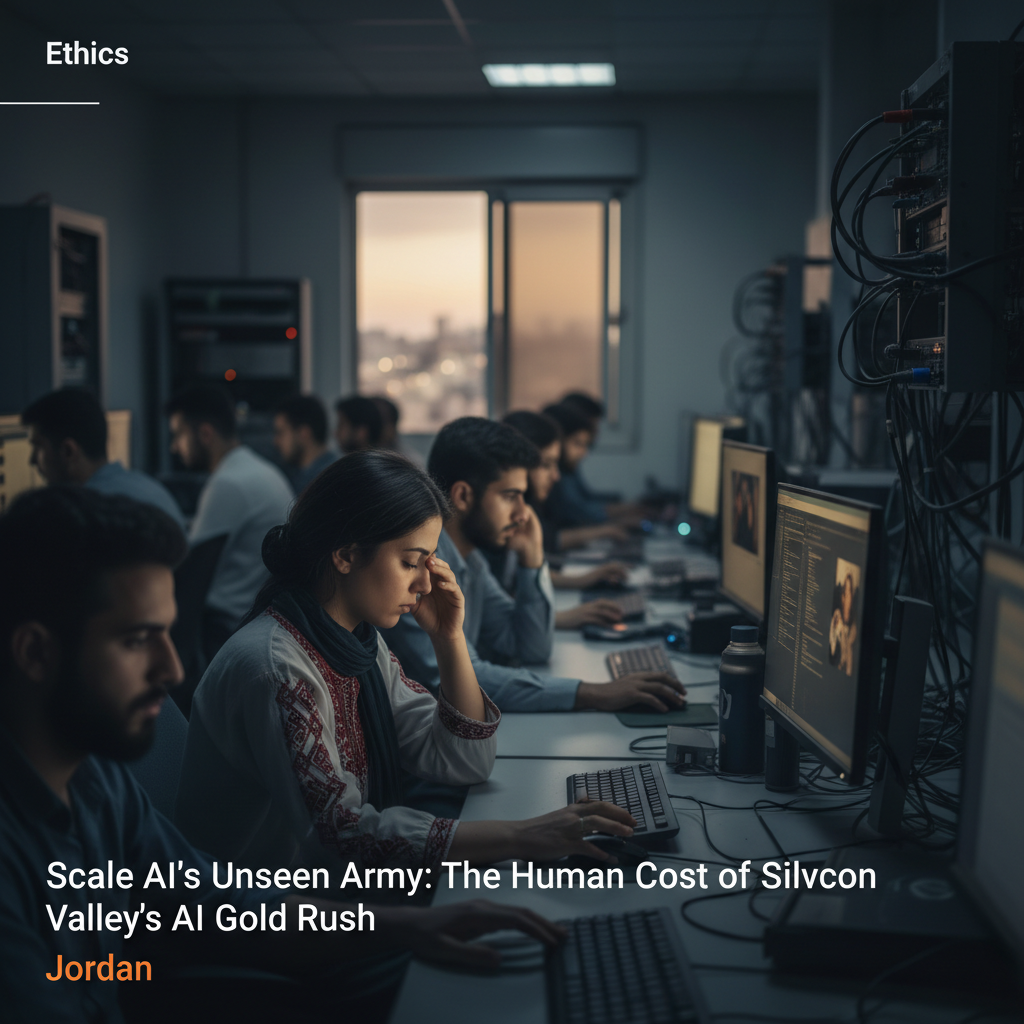
Dr. Gray and her colleagues have spent years studying the vast, often invisible workforce that powers much of the AI we interact with daily. These are the people who label images, transcribe audio, moderate content, and perform countless other tasks that machine learning models cannot yet do autonomously. They are the 'ghost workers,' and their labor is essential, yet largely unacknowledged. "The gig economy, particularly the kind that powers AI, is often presented as a path to entrepreneurship and flexibility," Dr. Gray told a conference audience recently, "but for many, it is a race to the bottom, where algorithms set the pace and pay, often leaving workers with little recourse." This statement struck me deeply, as it mirrors the experiences I have witnessed firsthand in my own country.
She emphasizes that the algorithms are not just tools; they are management systems. They assign tasks, monitor performance, calculate pay, and even discipline workers. This algorithmic management, as she calls it, creates a unique power dynamic. Workers are constantly trying to decipher the 'black box' of the algorithm, attempting to understand its logic to secure more work or better ratings. "When you are working for an algorithm, you are constantly trying to optimize for an opaque system," Dr. Gray has explained in interviews. "There is no human manager to appeal to, no supervisor to negotiate with. The algorithm is the boss, and its decisions are often final and unquestionable." This lack of transparency and accountability is a critical concern, especially in regions where labor laws are weak or unenforced.
Dr. Gray's research highlights how these systems can exacerbate existing inequalities. Many ghost workers are in developing countries, seeking opportunities where traditional employment is scarce. They are often women, young people, or those from marginalized communities. While technology can be a lifeline, offering a way to earn income when other avenues are closed, it also exposes them to new forms of exploitation. The promise of global access to work is often met with precarious conditions, low wages, and intense competition. "We are seeing a global labor arbitrage," Dr. Gray noted in a discussion about her research, "where companies can tap into a vast pool of labor willing to work for very little, simply because their local economies offer even fewer options." This reality is particularly poignant in places like Myanmar, where economic instability drives many to seek any available work, regardless of the terms.
The implications for workers' rights are profound. Without a clear employer, traditional labor protections like minimum wage, benefits, or collective bargaining become incredibly difficult to apply. Dr. Gray advocates for a fundamental rethinking of how we categorize and protect these workers. She argues that we need to move beyond the simplistic binary of 'employee' versus 'independent contractor' and develop new frameworks that recognize the realities of algorithmic management. "We need to ensure that these workers have dignity, fair pay, and a voice," she asserted in a recent article for MIT Technology Review. "Otherwise, we are building a future where a significant portion of the global workforce is trapped in a cycle of precarious, invisible labor." This is about survival, not convenience, for millions.
Her vision for the future is not one of abandoning the gig economy or AI, but rather of reimagining it with human dignity at its core. She calls for greater transparency in algorithmic systems, allowing workers to understand how decisions are made. She also advocates for policies that ensure a living wage, access to benefits, and avenues for dispute resolution, regardless of employment classification. This includes pushing for collective action among workers, even across borders, to demand better terms from platform companies. "The power imbalance is significant, but it is not insurmountable," Dr. Gray believes. "Workers, when organized and empowered, can demand change." She points to nascent efforts by gig workers in various countries to form unions or associations as a hopeful sign.
For Myanmar, where digital literacy is growing but access to resources remains limited, Dr. Gray's work offers crucial lessons. As more people turn to online platforms for income, understanding the mechanisms of algorithmic control becomes paramount. It is not enough to simply provide internet access; we must also equip workers with the knowledge and tools to navigate these complex digital labor markets fairly. This means investing in digital literacy programs that go beyond basic computer skills to include critical thinking about platform economics and algorithmic biases. It also means advocating for policies that protect workers, even those operating in the shadows of the global internet. The challenges are immense, but the opportunity to shape a more equitable digital future is equally significant. We cannot afford to let the promise of technology obscure the human cost of its implementation. The future of work, especially in vulnerable regions, depends on it. We must ensure that the algorithms serve humanity, not the other way around. For more insights into the unseen labor that powers AI, one might consider the ongoing discussions around data labeling and its impact on workers globally, as explored in articles like What is Data Labeling? The Unseen Labor Powering Google's AI and Why It Demands Dignity [blocked].
As I reflect on my conversation with Dr. Gray, I am reminded that the struggle for justice in the digital realm is deeply intertwined with broader struggles for human rights and economic equity. The algorithms may seem abstract, but their impact is profoundly real, shaping the daily lives and livelihoods of millions. It is a call to action for all of us, from policymakers to platform developers and, most importantly, to the workers themselves, to demand a more just and humane digital economy. The fight for fair labor practices in the age of AI is not just a Western concern; it is a global imperative, and its echoes are felt most acutely in places like my home, Myanmar, where every opportunity, and every challenge, carries immense weight. The path forward requires vigilance, solidarity, and a steadfast commitment to ensuring that technology truly serves all of humanity, not just a privileged few. Her work, accessible through resources like Wired's AI coverage, continues to shape this vital conversation.