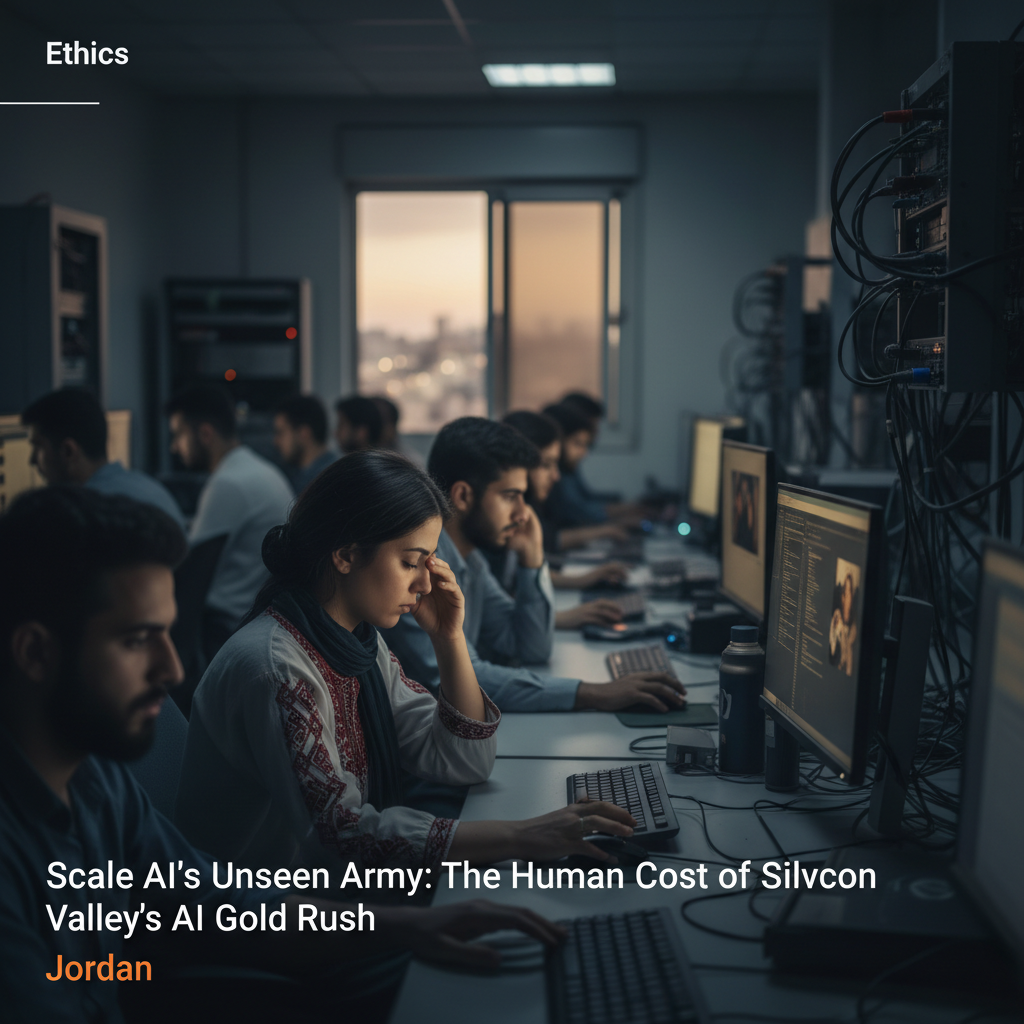

The air in Amman this morning is crisp, carrying the scent of cardamom coffee and the distant hum of traffic. Here, life moves with a rhythm distinct from the frenetic pace of Silicon Valley. Yet, the decisions made in those gleaming Californian campuses ripple across our world, often in ways we barely perceive. Today, I want to talk about one such ripple, a phenomenon so fundamental to the AI revolution that it’s almost entirely overlooked: the data labeling industry, spearheaded by companies like Scale AI.
The Headline Development: The Unseen Foundation of AI
We hear endless chatter about OpenAI's GPT models, Google's Gemini, and Anthropic's Claude. We marvel at their ability to generate text, code, and images. But how do these behemoths learn? They learn from data, vast oceans of it, meticulously annotated and categorized by human hands. This is where companies like Scale AI come in. They are the invisible backbone, the unsung heroes, or perhaps, the silent exploiters, depending on your perspective, of the entire AI ecosystem. They provide the crucial service of data labeling, turning raw, unstructured data into the neatly packaged, labeled datasets that machine learning models require for training.
Scale AI, founded by Alexandr Wang, has become a juggernaut in this space, reportedly valued at over $13 billion. They boast clients like OpenAI, Google, and Microsoft. Their business model is simple yet profound: connect companies with massive data labeling needs to a global workforce, often located in regions where labor costs are lower. This isn't just about drawing bounding boxes around cars for self-driving cars; it's about transcribing audio, moderating content, categorizing medical images, and refining the very language models that are reshaping our digital lives. It’s the digital equivalent of mining for gold, but the gold here is data, and the miners are often paid pennies.
Why Most People Are Ignoring It: The Glamour Gap
Let’s be honest. Data labeling isn't sexy. It doesn't involve flashy product launches, groundbreaking scientific papers, or billionaire CEOs debating existential risks on Twitter. It’s the grunt work, the digital pickaxe and shovel. The media, quite understandably, gravitates towards the dazzling outputs of AI, not the arduous, often repetitive input. We celebrate the generative art, the intelligent chatbots, the self-driving cars, but we rarely ask: who taught them? Who painstakingly drew those thousands of polygons around every pedestrian in a street scene? Who listened to hours of mumbled speech to transcribe it for voice assistants? The West has it backwards, focusing on the shiny facade while ignoring the human engine beneath.
This attention gap is dangerous. It allows for a lack of scrutiny, a blind spot where ethical concerns, labor rights, and economic disparities can fester. The narrative is always about technological progress, not the human cost of that progress. It’s easier to talk about AI safety at a Davos panel than to ensure fair wages for a data labeler in a remote village.
How It Affects YOU: The Personal Impact
Think about the AI you interact with daily. Your phone’s facial recognition, your smart speaker’s voice commands, the recommendations on your streaming service, even the spam filter in your email. All of these rely on labeled data. If that data is biased, incomplete, or poorly labeled, the AI will reflect those flaws. This means facial recognition might misidentify you, voice assistants might struggle with your accent, and content moderation algorithms might unfairly censor certain voices or perspectives.
More directly, for those of us in Jordan and across the Middle East, this industry presents a double-edged sword. On one hand, it offers remote work opportunities, a lifeline for many in regions with high unemployment. On the other, it risks creating a new form of digital sweatshop, where workers are underpaid, lack benefits, and face precarious employment conditions. It’s a digital gig economy at its most raw, often without the protections afforded to traditional employment. Your data, your privacy, and your digital experience are all shaped by this unseen labor.
The Bigger Picture: A New Global Digital Divide
The data labeling industry is not just about individual jobs; it's about the global distribution of wealth and power in the AI era. Countries that become hubs for data labeling could see a short-term economic boost, but at what long-term cost? Are we building sustainable digital economies, or merely creating a new tier of digital servitude? Jordan's approach makes more sense than Silicon Valley's if we consider long-term human development over short-term profit.
This industry also highlights fundamental questions about data ownership and intellectual property. When workers label data, who owns the value created? Is it the company that collects the data, the company that processes it, or the workers who imbue it with meaning? These are not trivial questions; they will define the economic landscape of the 21st century. The geopolitical implications are also significant. Control over high-quality, diverse datasets is a strategic asset, and the ability to process and label this data efficiently is a national capability.
What Experts Are Saying: Voices from the Field
Dr. Mary L. Gray, a principal researcher at Microsoft Research and author of Ghost Work, has been a vocal critic of the invisible labor powering AI. She states, “The data labeling industry is a stark reminder that AI is not truly artificial; it’s a product of human labor, often precarious and undervalued. We need to recognize these workers as essential to the AI supply chain and ensure they have fair conditions and protections.” Her work highlights the ethical imperative to address these issues here.
Similarly, Sarah T. Roberts, a professor at Ucla and author of Behind the Screen: Content Moderation in the Shadows of Social Media, emphasizes the psychological toll. “Many data labelers, particularly those involved in content moderation, are exposed to traumatic material daily. The emotional and mental health costs are immense, yet often completely ignored by the tech companies benefiting from their labor.” This is not just about economic exploitation; it is about human dignity.
From an economic perspective, Dr. Ayman H. Al-Qudah, an economist at the University of Jordan, points out the potential for regional growth. “While concerns about exploitation are valid, the data labeling sector can provide crucial employment opportunities for our youth, particularly women, in a flexible, remote format. The challenge is to ensure that these are not dead-end jobs, but rather stepping stones to higher-skilled AI roles.” He suggests that with proper regulation and investment in training, countries like Jordan could leverage this industry to build a more robust digital economy.
Finally, a representative from the Jordanian Ministry of Digital Economy and Entrepreneurship, who wished to remain anonymous due to ongoing policy discussions, told me, “We are actively exploring how to regulate this nascent industry to protect our workforce while attracting investment. The goal is to create a framework that balances economic growth with ethical labor practices. We cannot afford to be left behind, but we also cannot sacrifice our people’s well-being for technological advancement.” This shows a clear recognition of the stakes involved at a governmental level.
What You Can Do About It: Actionable Takeaways
First, demand transparency. Ask the companies whose AI products you use about their data labeling practices. Where is their data labeled? How are those workers treated? Support companies that are transparent and committed to ethical sourcing of data labor. Second, advocate for fair labor practices. Organizations like the Fairwork Foundation are doing critical work in assessing and rating platform economies based on labor standards. Support their efforts. Third, if you are in a position to hire or manage data labeling projects, prioritize fair wages, benefits, and humane working conditions. Do not simply chase the lowest bid. Lastly, for governments in regions like Jordan, invest in digital literacy and advanced AI training. The goal should be to move beyond basic labeling to higher-value AI tasks, creating a skilled workforce that can command better pay and contribute to local innovation. This is about building capacity, not just providing cheap labor.
The Bottom Line: Why This Will Matter in 5 Years
In five years, the AI landscape will be vastly different, but one thing will remain constant: the need for high-quality, human-labeled data. As AI models become more sophisticated, their appetite for diverse and nuanced data will only grow. The ethical and economic implications of the data labeling industry will become impossible to ignore. Will we have created a global underclass of digital laborers, or will we have built an equitable system that empowers workers worldwide?
Unpopular opinion from Amman: The future of AI isn't just about the algorithms or the chips; it's about the people who feed the machine. How we treat these unseen contributors will define the moral character of our AI-powered world. Ignore them at your peril, for their labor is the very ground upon which the AI revolution stands. We must ensure that this foundation is built on justice, not exploitation. The time to act is now, before the digital divide becomes an unbridgeable chasm. For more on the ethical considerations of AI, you can explore resources like MIT Technology Review. The conversation around responsible AI development must extend beyond the lab and into the lives of every person contributing to its creation, no matter how small their task may seem. The global AI supply chain, from GPU manufacturing to data labeling, demands our attention and ethical oversight. For deeper insights into the business of AI, TechCrunch often covers companies like Scale AI and their impact.