
The global retail industry, a behemoth of consumption and logistics, has been captivated by the siren song of artificial intelligence. From the sprawling warehouses of Amazon to the personalized recommendations of countless e-commerce platforms, AI is lauded as the panacea for everything from erratic demand forecasting to inefficient inventory management and the elusive quest for hyper-personalized shopping experiences. Tech giants and their evangelists promise a future where every product finds its buyer, every shelf is optimally stocked, and every customer feels uniquely understood. But here in Conakry, observing the vibrant, often chaotic, rhythm of our local markets, I must ask: is this vision truly universal, or is it another Silicon Valley mirage, shimmering just beyond the reach of places like Guinea?
The narrative is compelling, I concede. Companies like Amazon and Walmart have invested billions in AI systems that analyze vast datasets, predicting consumer behavior with uncanny accuracy. These systems ingest everything from historical sales data and seasonal trends to social media sentiment and macroeconomic indicators. The promise is clear: reduced waste, optimized supply chains, and ultimately, fatter profit margins. For a global corporation managing millions of SKUs across continents, the efficiency gains are undeniable. "AI is no longer a competitive advantage, it is a prerequisite for survival in modern retail," stated Satya Nadella, CEO of Microsoft, during a recent earnings call, emphasizing the pervasive nature of this technological shift. His words echo across boardrooms worldwide.
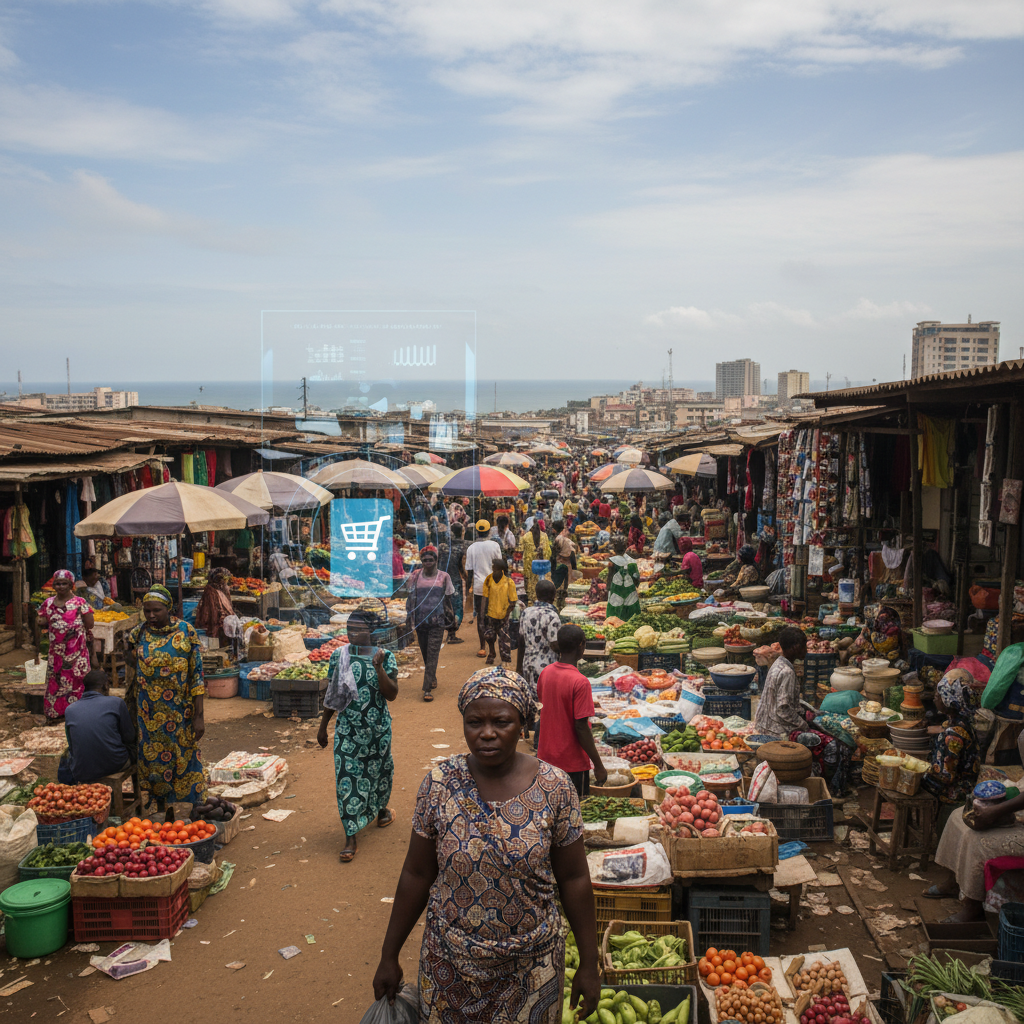
Yet, the application of such advanced AI in a context like Guinea presents a complex tapestry of challenges and opportunities. Our retail landscape is dominated not by sprawling supermarkets or seamless e-commerce platforms, but by the bustling, dynamic marchés and small, independent shops. Here, transactions are often cash-based, supply chains are informal, and data, in the structured, digital sense, is scarce. How does an algorithm learn to predict demand for attiéké or fonio when sales records are handwritten, if they exist at all, and customer preferences are communicated through generations of personal relationships rather than clickstream data?
Consider demand forecasting. In the West, AI models leverage sophisticated machine learning techniques, often employing deep neural networks, to sift through petabytes of data. They can account for micro-seasonal shifts, localized weather patterns, and even the impact of influencer marketing campaigns. But in Guinea, a sudden road closure due to heavy rains or a political demonstration can disrupt supply chains more profoundly than any predictable trend. How does an algorithm, trained on the predictable patterns of developed economies, account for the unpredictable realities of our daily lives? The devil is in the details, and our details are often far removed from the tidy datasets these models crave.
Inventory optimization, too, faces its own unique hurdles. Global retailers use AI to minimize holding costs and prevent stockouts, employing just-in-time delivery systems. For a maman selling vegetables in Madina Market, her inventory is her livelihood, purchased fresh each morning from local farmers. Her optimization is intuitive, based on years of experience, direct customer interaction, and an intimate understanding of her community's needs. Introducing a complex AI system here, requiring digital tracking, standardized product codes, and reliable connectivity, feels like asking a fisherman to trade his net for a drone. It is a solution searching for a problem that does not exist in the same form.
Then there is personalized shopping. The allure of AI-driven recommendations, where algorithms anticipate desires before they are even articulated, is powerful. Companies like Netflix and Spotify have perfected this art, shaping our entertainment consumption. In retail, this translates to targeted advertisements and curated product selections. But our personalized shopping experience in Guinea is often built on trust, conversation, and community. The local shopkeeper knows your family, your preferences, your creditworthiness. This is a personalization forged in human connection, not cold algorithms. Can an AI truly replicate the warmth of a familiar face or the nuanced understanding of local customs and traditions?
I dug deeper and found something troubling. While the narrative of AI transforming retail is global, its practical implementation remains largely concentrated in regions with robust digital infrastructure, high internet penetration, and established e-commerce ecosystems. For African nations, particularly those like Guinea where digital transformation is still nascent, the benefits remain largely theoretical. "The foundational infrastructure for advanced AI adoption in retail, including reliable data collection mechanisms and widespread digital literacy, is simply not present in many parts of Africa," noted Dr. Aminata Diallo, a leading economist at the University of Conakry. "Without addressing these fundamental gaps, talk of AI revolutionizing our local markets is premature, if not entirely disconnected from reality." Her perspective underscores a critical point: technology must meet reality where it stands, not where we wish it to be.
However, this is not to say that AI has no role to play. There are nascent efforts, often spearheaded by local entrepreneurs, to adapt these technologies to our context. Startups are exploring how AI can assist in managing logistics for agricultural produce, connecting farmers directly to urban markets, or optimizing delivery routes in congested cities. These are practical, ground-up applications, often leveraging simpler AI models and focusing on specific, localized problems rather than attempting to replicate Amazon's entire operational stack. For instance, some initiatives are using basic machine learning to predict crop yields based on weather patterns and soil data, helping farmers plan their sales more effectively. This is AI as an enabler, not a wholesale replacement.
One promising area could be the integration of mobile money data, which is far more prevalent than traditional banking in Guinea, with AI models. If transaction data from mobile wallets could be anonymized and aggregated, it might offer a glimpse into consumer spending patterns, providing a valuable, albeit incomplete, dataset for demand forecasting. But here's the catch: such data aggregation raises significant privacy concerns, and robust regulatory frameworks would be essential to prevent exploitation, a challenge many African nations are only beginning to address.
As I reflect on the grand pronouncements from Silicon Valley, I am reminded of the Guinean proverb: “L’eau ne monte pas la colline,” meaning water does not flow uphill. Technology, like water, must find its natural path. For AI in retail to truly benefit Guinea, it cannot be a top-down imposition of Western models. It must be a carefully considered, context-specific adaptation, built from the ground up, respecting our unique market dynamics and cultural nuances. Ignoring these realities risks creating a technological divide, where the promise of efficiency and personalization remains an exclusive luxury, far removed from the daily struggles and triumphs of our local traders and consumers. The future of retail AI in Guinea, if it is to be meaningful, must be distinctly Guinean, not merely a faint echo of Amazon's global ambition. We must forge our own path, leveraging technology that genuinely serves our people and our economy, rather than blindly adopting solutions designed for vastly different landscapes. For more insights into how technology is reshaping global economies, consider exploring articles on Reuters Technology or TechCrunch's AI section for broader industry trends. The conversation around AI's ethical implications, particularly in data-scarce regions, is also gaining traction, as highlighted by discussions on MIT Technology Review.
While the global narrative focuses on the scale and sophistication of AI, our focus in Guinea must remain on relevance and accessibility. Can AI help a small business owner in Dixinn manage her stock better, without requiring a supercomputer or a data science degree? Can it help our farmers get fairer prices for their produce by predicting market demand, without disintermediating their livelihoods? These are the questions that truly matter, and the answers will define whether AI becomes a tool for empowerment or another layer of complexity in our pursuit of progress. We must ensure that the algorithms serve us, not the other way around.