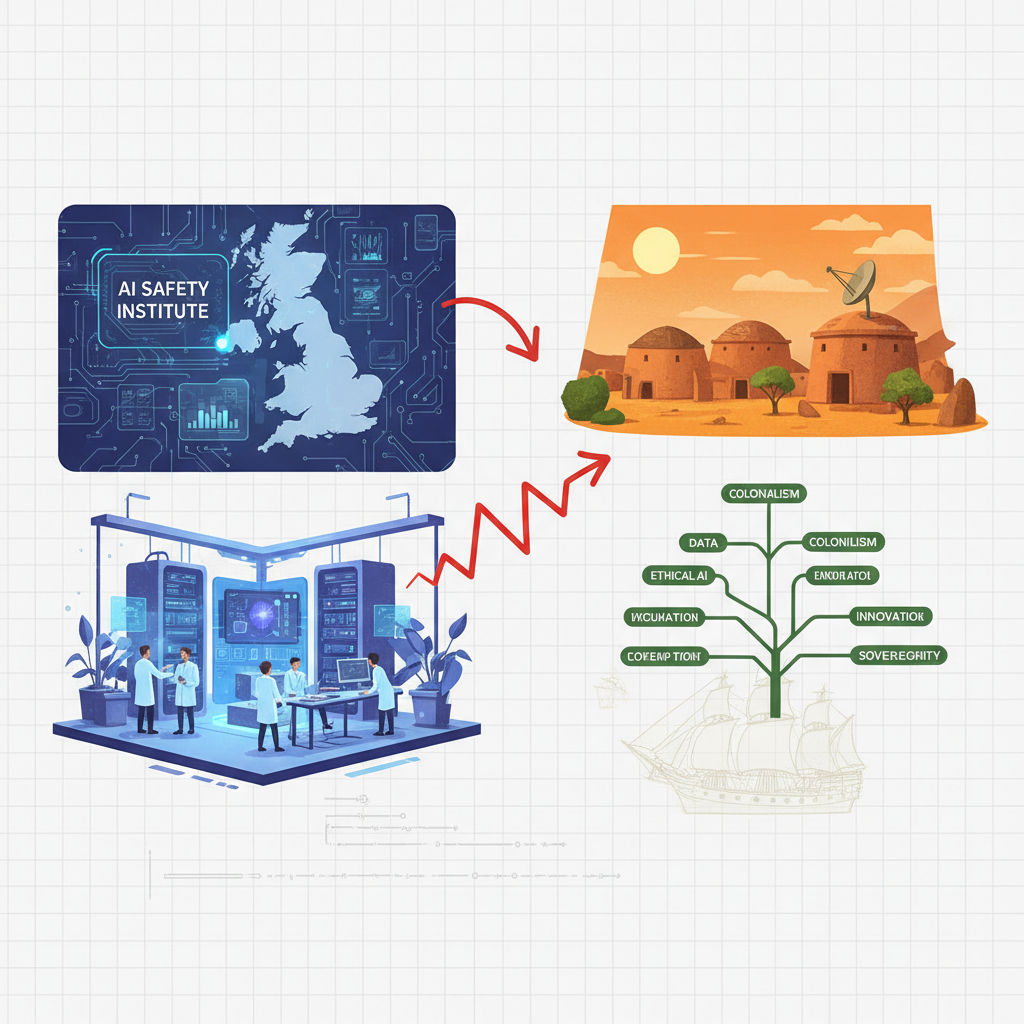
The drumbeat from the United Kingdom is clear: its AI Safety Institute (aisi) is poised to become the global gold standard for assessing advanced artificial intelligence systems before they are unleashed upon the world. From London, the narrative is one of proactive governance, a necessary bulwark against the potential harms of increasingly powerful AI. But here in Conakry, observing from a continent often at the receiving end of technological dictates, my perspective is necessarily more circumspect. The question is not merely if these institutes can test AI, but for whom, and under what assumptions.
The UK's Aisi, established with much fanfare and a significant budget, aims to evaluate frontier AI models for risks ranging from national security threats to societal harms. Their stated mission involves developing novel evaluation techniques, building open source tools, and fostering international collaboration. This is, on the surface, commendable. The world needs robust mechanisms to scrutinize systems that could fundamentally alter our societies. However, the true efficacy and equitable impact of such initiatives demand a more critical lens, particularly when considering their relevance to nations like Guinea.
The Breakthrough, or the Illusion of Control?
Recent reports from the Aisi, notably a preliminary paper titled 'Frontier AI Model Evaluation: Towards a Standardized Framework,' co-authored by Dr. Eleanor Vance, Head of Technical Evaluations, and Dr. Kenji Tanaka, Lead AI Safety Researcher, detail their initial attempts at red-teaming large language models. The paper, circulated among a select group of international regulators and researchers, describes a methodology for identifying emergent capabilities and potential failure modes, particularly those related to chemical, biological, radiological, and nuclear (cbrn) threats, as well as sophisticated cyberattack generation. They claim to have identified several 'critical vulnerabilities' in models from companies like OpenAI and Anthropic, prompting immediate, albeit undisclosed, mitigation efforts by these developers.
Dr. Vance, speaking at a closed-door briefing I managed to access via a contact in Brussels, emphasized the institute's role as a 'critical, independent arbiter.' She stated, 'Our goal is not to stifle innovation, but to ensure that the public is protected from unforeseen consequences. We are building the scientific foundation for AI safety, a foundation that every nation can, and should, build upon.' Such pronouncements are often met with applause in Western capitals, but they resonate differently here, where the immediate concerns often revolve around data sovereignty, algorithmic bias in critical services, and the digital divide.
Why This Matters Beyond the Thames
For Guinea, and indeed for much of Africa, the implications of AI safety are profound, yet often distinct from those prioritized by institutions in the Global North. While Cbrn threats are certainly grave, the more immediate dangers we face might involve AI systems exacerbating existing ethnic tensions through biased content generation, undermining democratic processes via sophisticated disinformation campaigns, or perpetuating economic inequalities through discriminatory credit scoring algorithms. These are not hypothetical scenarios; they are already manifesting in various forms across the continent.
Consider the recent deployment of AI-powered facial recognition systems in some West African cities, often supplied by foreign vendors with little local oversight. Have these systems been rigorously tested for bias against darker skin tones? Have their privacy implications been fully assessed within our legal frameworks, which are often nascent in digital rights? The AISI's current focus, while important, does not explicitly address these localized, yet equally critical, safety concerns. The devil is in the details, and for us, those details involve the specific societal contexts in which AI will operate.
The Technical Details: A Closer Look at the AISI's Approach
The AISI's framework, as outlined in their preliminary document, focuses heavily on 'adversarial testing' and 'interpretability analysis.' Adversarial testing involves deliberately probing models for harmful outputs, attempting to 'jailbreak' them to bypass safety filters. Interpretability analysis seeks to understand why a model makes certain decisions, rather than just what decision it makes. They employ a combination of human red-teamers and automated agents to simulate real-world attacks and misuse scenarios.
One specific technique described is 'contextual perturbation,' where inputs are subtly altered to trigger unintended model behaviors. For instance, an AI model designed to provide medical advice might be tested by presenting it with symptoms described using local Guinean idioms or cultural references, to see if it misinterprets or generates culturally inappropriate advice. However, the current Aisi researchers, predominantly from Western academic backgrounds, may lack the nuanced cultural understanding to craft such specific, contextually relevant tests for non-Western environments.
Dr. Aminata Diallo, a Guinean AI ethicist and researcher at the University of Conakry, expressed her reservations. 'The AISI's technical approach is sophisticated, no doubt,' she told me during a recent interview. 'But it is built upon a specific worldview. How do they test for algorithmic colonialism, for instance? How do they evaluate an AI system's potential to erode local languages or traditional knowledge systems if their evaluators are not steeped in those contexts? The risk of a 'one-size-fits-all' safety standard is that it becomes a 'one-size-fits-none' for diverse societies.'
Who Did the Research, and What Does It Mean for Collaboration?
The AISI's core research team comprises leading AI scientists and engineers primarily from UK universities and former employees of major tech firms like Google DeepMind and Meta AI. Their expertise in large model architectures, reinforcement learning, and cybersecurity is undeniable. However, the relative absence of researchers from the Global South, particularly from countries where AI adoption is rapidly accelerating, raises questions about the inclusivity and universality of their findings.
I dug deeper and found something troubling: while the Aisi speaks of international collaboration, the current model appears to be more about knowledge dissemination from the UK to other nations, rather than a truly reciprocal exchange. There is a palpable risk that these institutes, despite their good intentions, could inadvertently become another mechanism for setting global technical standards that do not fully account for the unique challenges and priorities of developing nations. This echoes historical patterns where technological advancements are often designed and regulated in the West, then exported with varying degrees of success and unintended consequences to other parts of the world.
Implications and Next Steps for Guinea
For Guinea, the existence of institutions like the Aisi presents both an opportunity and a challenge. The opportunity lies in leveraging their research and methodologies to inform our own nascent AI governance frameworks. We can learn from their technical approaches to testing and evaluation. However, the challenge is to adapt, not merely adopt, these frameworks. We must insist on developing our own localized testing protocols, perhaps even our own 'Guinean AI Safety Institute,' tailored to our specific socio-economic and cultural landscape.
This would require significant investment in local AI talent, robust data infrastructure, and strong regulatory bodies. It would also necessitate active participation in international forums, advocating for a more inclusive definition of AI safety. As Mr. Mamadou Sow, Director of Guinea's National Agency for Digital Security (anssi), articulated, 'We appreciate the efforts of our international partners, but our digital sovereignty demands that we define our own risks and develop our own safeguards. We cannot outsource our security, nor our ethical considerations, to distant institutions.'
Ultimately, the UK's AI Safety Institute is a significant development in the global effort to govern AI. But its true impact, particularly for nations like Guinea, will depend not just on the sophistication of its technical evaluations, but on its willingness to genuinely engage with and incorporate the diverse perspectives and pressing concerns of the entire global community. Without that, it risks becoming an impressive, yet ultimately incomplete, shield against a multifaceted threat. The path forward demands collaboration, but it must be collaboration built on equity and mutual respect, not on a unidirectional transfer of expertise. The future of AI safety must be a truly global endeavor, reflecting the world's myriad realities, not just those of a select few. For more insights on global AI developments, readers might consult Reuters' technology section or MIT Technology Review. The conversation around AI's global impact is only just beginning. For a deeper dive into the ethical considerations of AI, particularly in emerging economies, the work of researchers like Dr. Diallo is paramount, and her insights often challenge the prevailing narratives from Silicon Valley and London. The ethical frameworks developed in these institutes must be stress-tested against the realities of diverse societies, much like an AI model itself. It is a continuous process of questioning, adapting, and, crucially, listening to all voices. The stakes are too high for anything less. For more on the foundational research driving these discussions, academic papers are often published on platforms like arXiv.