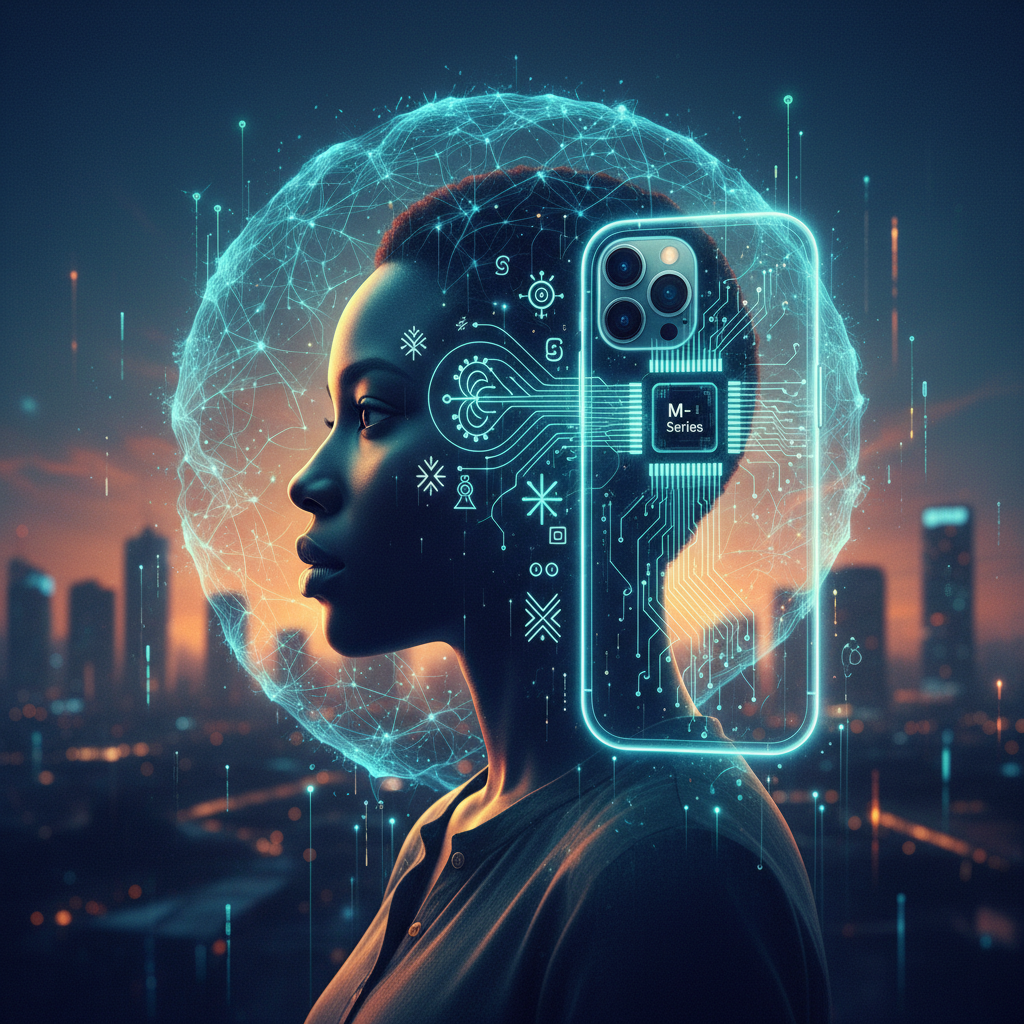

Imagine this: you are stuck in Lagos traffic, the kind that makes you question your life choices, and you need to translate a complex business document from Yoruba to English, right now. Your iPhone, powered by its M-series chip, handles it instantly, offline, with a nuance that cloud-based services often miss. No data worries, no latency. This isn't a futuristic fantasy; it is the reality Apple is building, and it is quietly reshaping the minds and habits of millions across Nigeria.
For years, the talk about AI has been dominated by the cloud, by massive data centers humming away in distant lands, processing our queries and generating our content. But Apple, with its M-series processors, has been playing a different game. They are putting serious AI horsepower directly into your device, making it a personal, always-on, always-available intelligent companion. This 'on-device AI' or 'local AI' is not just a technical specification; it is a psychological game changer, especially here in Africa where internet connectivity can be a fickle thing.
My opinion, and mark my words, this shift to local AI is more impactful than many realize. It is not merely about convenience; it is about autonomy, privacy, and a fundamental alteration in how we engage with information and even our own thoughts. When your AI assistant lives on your device, it is less a remote server and more an extension of your own cognitive processes. This intimacy, this immediacy, is creating new patterns of thought and behavior.
Consider the cognitive load. When you rely on cloud AI, there is always that tiny, almost imperceptible delay, that moment of waiting for the server to respond. With local AI, that friction is drastically reduced. Tasks like advanced photo editing, real-time language translation, or complex voice commands become instantaneous. This constant, seamless interaction can lead to what psychologists call 'cognitive offloading' in a new dimension. Our brains, ever efficient, will increasingly delegate routine or even complex mental tasks to these on-device assistants. While this frees up mental bandwidth for creativity or deeper thought, it also raises questions: are we becoming overly reliant? Are we losing the muscle memory for certain cognitive functions?
Dr. Ngozi Okonjo-Iweala, a brilliant mind and a global leader, once spoke about the importance of digital literacy and critical thinking in an interconnected world. Her insights, though not directly about local AI, resonate deeply here. When AI is so seamlessly integrated into our daily lives, the line between our own thoughts and the AI's suggestions can blur. Are we still thinking critically, or are we simply accepting the AI's optimized answer? This is a particular concern in Nigeria, where digital literacy levels vary widely and the allure of instant answers can be powerful.
The research is beginning to catch up with this phenomenon. Studies from institutions like Stanford and MIT are exploring the long-term effects of constant AI interaction on human cognition. For instance, a recent paper highlighted how instant access to information via AI can sometimes reduce our capacity for deep memory formation. If we know we can always ask Siri or a local AI model on our iPhone, are we less likely to commit information to our own memory? This is not necessarily a bad thing, as our brains are adapting, but it is a change we must observe carefully.
Professor Olufemi Taiwo, a philosopher whose work often touches on technology and society, articulated this beautifully in a recent lecture at the University of Ibadan. He said, "The tools we build inevitably reshape us. Local AI, by its very proximity and speed, becomes less of a tool and more of a cognitive partner. We must understand the terms of this partnership before it fully defines us." His point is clear: the psychological implications are profound. The future is already here because it is just not evenly distributed, and Nigeria is experiencing this distribution in unique ways.
One area where this is particularly evident is in communication. Imagine a young entrepreneur in Kano, using their M-series powered iPhone to instantly draft business proposals in flawless English, even if their primary language is Hausa. Or a student in Port Harcourt, using AI to summarize dense academic papers, freeing up time for deeper analysis. These are powerful accelerants for productivity and learning. However, the constant mediation of language and thought through AI could also subtly alter our natural communication styles, perhaps making us less patient with human imperfections or less adept at crafting original prose without assistance.
Apple's M-series chips, from the M1 to the latest M3 and beyond, are designed with a neural engine specifically for machine learning tasks. This dedicated hardware means that complex AI models can run directly on the device with incredible efficiency and speed. This is crucial for privacy too, as your data does not need to leave your device to be processed. For Nigerians, in a world where data privacy is an increasing concern, this local processing offers a significant advantage. It builds trust, and trust is a cornerstone of any meaningful human-technology relationship.
However, the societal implications extend beyond individual cognition. As more Nigerians adopt these powerful local AI devices, we might see shifts in social dynamics. Will the ease of AI-assisted communication reduce face-to-face interactions? Will the ability to instantly access information create new divides between those who have access to these advanced tools and those who do not? These are not trivial questions. The digital divide, a persistent challenge, could evolve into an 'AI cognitive divide' if we are not careful.
Practical advice for readers, for us, is to be mindful. Embrace the power of local AI, but do so with intention. Use it to augment your abilities, not to replace them entirely. Challenge the AI's suggestions, verify information, and continue to cultivate your own critical thinking skills. Encourage digital literacy programs that teach not just how to use AI, but how to think with AI, and how to understand its limitations and biases. We must ensure that this powerful technology serves us, rather than subtly dictating our cognitive processes.
Ultimately, Apple's M-series processors are not just about faster devices; they are about a fundamental re-architecture of our relationship with intelligence itself. They are putting a powerful, personal AI in the hands of millions, and in Nigeria, this is igniting a quiet revolution in how we think, learn, and connect. The responsibility now falls to us to navigate this new cognitive landscape wisely, ensuring that the M-series mind meld empowers us, rather than diminishes us. For more on the broader implications of AI in our daily lives, you can often find insightful analyses on Wired's AI section or MIT Technology Review. The conversation is just beginning, and Nigeria will lead this revolution in its own unique way. For a deeper dive into how other tech giants are approaching on-device AI, TechCrunch's AI coverage is always a good resource.