The rhythmic clatter of looms in Tlemcen, the scent of olive oil from Kabylie, the meticulous craftsmanship of Ghardaia's artisans; these are not merely economic activities, they are the very sinews of Algeria's cultural identity. For generations, traditional industries have provided livelihoods and preserved heritage. Now, a new force, as subtle as the desert wind yet as powerful as a sirocco, is reshaping these ancient landscapes: artificial intelligence. The question is not if AI will transform these sectors, but how, and whether Algeria is prepared to guide this change rather than be swept away by it.
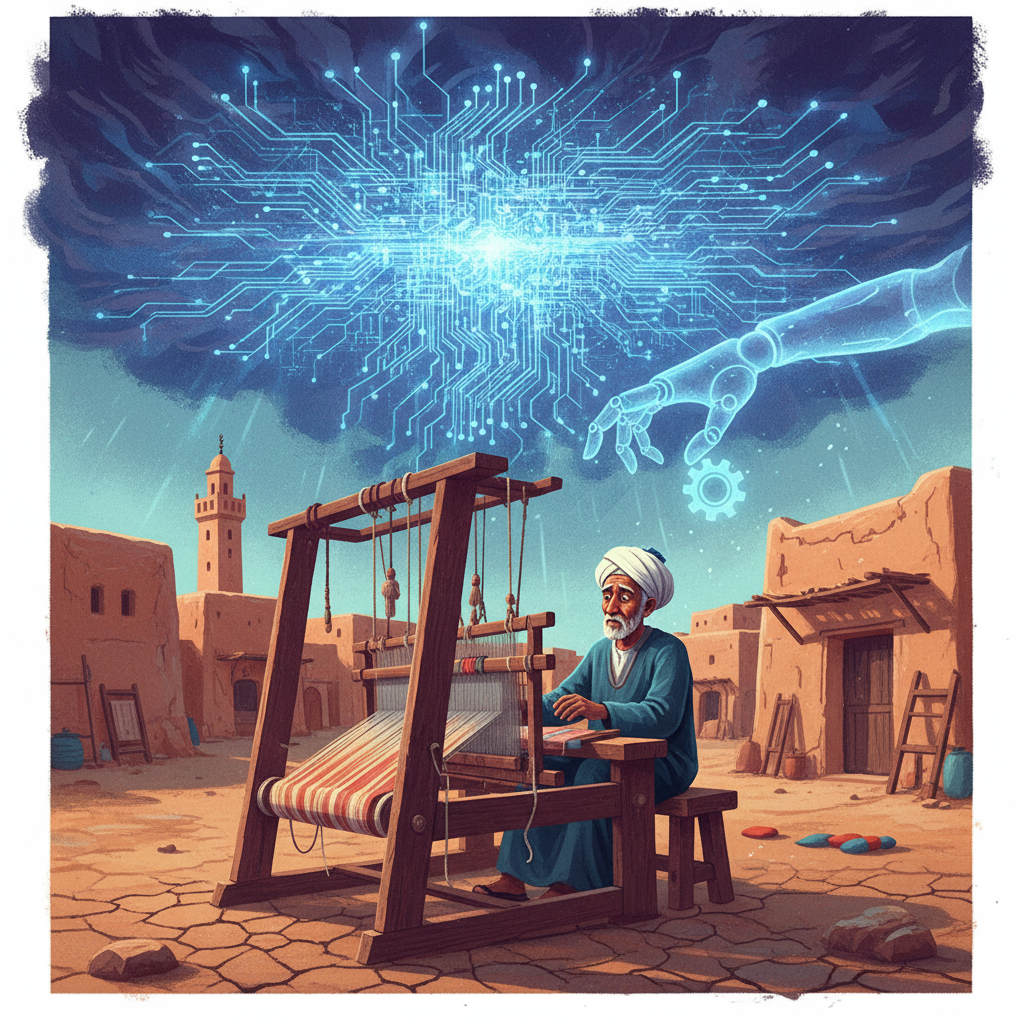
The risk scenario is stark: unbridled AI adoption, particularly in sectors reliant on manual labor and artisanal skill, could lead to widespread displacement without adequate preparation. Imagine, if you will, the intricate patterns of a traditional Algerian carpet, woven by hand over weeks. An advanced generative AI, coupled with robotic looms, could replicate this design, perhaps even innovate upon it, in a fraction of the time and at a fraction of the cost. While efficiency gains are undeniable, the human cost, particularly in a developing economy like ours, could be catastrophic. The mathematics behind this is elegant in its optimization, yet profoundly complex in its societal implications.
Let me walk you through the architecture of this potential disruption. At its core, AI's transformative power stems from its ability to automate cognitive and physical tasks previously thought to be exclusively human domains. In traditional manufacturing, this involves several key AI subfields. First, computer vision systems can inspect product quality with superhuman precision, identifying flaws in textiles or ceramics that a human eye might miss. This isn't just about speed; it's about consistency and objectivity. Second, generative AI models are now capable of designing new patterns, optimizing material usage, and even simulating entire production lines. Consider the textile industry, where design is paramount. Generative adversarial networks, or GANs, can produce novel fabric designs or clothing patterns that are aesthetically pleasing and optimized for production, potentially rendering human designers less central. Third, predictive analytics can forecast demand, optimize supply chains, and manage inventory with an accuracy that minimizes waste and maximizes profit. For a small artisan producing traditional pottery, this means a shift from intuitive market understanding to data-driven forecasting, a paradigm shift that requires significant digital literacy.
From a technical standpoint, the deployment of AI in these traditional industries is becoming increasingly accessible. Cloud-based AI platforms, often offered by giants like Google and Amazon, provide sophisticated algorithms and computational power without the need for massive upfront investment in hardware. This democratizes access to powerful tools, but also accelerates the pace of change for those ill-equipped to adapt. According to MIT Technology Review, the global market for AI in manufacturing is projected to reach over 16.7 billion USD by 2027, indicating a rapid and pervasive integration across industries worldwide.
The expert debate on this topic is vibrant and multifaceted, reflecting a global challenge with local nuances. Dr. Fatima Zahra Bouzid, a leading economist at the University of Algiers, emphasizes the need for proactive policy. "We cannot afford to be passive observers," she stated in a recent symposium. "The digital revolution is not waiting for us. We must invest heavily in reskilling programs, focusing on digital literacy, AI literacy, and the uniquely human skills that AI cannot replicate: creativity, critical thinking, and complex problem-solving. Our youth must be prepared not just to use AI, but to build it, to adapt it to our specific needs." Her perspective is echoed by many who advocate for a 'human-in-the-loop' approach, where AI augments human capabilities rather than replacing them entirely.
Conversely, some industry leaders, like Mr. Karim Meziane, CEO of Al-Nour Textiles, argue for aggressive adoption to remain competitive. "The global market is unforgiving," Meziane explained during a panel discussion at the Algerian Chamber of Commerce. "If our competitors in Asia or Europe are leveraging AI to reduce costs and increase output by 30 percent, and we are not, then our traditional industries will simply wither away. The choice is not between AI and no AI; it is between adapting or becoming obsolete." He points to pilot projects where AI-driven quality control has reduced defects by 15 percent and increased throughput by 10 percent in Algerian textile factories, demonstrating tangible benefits.
However, the social implications cannot be overlooked. Mr. Omar Benali, head of the National Union of Artisans, voices a poignant concern. "Our craft is passed down through generations, a living tradition. When a machine takes over the intricate weaving or the delicate carving, what happens to that knowledge, that connection to our ancestors? We risk losing not just jobs, but our very cultural memory." This sentiment resonates deeply in a country where artisanal work is often a familial legacy, a source of pride and community cohesion. The risk is not just economic, but cultural erosion.
The real-world implications for Algeria are profound. Consider the date palm industry, a cornerstone of our agricultural economy. AI-powered drones can monitor palm health, detect diseases early, and optimize irrigation, leading to increased yields. This is beneficial. However, the labor-intensive process of harvesting, often performed by seasonal workers, could see disruption from robotic harvesters in the long term. The transition needs careful management. Similarly, in the fishing industry, AI can optimize fishing routes, predict fish movements, and even monitor marine ecosystems for sustainability. Yet, the traditional fishermen who navigate the Mediterranean and Atlantic coasts using ancestral knowledge face a future where their skills might be undervalued or rendered less competitive by algorithmic precision.
What should be done? A multi-pronged strategy is imperative. First, the Algerian government, in collaboration with institutions like the National Agency for the Promotion and Development of Technology Parks (anpt), must establish AI readiness programs tailored for traditional sectors. These programs should not merely train workers on how to use AI tools, but also empower them to understand the underlying principles and even contribute to their development. This includes accessible education in data science, machine learning fundamentals, and ethical AI deployment. Second, incentives for hybrid models are crucial, encouraging businesses to integrate AI as an assistive technology rather than a complete replacement for human labor. For instance, AI could handle repetitive tasks, freeing artisans to focus on unique, high-value, creative aspects of their craft.
Third, policy frameworks must be developed to address potential job displacement and ensure a just transition. This could involve social safety nets, entrepreneurship support for displaced workers, and investments in new, AI-adjacent industries that create different types of jobs. We must look to examples like the European Union's AI Act, which aims to balance innovation with ethical considerations, as a potential blueprint, adapting it to our specific context. Finally, fostering a culture of innovation and adaptation within our traditional sectors is key. This means encouraging collaboration between technologists, artisans, and policymakers to co-create solutions that preserve heritage while embracing progress. The goal is not to resist the tide of AI, but to learn to sail upon it, guiding our traditional industries towards a future where efficiency and heritage can coexist. This is a journey that demands foresight, courage, and a collective commitment to our people and our traditions.