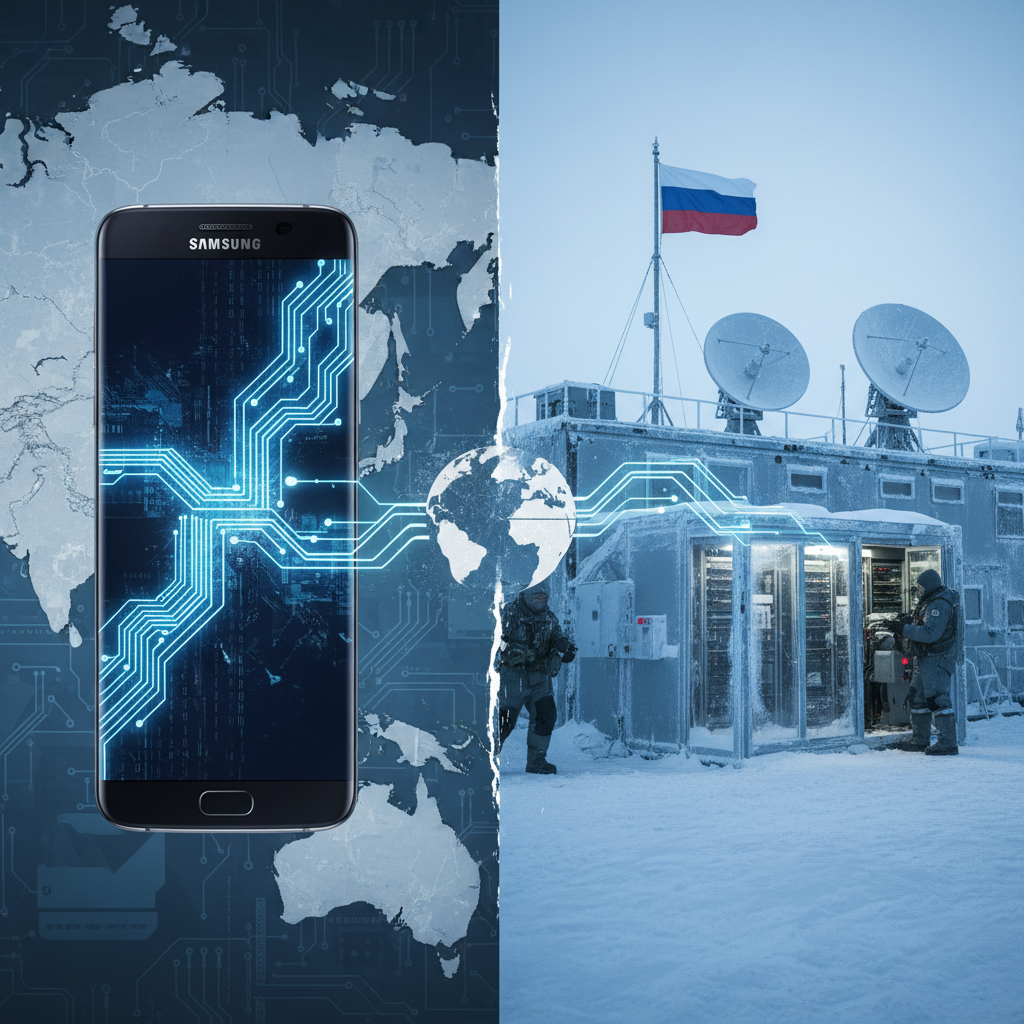

From the Vostok Station, where the ice sheet stretches for kilometers and the air bites with a ferocity unknown to most of humanity, the digital tremors of the world resonate with a peculiar clarity. Here, where every byte of data transmitted is a victory against the elements, the global competition for artificial intelligence, particularly in our everyday devices, takes on a stark, almost elemental significance. Samsung's recent unveiling and continuous refinement of its Galaxy AI features have not merely introduced new functionalities, they have ignited a cold war of silicon and software, a battle for the very soul of personal computing that mirrors our own relentless pursuit of scientific data in this unforgiving Antarctic frontier.
The smartphone AI arms race is not a new phenomenon, but Samsung's aggressive push with features like 'Circle to Search', 'Live Translate', and 'Generative Edit' has escalated the stakes considerably. These are not merely incremental improvements, they represent a fundamental shift in where and how AI processing occurs. The move towards on-device AI, rather than relying solely on cloud infrastructure, is a strategic gambit with profound implications for speed, privacy, and crucially, cybersecurity. At -40°C, technology behaves differently, and the reliability of local processing becomes paramount, a lesson the tech giants are now learning on a global scale.
Consider the 'Live Translate' feature, which offers real time, on-device voice and text translation during calls. From a user perspective, this is a marvel of convenience, dissolving language barriers instantly. From a cybersecurity standpoint, however, it presents a complex challenge. While Samsung asserts that processing occurs locally, minimizing data transmission risks, the sheer volume of personal conversations being processed by an embedded neural engine raises questions about potential vulnerabilities. What if a sophisticated malware could intercept or manipulate these local AI models? The data from our Antarctic station reveals that even the most isolated systems are not immune to determined threats, and the attack surface of a device with powerful, always-on AI capabilities expands significantly.
Dr. Elena Petrova, a leading cybersecurity expert at the Russian Academy of Sciences, recently articulated this concern. "The decentralization of AI processing to individual devices offers undeniable benefits in terms of latency and privacy, but it also democratizes the target for malicious actors," she stated in a recent symposium. "Securing billions of individual AI models, each interacting with sensitive personal data, is a monumental task. The onus is on manufacturers to implement robust, verifiable security at the hardware and software level, and on users to understand the new risk landscape." Her words echo the meticulous, multi layered security protocols we employ for our critical data pipelines here, where a single breach could compromise years of climate research.
The competitive landscape is fierce. Google, with its Pixel series and Gemini Nano, is a direct competitor, offering similar on-device AI capabilities. Apple is reportedly investing heavily in its own on-device AI for future iPhone models, aiming to integrate it deeply into its ecosystem. Qualcomm, NVIDIA, and other chip manufacturers are locked in a race to produce the most efficient and powerful neural processing units, or NPUs, capable of handling these complex AI workloads directly on the device. This technological arms race is not just about features, it is about controlling the next generation of personal computing, much like the race to map the deepest parts of the Southern Ocean.
Samsung's strategy, however, extends beyond just hardware. Their partnership with Google for 'Circle to Search' demonstrates a collaborative approach to feature development, leveraging Google's expansive search capabilities with Samsung's hardware integration. This symbiotic relationship, while beneficial for consumers, also intertwines the security postures of multiple entities. A vulnerability in one could potentially affect the other, creating a complex web of interdependencies that demands constant vigilance. This is a lesson we learned quickly in Antarctica, where the failure of one system can cascade through an entire research operation.
Moreover, the rise of generative AI features, such as 'Generative Edit' for photos, introduces new ethical and security considerations. While seemingly innocuous, the ability to seamlessly alter reality with a few taps raises questions about deepfakes and misinformation, even on a personal level. If a device can generate highly convincing images or audio, how do we ensure the authenticity of digital content? The challenge is not just technical, it is societal. "The line between reality and AI generated content is blurring at an alarming rate," commented Professor Lee Jae-won, a specialist in digital ethics at Seoul National University, in a recent interview with Reuters Technology. "Companies like Samsung and Google have a responsibility to not only innovate but also to educate users and implement safeguards against potential misuse." This sentiment resonates strongly with our scientific community, where data integrity is paramount.
The implications for cybersecurity are multifaceted. On one hand, on-device AI can enhance security by performing tasks like anomaly detection or biometric authentication locally, reducing reliance on potentially vulnerable cloud connections. On the other hand, the complexity of these models, combined with the sheer volume of personal data they process, creates new attack vectors. Adversarial attacks, where subtly manipulated inputs can trick an AI model into making incorrect decisions, become a more significant threat when the model is directly accessible on a user's device. Furthermore, the rapid pace of AI development means that new vulnerabilities are constantly emerging, requiring continuous updates and patches, a logistical challenge for billions of devices globally.
For us, observing from the Russian Antarctic Station, the global AI landscape is a dynamic, ever evolving system, much like the polar weather patterns we study. The drive for innovation is relentless, but so too must be the commitment to security and ethical deployment. The smartphone, once a mere communication tool, is rapidly transforming into a personal AI hub, a powerful extension of our cognitive abilities. This transformation brings immense benefits, but also demands a heightened awareness of the inherent risks. Science at the bottom of the world teaches us that even the most robust systems require constant monitoring and adaptation. The same principle applies to the digital ecosystems now taking root in our pockets.
As the world races towards ever more intelligent devices, the lessons from extreme environments become increasingly relevant. The need for resilient, secure, and ethically sound AI is not a luxury, it is a necessity. The future of personal AI, spearheaded by companies like Samsung, hinges not just on groundbreaking features, but on the foundational trust users place in these powerful, intelligent companions. The cold reality of cybersecurity demands nothing less than absolute vigilance. For further insights into the broader AI industry, one might consult TechCrunch's AI section, which tracks these developments closely. The ongoing chip war, a foundational element of this AI arms race, also has significant implications, as explored in articles such as Jensen Huang's Silicon Gambit: Can NVIDIA, AMD, and Intel's Chip War Spark a Balkan Tech Boom, or Just More Heat? [blocked].