
Have you ever thought about how a farmer selects the best seeds for the next season, or how a cattle rancher chooses the strongest bull to improve his herd? It is a process as old as time, rooted in careful observation and the desire for improvement. Now, imagine applying that same ancient wisdom, that same patient, iterative approach, to something as cutting-edge as artificial intelligence. That, my friends, is what the brilliant minds at Sakana AI in Tokyo are doing, and it is making waves across the tech world.
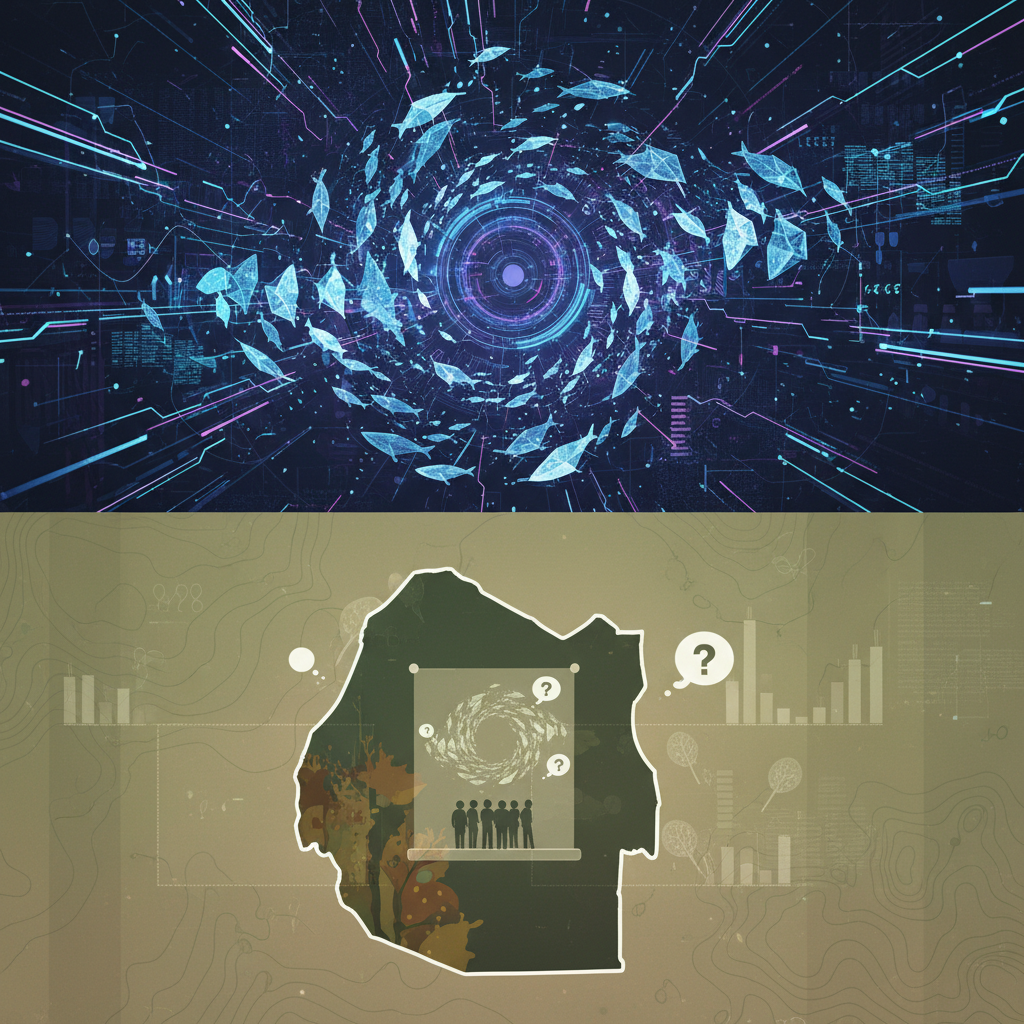
Sakana AI, a startup founded by former Google Brain and Stability AI researchers, is not just building AI models; they are breeding them. They are using evolutionary algorithms, a kind of digital natural selection, to create better, more efficient, and more specialized AI. Instead of painstakingly designing every component of a neural network, they are setting up environments where AI models compete and adapt, with the best traits passed on to the next generation. It is a fascinating concept, almost like watching digital life emerge, and it begs the question: is this a fleeting trend, or the new normal for how we develop artificial intelligence?
For us in Eswatini, where our connection to the land and its cycles runs deep, this analogy resonates powerfully. We understand the value of selective breeding, of nurturing what works best for our environment. But how does this high-tech, Tokyo-born innovation translate to our valleys and mountains, to our communities where technology often feels like a distant hum? This tiny kingdom has big ideas about technology, and we are always looking for ways to adapt global trends to our local needs.
Historically, AI development has been a more direct, top-down process. Engineers would design architectures, tweak parameters, and train models on massive datasets, often requiring immense computational power and human expertise. Companies like OpenAI and Google have poured billions into this approach, yielding impressive results like GPT-4 and Gemini. But this traditional method can be slow, resource-intensive, and sometimes leads to models that are good at general tasks but not specialized enough for niche applications. According to a recent report on AI development trends, the cost of training state-of-the-art models increased by 10x every 18 months between 2012 and 2018, a pace that is simply unsustainable for many players, especially those outside the tech giants. You can read more about these trends in publications like TechCrunch.
Sakana AI’s approach offers a potential alternative. By letting models evolve, they aim to discover novel architectures and training strategies that humans might not conceive. Imagine an AI that learns to optimize itself, finding efficiencies and solutions through trial and error, much like nature does. This could lead to smaller, more specialized, and more energy-efficient models, which is a significant advantage in a world grappling with the environmental footprint of large AI systems. Their work hints at a future where AI is not just built, but grown.
“What Sakana AI is doing is a paradigm shift,” explains Dr. Nombuso Dlamini, a computational biologist and lecturer at the University of Eswatini. “Instead of brute-forcing solutions, they are leveraging principles of natural selection to explore a vast design space. This could democratize AI development, making it less reliant on massive budgets and more on clever algorithmic design. It is a very exciting prospect, especially for nations with limited resources, as it could lead to more efficient models.”
Indeed, the implications for efficiency are profound. Large language models like GPT-4 require enormous computing power, often housed in data centers consuming as much electricity as small towns. If evolutionary algorithms can produce smaller, more performant models for specific tasks, it could drastically reduce the barrier to entry for AI development and deployment. This is crucial for places like Eswatini, where reliable and affordable energy is still a challenge in some rural areas. We cannot afford to build energy-guzzling AI infrastructure if it does not directly benefit our people and our economy.
However, not everyone is convinced that this evolutionary path is a silver bullet. “While promising, evolutionary algorithms can be computationally expensive in their own way, requiring many iterations to converge on an optimal solution,” cautions Mr. Sipho Maseko, a software engineer at Eswatini Mobile and an avid AI enthusiast. “The challenge is in defining the ‘fitness function’, what exactly makes an AI ‘better’? If you do not define that well, you could end up with highly optimized but ultimately useless or even harmful AI. It is not just about speed or efficiency; it is about alignment with human values.” His point is well taken; in Eswatini, we say 'a person is a person through other people', and AI should learn this lesson. Its purpose must always be to serve humanity, not just to exist.
Another perspective comes from Ms. Thandiwe Nxumalo, a policy advisor at the Eswatini Ministry of Information, Communication, and Technology. “The regulatory landscape for AI is already complex, and this new ‘breeding’ approach adds another layer of intricacy. If AI models are evolving semi-autonomously, who is responsible for their behavior? How do we ensure transparency and accountability? These are not just technical questions; they are ethical and legal ones that demand careful consideration from governments worldwide, including our own.” These are the kinds of questions that keep policymakers up at night, and rightly so.
So, is Sakana AI’s evolutionary approach a fad or the new normal? My verdict, after speaking with experts and reflecting on our own context, is that it is very much the new normal, but one that will evolve alongside traditional methods. It is not about replacing human ingenuity, but augmenting it. The ability to “breed” specialized AI models could lead to a proliferation of highly effective, niche applications that are currently too expensive or complex to develop using conventional methods. Imagine an AI specifically evolved to predict crop yields in Eswatini’s specific climate conditions, or one optimized to translate Siswati proverbs with their full cultural nuance. The potential is immense.
For Eswatini, this trend offers both opportunities and challenges. We might not have the mega-labs of Tokyo or Silicon Valley, but our strength lies in our community, our adaptability, and our unique perspective. We can be early adopters of these more efficient AI models, tailoring them to our specific needs in agriculture, healthcare, and education. Our smaller scale can sometimes be an advantage, allowing for quicker implementation and feedback loops. We need to invest in local talent, ensuring our young people are equipped with the skills to not just use AI, but to understand its underlying principles and guide its evolution.
The future of AI, it seems, will not be a single monolithic entity, but a diverse ecosystem of models, some meticulously crafted, others organically grown. And in this evolving landscape, even the smallest countries can have the biggest vision. Our task is to ensure that as AI evolves, it does so in a way that truly benefits all of humanity, reflecting the best of our shared values and helping us build a more prosperous and connected world. The journey is just beginning, and I, for one, am excited to see where this digital evolution takes us. For more insights into the broader implications of AI, I often look to sources like MIT Technology Review.