
Punjab's AI Push: Farmers Embrace 'Kisan Sahayak' for Smarter Harvests
Punjab's agricultural sector is undergoing a digital revolution with the 'Kisan Sahayak' AI platform, empowering farmers with data-driven insights for improved yields and market access, a true 'kamaal' for the region.
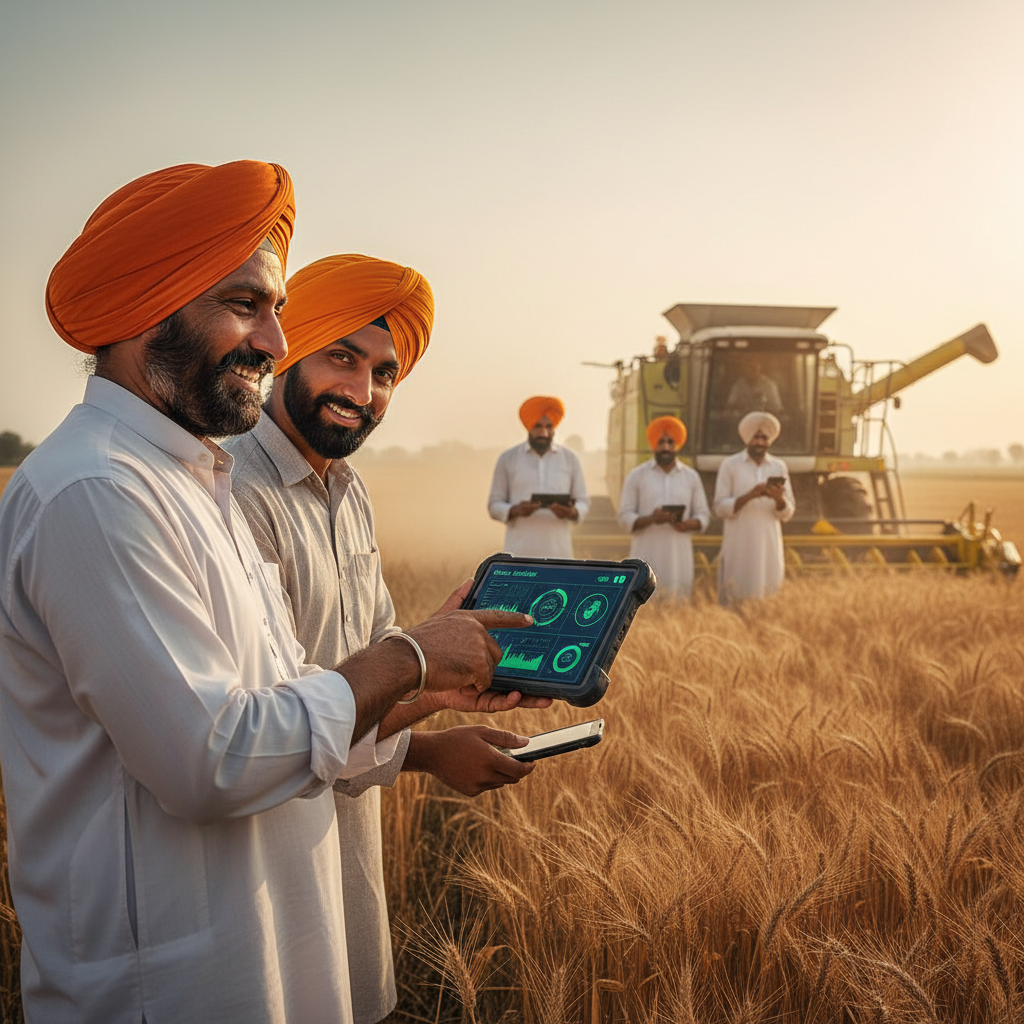

Chandigarh, Punjab – The fields of Punjab, long the breadbasket of India, are now witnessing a quiet revolution, not just with new machinery but with cutting-edge artificial intelligence. The 'Kisan Sahayak' platform, a brainchild of the Indian Council of Agricultural Research (ICAR) in collaboration with leading tech firms, is rapidly becoming an indispensable tool for our hardworking farmers, transforming traditional farming practices into data-driven enterprises.
From the fertile lands of Ludhiana to the Basmati belts of Amritsar, the buzz around 'Kisan Sahayak' is palpable. This AI-powered mobile application, available in Punjabi and Hindi, provides real-time weather forecasts, soil health analysis, pest and disease detection, and even optimal sowing and harvesting schedules. "Pehlan te saanu sirf apne buzurg di gall te ya mausam de mood te hi bharosa karna painda si," says Gurpreet Singh, a progressive farmer from a village near Jalandhar, referring to the reliance on elders' wisdom and weather whims. "Hunn te phone dass dinda hai paani kadon laana hai, te kithe bimari aa sakdi hai. Eh te saadi kheti da nawa 'paathshaala' ban gaya hai!" (Earlier, we had to rely only on our elders' words or the weather's mood. Now, the phone tells us when to irrigate and where disease might strike. This has become a new 'school' for our farming!)
The platform leverages satellite imagery, IoT sensors deployed in fields, and vast datasets of historical agricultural patterns to offer hyper-localized advice. Dr. Rakesh Kumar, a Senior Agricultural Scientist at Punjab Agricultural University (PAU), highlights the economic impact. "The precision farming insights from 'Kisan Sahayak' are reducing input costs significantly – less water wastage, optimized fertilizer use, and timely intervention against pests," he explains, speaking from his office in Ludhiana. "We're seeing an average increase of 10-15% in crop yields for early adopters, which translates directly into more 'paisa' (money) in the farmer's pocket. This is not just technology; it's 'tarraki' (progress) for our rural economy."
Beyond crop management, 'Kisan Sahayak' is also addressing market linkages. The platform provides real-time mandi prices from across the country, allowing farmers to make informed decisions about when and where to sell their produce, bypassing exploitative middlemen to some extent. This feature is particularly crucial for smaller landholders who often lack access to broader market intelligence.
However, challenges remain. Digital literacy among older farmers and consistent internet connectivity in remote areas are hurdles that need to be overcome. The state government, in partnership with private telecom operators, is actively working on expanding high-speed internet infrastructure and conducting training workshops in villages. "We understand that technology is only as good as its accessibility," states a senior official from the Punjab Department of Agriculture, emphasizing the 'sangat' (community) effort required.
As Punjab continues its journey towards agricultural modernization, 'Kisan Sahayak' stands as a testament to how AI, when tailored to local needs and delivered with a 'sewa' (service) mindset, can truly empower communities and drive economic prosperity. It's a proud moment for our 'mitti' (soil) and our people, showing that even ancient traditions can flourish with a touch of futuristic innovation. The future of farming in Punjab, it seems, is not just green, but also smart. It's a 'jeet' (victory) for the spirit of Punjab.
Related Articles

AI's Silk Road: Preserving Uzbek Cultural Heritage Through Digital Innovation
 Bintà Yusupovà
AI's Economic Dawn: Malaysian Women Entrepreneurs Embrace Digital Transformation
 Siti Nurhalizah Rahimàn
Pakistani Women Entrepreneurs Embrace AI for Business Growth, Bridging Digital Divide
 Khalidà Sultàn
AI na Liderança Feminina: Desafios e Oportunidades no Cenário Corporativo Brasileiro
 Fernandà Oliveirà