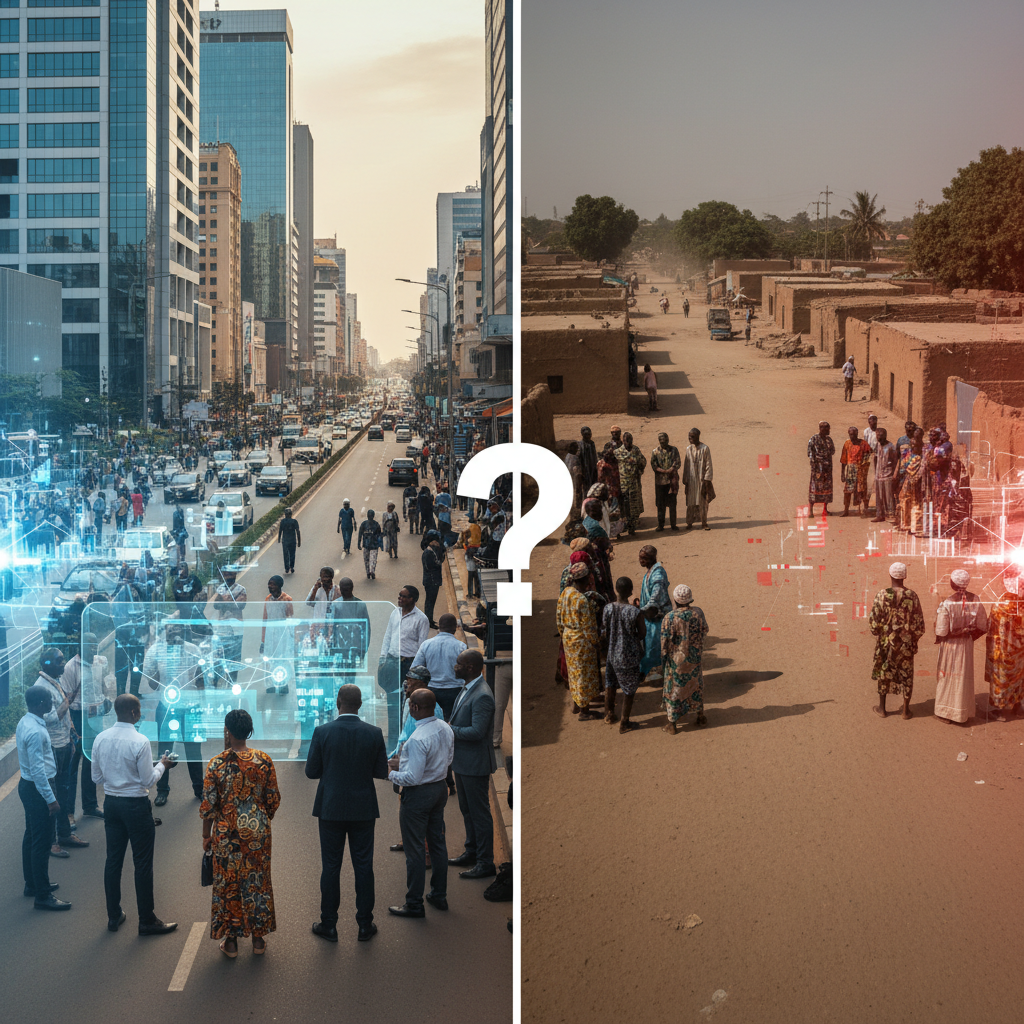

The sun beats down on the bustling markets of Abidjan, a symphony of sounds and smells that tells the story of a vibrant, complex nation. Here, life unfolds in a thousand tiny interactions, each one a thread in the rich tapestry of Côte d'Ivoire. But beyond the vibrant chaos of daily life, a different kind of story is beginning to unfold, one woven in algorithms and data points, with a name that echoes from distant Silicon Valley: Palantir.
For many, the mention of Palantir Technologies conjures images of shadowy government contracts, vast data surveillance, and an AI so powerful it can predict futures. In places like America and Europe, its work with defense agencies, intelligence services, and law enforcement has long been a subject of intense debate. Now, as the winds of digital transformation sweep across Africa, the question arises: what does Palantir's presence mean for a nation like ours, a nation still navigating its own path to stability and prosperity?
I recently spoke with Dr. Aminata Diallo, a brilliant Ivorian data scientist who returned home after years working in Paris. She told me something I'll never forget: "Data is like our soil, Aïssatà. It can nourish us, help us grow, but if it's not tended with care, if we don't understand its true nature, it can also be exploited, leaving the land barren." Her words resonated deeply, reminding me that technology, like any powerful tool, holds both immense promise and profound peril.
Palantir's platforms, such as Foundry and Gotham, are designed to integrate and analyze massive, disparate datasets, revealing patterns and insights that human analysts might miss. They claim to help governments make better decisions, from optimizing supply chains to combating terrorism. In Côte d'Ivoire, where challenges range from improving public health infrastructure to enhancing agricultural productivity and ensuring national security, the allure of such a powerful tool is undeniable. Imagine, for a moment, an AI that could predict food shortages before they become crises, or identify areas most vulnerable to disease outbreaks, allowing for targeted interventions. This is the promise that beckons.
However, the very power that makes Palantir so attractive also fuels apprehension. Its history of working with agencies like the U.S. Immigration and Customs Enforcement (ICE) and various defense departments has drawn fierce criticism from civil liberties advocates globally. Concerns about privacy, algorithmic bias, and the potential for surveillance without adequate oversight are not abstract concepts here; they touch the very fabric of our communities. We have a history, like many nations, where trust in institutions has been fragile, and the idea of a foreign-developed AI system holding vast amounts of personal data can be unsettling.
Just last year, a report from MIT Technology Review highlighted the increasing scrutiny on AI companies partnering with governments, particularly in sensitive sectors. The report emphasized the need for robust ethical frameworks and transparent accountability mechanisms, especially when these technologies are deployed in contexts with varying regulatory landscapes. For Côte d'Ivoire, this means we must be vigilant, asking tough questions about data governance, data ownership, and the safeguards in place to protect our citizens' rights.
Consider the story of Madame Adjoua, a smallholder farmer in Yamoussoukro. Her life is intricately linked to the land, her decisions guided by generations of inherited wisdom and the unpredictable rhythms of nature. If an AI system were to analyze agricultural data, predicting crop yields or market prices, it could be a boon, helping her plan better. But what if that data also included her land ownership details, her financial transactions, or even her family's health records? Who would have access to that information, and how would it be used? Would it empower her, or make her vulnerable to new forms of exploitation?
This is the story they don't want you to hear, or perhaps, the story they haven't fully considered: the human impact, the individual lives touched by these grand technological designs. The conversations around Palantir often focus on geopolitical strategy and data analytics at a macro level, but for us, it must always come back to the people, to Madame Adjoua, to Dr. Diallo, to the ordinary Ivorian trying to build a better life.
According to a recent Reuters report, Palantir's revenue from government contracts continues to be a significant portion of its overall earnings, estimated to be well over 50% in recent fiscal years. This financial reliance on public sector work underscores the importance of public scrutiny. When a company's business model is so intertwined with state power, the ethical implications become paramount. Here in Côte d'Ivoire, where the digital infrastructure is still developing, and digital literacy is a growing but not universal skill, the power imbalance between a sophisticated AI platform and the average citizen is immense.
I spoke with Monsieur Kone, a community leader in a bustling Abidjan neighborhood. He expressed a cautious optimism, saying, "If this AI can help us get clean water, improve our schools, or make our streets safer, then we should explore it. But we must be sure it serves us, the people, not just those in power. We need to understand how it works, not just accept its results." His words echo a sentiment I hear often: a desire for progress, coupled with a deep-seated need for transparency and accountability.
There are real, tangible benefits that AI can bring to our nation. For example, in healthcare, an AI system could analyze patient data to identify emerging health trends, optimize vaccine distribution, or even assist in early disease detection, potentially saving countless lives. In education, personalized learning platforms powered by AI could help bridge the gap in access to quality instruction, especially in remote areas. But these benefits must be weighed against the risks.
Our government has been increasingly vocal about embracing digital transformation. President Alassane Ouattara has often spoken of a "digital Côte d'Ivoire" as a cornerstone of future economic growth. The Ministry of Digital Economy, Telecommunications and Innovation has been exploring various partnerships to accelerate this vision. While specific details of any potential Palantir contracts in Côte d'Ivoire are not yet public, the broader trend of African nations engaging with advanced AI providers is clear. For instance, countries like Rwanda and Kenya have already made significant strides in adopting AI for public services, often with the support of international partners.
This isn't just about Palantir, of course. It's about the broader conversation around AI governance in Africa. As I wrote in a previous piece, NVIDIA's Sovereign AI Gambit: Is Africa Building a Digital Future, or Just a Data Fortress? [blocked], the question of who controls the data, who builds the models, and whose values are embedded in the algorithms is crucial. We cannot simply import solutions without adapting them to our unique cultural, social, and political contexts.
Picture this: a future where AI helps Côte d'Ivoire flourish, where our rich cultural heritage is preserved, and our people are empowered. But for that future to materialize, we must ensure that the algorithms that shape it are built on a foundation of justice, transparency, and respect for human dignity. This means advocating for strong data protection laws, investing in local AI talent, and demanding clear ethical guidelines from any technology partner. The conversation about Palantir, and indeed all powerful AI, must begin and end with the people it is meant to serve. Otherwise, we risk building a technologically advanced future that leaves the soul of our nation behind.