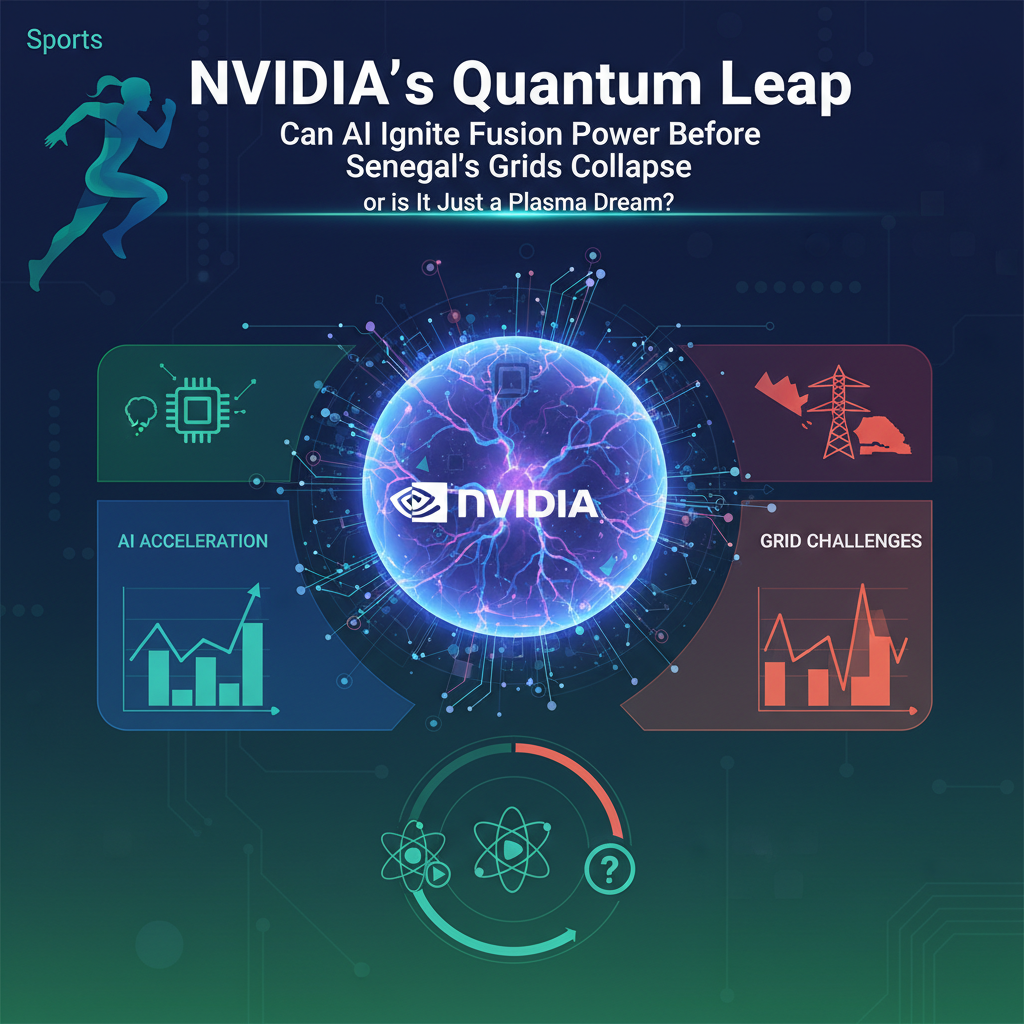
For decades, the dream of nuclear fusion has shimmered on the horizon, a tantalizing promise of clean, abundant energy that could liberate humanity from the shackles of fossil fuels. It is a vision that resonates deeply in places like Senegal, where reliable power remains a critical bottleneck for development. Now, the whispers are growing louder, echoing through the hallowed halls of scientific institutions and the gleaming data centers of Silicon Valley: artificial intelligence, particularly advanced machine learning from companies like NVIDIA, is poised to accelerate this quest. But as an investigative journalist, I must ask: is this a genuine dawn for energy independence, or merely another mirage in the desert of technological promises?
The history of fusion research is replete with cycles of optimism and frustration. Since the mid-20th century, scientists have grappled with the immense challenge of recreating the conditions of the sun on Earth. The core problem lies in containing plasma, a superheated, ionized gas, at temperatures exceeding 100 million degrees Celsius. Any instability, even for a fraction of a second, can cause the plasma to cool and the reaction to cease. Early attempts relied on brute force engineering and theoretical models, yielding incremental progress but no sustained, energy-producing reactions. The colossal Iter project in France, a testament to international collaboration, has been under construction for years, a monument to the sheer scale of the challenge and the slow pace of traditional scientific inquiry.
The current state of affairs, however, introduces a new variable: AI. Researchers are now deploying sophisticated algorithms to model plasma behavior, predict instabilities, and optimize magnetic confinement fields with unprecedented precision. Companies like Google DeepMind have already demonstrated significant strides, notably with their work on the Tokamak Energy ST40 spherical tokamak. Their AI system, using reinforcement learning, successfully controlled plasma in real time, maintaining it for longer durations and with greater stability than previously possible through conventional methods. This is not merely an academic exercise; it represents a fundamental shift in how fusion experiments are designed and executed.
NVIDIA, a company synonymous with the computational power driving the AI revolution, is at the forefront of this paradigm shift. Their GPUs, originally designed for gaming, have become the indispensable engines for training complex neural networks. In fusion research, these powerful processors are enabling simulations of plasma dynamics that were once unimaginable. Dr. Ian Chapman, CEO of the UK Atomic Energy Authority, recently stated, "AI is transforming our ability to understand and control the extreme conditions required for fusion. With NVIDIA's computational muscle, we are crunching data and running simulations at scales that would have taken decades just a few years ago." This sentiment is echoed by researchers at institutions like Princeton Plasma Physics Laboratory, who are leveraging NVIDIA's Cuda platform to accelerate their computational fluid dynamics models for fusion reactors.
My sources tell me that the investment in AI for fusion is not just academic. Venture capital firms, typically cautious with long-term, high-risk projects, are beginning to take notice. Companies like Commonwealth Fusion Systems, backed by Bill Gates' Breakthrough Energy Ventures, are integrating AI into their reactor designs from the ground up. They are using machine learning to optimize everything from coil geometry to diagnostic data interpretation, aiming to drastically shorten the development timeline. This is just the tip of the iceberg, as more startups emerge, each promising to leverage AI to solve specific bottlenecks in the fusion pathway.
From an African perspective, particularly here in Senegal, the implications are profound, yet distant. Our nation, like many across the continent, grapples with an energy deficit. According to the International Energy Agency, over 600 million people in sub-Saharan Africa lack access to electricity. Our current energy mix, heavily reliant on fossil fuels and hydroelectricity, is vulnerable to global price fluctuations and climate change impacts. The promise of clean, limitless fusion energy is an alluring one, a potential game-changer that could power our burgeoning industries and provide lighting for every home, from Dakar to Kedougou.
However, the path from laboratory breakthrough to grid-scale deployment is long and fraught with challenges. The sheer capital investment required for fusion reactors is astronomical. While AI can accelerate research, it cannot magically conjure the billions of dollars needed for construction, nor can it instantly build the regulatory frameworks and skilled workforce necessary for operation. "The technology is exciting, yes, but we must be pragmatic," cautioned Dr. Aissatou Sow, a Senegalese energy policy analyst at Cheikh Anta Diop University. "For us, the immediate focus must remain on diversifying our existing energy sources, investing in renewables like solar and wind, and improving grid infrastructure. Fusion is a long-term goal, perhaps for our grandchildren's generation, not a solution for today's blackouts."
The documents reveal a growing disparity. While developed nations pour resources into advanced AI for fusion, African countries are still struggling to build basic digital infrastructure. The computational power required for cutting-edge AI fusion research is immense, demanding supercomputers and specialized NVIDIA GPU clusters that are simply not available on our continent. This creates a new form of technological dependency, where the benefits of such breakthroughs may only trickle down after decades, if at all. We risk becoming mere consumers of technology, rather than co-creators or even early beneficiaries.
Moreover, the geopolitical implications are significant. The nation that first masters fusion power will wield immense influence. Will this technology be shared equitably, or will it become another tool for global power projection, exacerbating existing inequalities? These are questions that demand urgent consideration, even as the scientific community celebrates each incremental step forward.
In conclusion, the application of AI, championed by companies like NVIDIA, to nuclear fusion research is undoubtedly a monumental stride. It is accelerating discovery, optimizing complex systems, and rekindling hope for a clean energy future. The ability of AI to model and control plasma, as demonstrated by Google DeepMind and others, is a testament to its transformative potential. This is not a fad; it is the new normal for high-stakes scientific endeavor. However, for nations like Senegal, while we watch with keen interest, the immediate reality demands practical, accessible energy solutions today. The fusion dream, while brighter than ever, remains a distant sun on our horizon, its warmth yet to reach our shores. We must ensure that when that energy finally arrives, it empowers all, not just a select few. The road to energy justice is long, and it requires more than just technological brilliance; it demands equitable access and intentional collaboration, a lesson that should be learned from every major technological leap. More insights into AI's broader impact on global energy can be found at Reuters Technology. For those interested in the deeper scientific implications, MIT Technology Review offers comprehensive analysis.