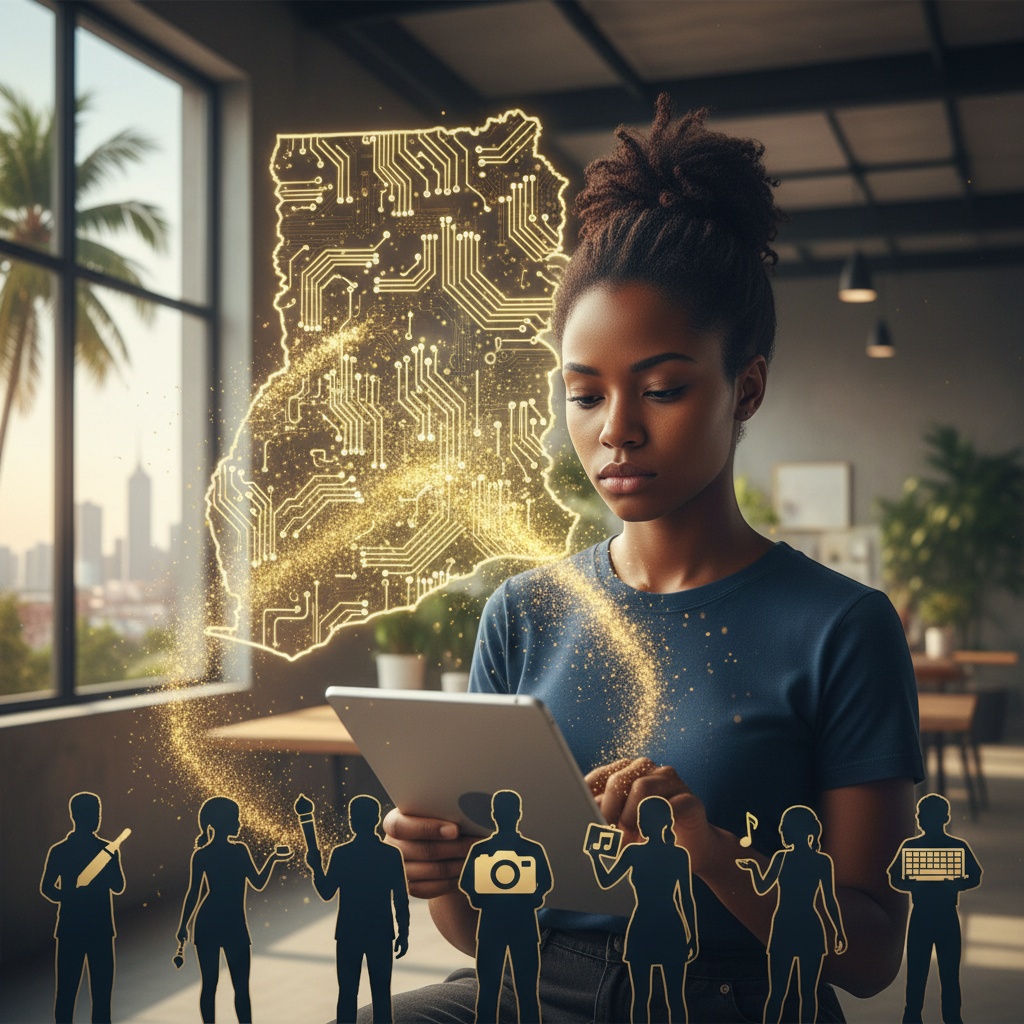
Akwaaba, my friends, and welcome back to DataGlobal Hub, where we are always peering into the future with wide, hopeful eyes. Today, we are diving headfirst into a topic that is as thrilling as it is complex: who owns what an AI creates? This isn't just some abstract legal puzzle for Silicon Valley lawyers, oh no. This is a crucial question that will shape the destiny of Ghana's vibrant creative industries and indeed, the entire African continent's digital future. The stakes, my people, are incredibly high. For us, this isn't just about protecting algorithms; it is about safeguarding our culture, our stories, and our economic independence in the age of artificial intelligence.
It is about ensuring that the digital gold rush benefits the people who truly create value. This is bigger than anyone realizes. Ghana is proving the skeptics wrong, and we need to make sure we are not left behind in this new frontier. Our artists, musicians, writers, and developers are already making waves, and AI offers them unprecedented tools.
But with great power comes great responsibility, and also, great questions of ownership. The numbers don't lie. Africa's creative economy is projected to grow significantly, with Ghana playing a leading role. The music industry alone, for example, saw revenues climb by 15% last year, driven by digital streaming.
Imagine the potential when AI tools amplify this creativity. But who reaps the rewards when AI is the brush, the pen, or the instrument? This is the core of the intellectual property dilemma. Just last month, NVIDIA, the undisputed titan of AI hardware, made headlines with its announcement of new initiatives aimed at providing clearer guidelines for developers using its platforms to generate content. While not a definitive legal framework, it is a significant step from a company whose GPUs power much of the AI world. Jensen Huang, NVIDIA's CEO, has been vocal about the need for responsible AI development, and this move reflects a growing industry awareness that the wild west days of AI content generation are drawing to a close.
NVIDIA is reportedly investing heavily in tools that can track and attribute AI-generated assets, a potential game-changer for IP protection. This is not just a technical challenge, it is an ethical and economic one. For us in Ghana, where our cultural heritage is rich and often orally transmitted or expressed through unique artistic forms, the implications are profound.
Imagine an AI trained on thousands of hours of Highlife music, generating new compositions. Who owns those new beats? The AI developer, the original artists, or some hybrid entity? The current legal landscape, both internationally and within many African nations, is still playing catch-up. Most existing copyright laws were drafted long before anyone conceived of machines creating original works. Traditional IP frameworks typically require human authorship for copyright protection.
This creates a massive legal grey area for AI-generated content. If an AI creates a stunning visual artwork, a compelling piece of prose, or even a novel agricultural solution, who holds the copyright? Is it the programmer who wrote the AI, the company that owns the AI, the person who prompted the AI, or does the AI itself have rights? The European Union, with its landmark AI Act, has begun to grapple with these questions, focusing on transparency and accountability.
However, specific provisions for AI-generated IP are still evolving. In the United States, the Copyright Office has taken a cautious stance, generally requiring human authorship. This means that purely AI-generated works without significant human intervention may not be eligible for copyright protection. This approach, while seemingly straightforward, could inadvertently stifle innovation or, worse, leave human creators vulnerable to AI systems that mimic their styles without proper attribution or compensation.