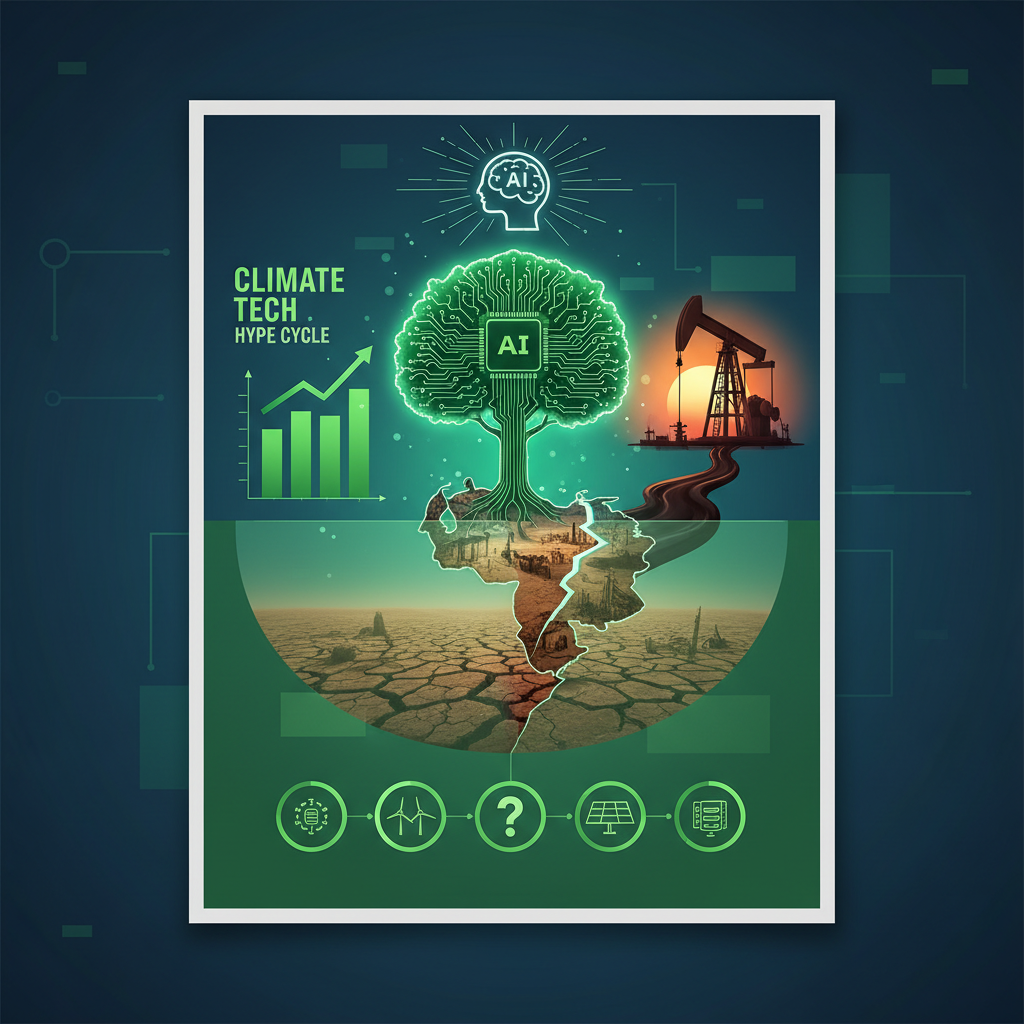

The air in Caracas, even on a good day, carries a certain weight. It is not just the exhaust fumes or the dust from construction, it is the palpable sense of a future constantly under negotiation. So when I hear the global tech elite, the likes of NVIDIA's Jensen Huang and OpenAI's Sam Altman, waxing poetic about AI saving the planet, my first instinct is always to ask: whose planet, and at what cost?
This whole narrative, this idea that artificial intelligence is our great green savior, has taken root with astonishing speed. Suddenly, every company from Google to countless startups is touting its AI powered solutions for everything from optimizing energy grids to predicting extreme weather. It is a compelling vision, a balm for our collective climate anxiety. But let us be honest, folks. Is this a genuine paradigm shift, or just the latest shiny object distracting us from the fundamental, messy truths of our environmental crisis? From where I sit, in a country that knows a thing or two about resource scarcity and environmental struggle, the answer is far from simple.
Historically, the tech world has always had a messianic complex. Remember the internet was going to democratize everything, then blockchain was going to solve poverty, and now AI is going to reverse climate change. Each wave brings its prophets and its true believers. In the early days, climate tech was often about hardware: solar panels, wind turbines, electric vehicles. AI’s role was secondary, mostly in data analysis or process optimization. But as large language models and advanced machine learning have exploded, the narrative has shifted dramatically. Now, AI is presented as the brain, the central nervous system, that can orchestrate a global green transition.
Take NVIDIA, for example. Their GPUs, the very engines of the AI boom, are also energy hogs. Yet, they are heavily invested in climate research, pushing their hardware for climate modeling and sustainable agriculture. Jensen Huang, NVIDIA's CEO, has spoken extensively about the company's commitment to using AI for scientific discovery, including climate science. He often highlights how their platforms accelerate research into new materials for batteries or more efficient energy systems. It is a powerful message, but one cannot help but wonder about the carbon footprint of the very infrastructure enabling this research. It is a paradox, a kind of digital ouroboros, eating its own tail while promising salvation.
Today, the landscape is dotted with initiatives. Google DeepMind is using AI to optimize traffic flow and reduce energy consumption in its data centers. Microsoft is investing in AI for biodiversity monitoring and smart agriculture. Startups are emerging daily, promising everything from AI driven carbon capture to predictive maintenance for renewable energy infrastructure. The numbers are staggering. A recent report estimated that the global AI in climate change market could reach over $30 billion by 2030, growing at a compound annual growth rate exceeding 25 percent. This is not pocket change; this is serious money flowing into a sector that promises to be both profitable and planet saving. According to Reuters, investments in AI climate solutions are skyrocketing, drawing attention from major venture capital firms.
But here is my unpopular opinion from Caracas: much of this feels like a distraction. While the big tech companies are busy optimizing data centers in California or tracking polar bears with drones, the real, immediate climate challenges in places like Venezuela often go unaddressed by these grand AI schemes. We are talking about basic infrastructure resilience, access to clean water, sustainable food systems in the face of erratic weather patterns. These are not problems that a GPT model can solve with a few clever prompts, at least not yet.
Expert opinions are, predictably, divided. Dr. Sarah Myhre, a climate scientist and advocate, recently articulated a healthy skepticism. She said, and I am paraphrasing here, that while AI offers powerful tools for analysis and prediction, it is not a magic bullet. The fundamental issues are political will, economic structures, and social equity. AI can inform, but it cannot decide for us. Her point is crucial: technology is an amplifier; it makes existing systems more efficient, for better or worse. If the underlying system is flawed, AI just makes it more efficiently flawed.
On the other hand, there are optimists like Dr. Fei-Fei Li, co-director of Stanford's Human Centered AI Institute. She champions the idea of AI as a force multiplier for human ingenuity. She believes AI can give us unprecedented insights into complex climate systems, allowing us to model scenarios and develop solutions that were previously unimaginable. Her argument is that the scale of the climate crisis demands tools of equivalent scale, and AI fits that bill. This perspective is not without merit; the sheer complexity of Earth's systems does indeed require advanced computational power to understand and predict.
But let us bring it back home. What does this mean for Venezuela, for Latin America? We are not just passive recipients of climate change; we are on the front lines. The Amazon rainforest, a global lung, is under constant threat. Our coastlines face rising sea levels. Our agricultural lands are vulnerable to drought and flood. Where is the AI that helps a campesino in the Venezuelan Andes predict crop failures due to El Niño? Where is the AI that helps our struggling state utility manage an aging power grid to minimize blackouts during extreme heat? The crisis created something unexpected here: a diaspora of incredibly talented engineers and scientists, many of whom are now working on cutting edge AI projects abroad. Venezuela's tech diaspora is reshaping AI globally, and some of them are indeed turning their minds to climate solutions, often with a more grounded, practical approach than what you see coming out of Silicon Valley.
For example, I recently spoke with a Venezuelan engineer, now working for a climate tech startup in Spain, who is developing AI models for optimizing water distribution in arid regions. He told me, “The problems we faced back home, the sheer ingenuity required to make things work with limited resources, that experience is invaluable. It teaches you to build solutions that are resilient, not just elegant.” This is the kind of innovation that truly matters, born from necessity and hardship, not just from venture capital dreams.
So, is AI in climate change a fad or the new normal? It is both, and neither. The hype is certainly a fad, a cyclical phenomenon of the tech industry. The actual application of AI as a powerful tool for scientific discovery, for optimization, for prediction, that is undoubtedly the new normal. But we must be discerning. We must ask tough questions about who benefits, who pays, and whether these solutions are truly equitable and accessible. We cannot afford to be swayed by mere rhetoric. The planet, our home, demands more than just fancy algorithms; it demands genuine, systemic change, and AI is just one piece of that very complex puzzle. Without addressing the underlying economic and social injustices, AI risks becoming another tool that widens the gap between the privileged few and the vulnerable many, even as the waters rise for us all.
For more on how AI is impacting global economies, consider reading about Meta's New AI Recommendation Engine: Is Argentina's Digital Economy Ready for Zuckerberg's Invisible Hand? [blocked]. The challenges are interconnected, and the solutions must be too. We need to look beyond the slick presentations and into the real world, the world where people are grappling with climate change every single day. That is where the true innovation will happen, with or without the Silicon Valley fanfare. We must ensure that AI serves humanity, not just the bottom line, especially when the stakes are this high. The future of our planet is not just a coding problem; it is a human problem, and it requires human solutions, informed by technology, but driven by empathy and justice. The conversation needs to shift from 'can AI save us?' to 'how can we use AI to empower communities to save themselves?'